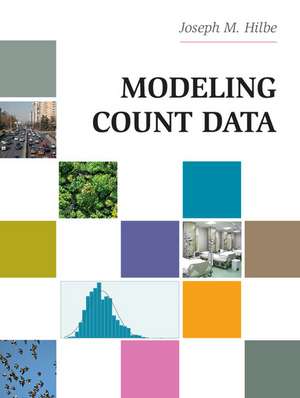
Modeling Count Data
Autor Joseph M. Hilbeen Limba Engleză Paperback – 3 apr 2018
În Modeling Count Data, apreciem abordarea structurată și accesibilă a unui subiect adesea intimidant pentru cercetătorii din științele aplicate. Această ediție se distinge prin claritatea cu care ghidează cititorul de la fundamentele modelării — capitolul dedicat regresiei Poisson — până la soluționarea problemelor complexe de supradispersie și subdispersie. Subliniem faptul că, spre deosebire de alte manuale teoretice, lucrarea de față este orientată spre practică, oferind 81 de tabele și exemple concrete de cod în Stata, R și SAS, esențiale pentru implementarea rapidă a modelelor în proiecte de sănătate publică, ecologie sau econometrie. Structura cărții urmărește o progresie logică: după stabilirea bazei Poisson, se trece la testarea adecvării modelului și la utilizarea regresiei binomiale negative, culminând cu tratarea dificultăților cauzate de excesul de zerouri și modelele avansate pentru date complexe. Modeling Count Data completează perspectiva oferită de Econometric Analysis of Count Data, adăugând un nivel de accesibilitate sporit pentru cei fără o pregătire matematică riguroasă, concentrându-se mai mult pe procesul de selecție și evaluare a modelului decât pe demonstrații teoretice pure. Această lucrare consolidează expertiza lui Joseph M. Hilbe în domeniul modelelor de regresie, făcând trecerea de la analiza variabilelor categorice explorată în Logistic Regression Models către universul datelor de numărare. Este un instrument metodologic care transformă statistica avansată într-o resursă utilizabilă pentru orice cercetător care dorește să interpreteze corect frecvența evenimentelor în seturi de date reale.
Preț: 371.72 lei
Carte tipărită la comandă
Livrare economică 25 noiembrie-09 decembrie
Specificații
ISBN-10: 1107611253
Pagini: 300
Ilustrații: 10 b/w illus. 81 tables
Dimensiuni: 170 x 244 x 17 mm
Greutate: 0.48 kg
Ediția:New.
Editura: Cambridge University Press
Locul publicării:New York, United States
V-ar putea interesa
-
 Bayesian Logical Data Analysis for the Physical SciencesP. C. Gregory-11%Preț: 518.38 lei582.45 lei
 -
 Negative Binomial RegressionJoseph M. Hilbe-11%Preț: 654.97 lei735.92 lei
 -
 Behavioral Decision TheoryE. C. Poulton-14%Preț: 811.75 lei943.90 lei
 -
 Principles of Statistical InferenceD. R. CoxPreț: 366.32 lei
 -
 -11%Preț: 645.38 lei725.14 lei
 -
 Sample Size CalculationsPaul MathewsPreț: 333.50 lei
 -
 Preț: 474.36 lei
 -
 Methods of Statistical Model EstimationJoseph Hilbe-18%Preț: 711.24 lei867.38 lei
 -
 Generalized Estimating EquationsJames W. Hardin-18%Preț: 787.20 lei960.01 lei
 -
 Spectral Analysis of Large Dimensional Random MatricesJack W. Silverstein-18%Preț: 1737.43 lei2118.81 lei
 -
 Statistical Analysis of Designed Experiments, Third EditionHelge Toutenburg-18%Preț: 1002.41 lei1222.44 lei
 -
 Progress in Applied Statistics ResearchM Ahsanullah-26%Preț: 1088.52 lei1478.05 lei
 -
 Time Series Analysis of Long Memory Versus Structural BreaksGeorg M. GoergPreț: 313.25 lei
 -
 Bootstrapping Stationary ARMA-GARCH ModelsKenichi ShimizuPreț: 381.32 lei
 -
 -8%Preț: 409.07 lei444.64 lei
 -
 Optimal Crossover Designs with Interactions between Treatments & UnitsAndrea M. Bludowsky-8%Preț: 409.48 lei445.09 lei
 -
 Applications of Microscopic Modelling in FinanceAlexander Weiß-8%Preț: 467.41 lei508.06 lei
De ce să citești această carte
Recomandăm această carte cercetătorilor care au nevoie de o metodologie clară pentru analiza datelor de numărare, fără a se pierde în demonstrații matematice abstracte. Veți câștiga abilitatea de a selecta modelul statistic corect (Poisson, binomial negativ sau Poisson-Gaussian) și veți avea la dispoziție codul necesar pentru Stata, R și SAS. Este ghidul ideal pentru a trece de la date brute la interpretări statistice valide în cercetarea aplicată.
Despre autor
Joseph M. Hilbe este o figură proeminentă în statistica internațională, fiind Ambasador al Sistemului Solar pentru NASA Jet Propulsion Laboratory și profesor emerit la Universitatea din Hawaii. Expertiza sa este recunoscută prin alegerea sa ca membru al American Statistical Association și președinte al rețelei internaționale de astrostatistică din cadrul ISI. Autor de referință pentru lucrări precum Logistic Regression Models, Hilbe reușește să sintetizeze concepte complexe în ghiduri aplicative, fiind un mentor recunoscut pentru cercetătorii care utilizează metodele bayesiene și regresia logistică în diverse discipline științifice.
Descriere scurtă
Cuprins
Recenzii
'The negative binomial model is the foundation for modern analysis of count data. Joe Hilbe's work collects a vast wealth of technical and practical information for the analyst. The theoretical developments and thoroughly worked applications use realistic data sets and a variety of computer packages. They will provide to the practitioner an indispensable guide for basic single-equation count data regressions and advanced applications with recently developed model extensions and methods.' William Greene, New York University
'This book is a great introduction to models for the analysis of count data. Using the Poisson GLM as the basis, it covers a wide range of modern extensions of GLMs, and this makes it unique. Potentially complex models (which are often needed when analyzing real data sets) are presented in an understandable way, partly because data sets and software code are provided. I reckon that this volume will be one of the standard GLM reference books for many years to come.' Alain F. Zuur, Highland Statistics Ltd
'Modeling Count Data is a well-organized entry-level book mainly written for applied researchers with little formal theoretical background in statistics who need to analyse count data … Thoroughly worked examples with software code, several of them devoted to applying alternative count models to the same data set, provide a basic guide for model selection among competing models. The chapters are well structured, starting with points of discussion and ending with a brief summary. Where required, section themes are summarized. Also, the formula used, abbreviations used and examples used are summarized in tabular form. In brief, it is a remarkable book and can be used as a practical guide for introducing count data analysis.' Anoop Chaturvedi, Journal of the Royal Statistical Society