
Eugene Onegin
Autor Alexander Pushkinen Limba Engleză Hardback – noi 2018
Reținem, înainte de orice, că Eugene Onegin nu este doar un text fundamental, ci însăși inima literaturii ruse. Poziționată central în opera lui Alexander Pushkin, această lucrare marchează momentul transformării sale dintr-un poet romantic într-un romancier capabil să surprindă realismul crud al Rusiei imperiale. Dacă în Lyrics sau în Selected Poetry descoperim spontaneitatea lirică a autorului, în acest „roman în versuri” găsim o maturitate artistică ce reușește să lege destinul plictisitului Onegin de puritatea Tatianei și de idealismul tragic al lui Lensky. Notăm cu interes felul în care Pushkin se inserează ca personaj, transformând narațiunea într-un dialog continuu cu cititorul prin digresiuni satirice și filosofice. Ritmul narativ amintește de analizele critice semnate de A. D. P. Briggs în Alexander Pushkin: Eugene Onegin, dar structura versificată oferită aici de traducerea lui James E. Falen păstrează acea muzicalitate originală care face textul să vibreze. Față de proza sa ulterioară, cum este The Captain's Daughter — numită adesea un „Onegin în proză” — acest volum păstrează o eleganță poetică și o ironie fină care nu au fost niciodată egalate. Este o experiență de lectură care alternează între melancolia peisajului rusesc și efervescența balurilor din Sankt Petersburg, totul subordonat unei rime riguroase, dar care curge cu o naturalețe surprinzătoare.
Preț: 186.06 lei
Carte tipărită la comandă
Livrare economică 23-28 noiembrie
Specificații
ISBN-10: 1731702795
Pagini: 172
Dimensiuni: 157 x 235 x 14 mm
Greutate: 0.36 kg
Editura: Simon & Brown
V-ar putea interesa
-
 Eliza and Her MonstersFrancesca ZappiaPreț: 114.59 lei
 -
 The Origin of SpeciesCharles Darwin-15%Preț: 83.33 lei97.82 lei
 -
 Pale FireVladimir Nabokov-26%Preț: 58.39 lei78.80 lei
 -
 The CyberiadStanislaw Lem-26%Preț: 57.74 lei78.12 lei
 -
 The Complete Short StoriesOscar Wilde-18%Preț: 47.85 lei58.16 lei
 -
 The Notebooks of Henry JamesHenry JamesPreț: 422.14 lei
 -
 Novels, Tales, JourneysAlexander Pushkin-18%Preț: 77.57 lei94.62 lei
 -
 After MidnightIrmgard Keun-28%Preț: 51.34 lei70.92 lei
 -
 Ferdinand, the Man with the Kind HeartIrmgard Keun-20%Preț: 57.32 lei71.23 lei
 -
 After MidnightIrmgard KeunPreț: 42.38 lei
 -
 Origin StoryDavid ChristianPreț: 73.83 lei
 -
 -23%Preț: 63.17 lei81.96 lei
 -
 The Eternal Husband and Other StoriesFyodor DostoevskyPreț: 36.86 lei
 -
 The Wings of the DoveHenry JamesPreț: 80.61 lei
 -
 Choose More, Lose More for LifeChris PowellPreț: 132.29 lei
 -
 HappinessAminatta Forna-32%Preț: 48.90 lei72.35 lei
 -
 OblomovIvan GoncharovPreț: 37.37 lei
 -
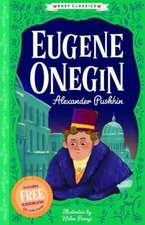 Eugene Onegin (Easy Classics)Helen PanayiPreț: 49.30 lei
 -
 Yevgeny OneginAlexander PushkinPreț: 93.07 lei
 -
 Memento MoriMuriel Spark-27%Preț: 57.24 lei78.42 lei
 -
 Territorial Rights: A Virago Modern ClassicMuriel Spark-28%Preț: 55.67 lei77.10 lei
 -
 The IdiotFyodor DostoevskyPreț: 68.42 lei
 -
 Lyrics: Vol. 1 (1813-17): Dual LanguageAlexander Pushkin-16%Preț: 80.83 lei96.36 lei
 -
 Lyrics: Vol. 2 (1817-24): Dual LanguageAlexander Pushkin-17%Preț: 78.71 lei95.10 lei
 -
 Lyrics: Volume 4 (1829-37)Alexander PushkinPreț: 76.31 lei
 -
 Pushkin's LettersAlexander PushkinPreț: 145.51 lei
 -
 Anna KareninaLeo TolstoyPreț: 42.39 lei
 -
 Pushkin Eugene Onegin And Other PoemsAlexander Pushkin-19%Preț: 68.12 lei84.57 lei
De ce să citești această carte
Recomandăm această ediție oricărui cititor care dorește să descopere de unde începe marea literatură rusă. Veți câștiga nu doar o poveste de dragoste neîmplinită, ci o frescă socială completă a secolului al XIX-lea. Este o lectură esențială pentru a înțelege profunzimea sufletului rus, oferind un echilibru perfect între poezie și analiză psihologică, susținut de notele excelente din seria Oxford World's Classics.
Despre autor
Alexander Pushkin (1799–1837) este considerat fondatorul literaturii ruse moderne și cel mai mare poet al națiunii sale. Născut într-o familie nobilă din Moscova, cu origini africane prin străbunicul său Abram Gannibal, Pushkin a revoluționat limba rusă, îmbinând stilul arhaic cu graiul viu al poporului. Viața sa a fost marcată de exiluri din cauza vederilor sale liberale și de o supraveghere constantă din partea poliției imperiale. În ciuda acestor presiuni, a creat opere monumentale precum drama Boris Godunov și romanul Eugene Onegin. Spiritul său rebel și onoarea neînduplecată i-au adus sfârșitul prematur la doar 37 de ani, în urma unui duel.
Descriere
Eugene Onegin is the master work of the poet whom Russians regard as the fountainhead of their literature. Set in 1820s imperial Russia, Pushkin's novel in verse follows the emotions and destiny of three men - Onegin the bored fop, Lensky the minor elegiast, and a stylized Pushkin himself - and the fates and affections of three women - Tatyana the provincial beauty, her sister Olga, and Pushkin's mercurial Muse. Engaging, full of suspense, and varied in tone, it also portrays a large cast of other characters and offers the reader many literary, philosophical, and autobiographical digressions, often in a highly satirical vein. Eugene Onegin was Pushkin's own favourite work, and it shows him attempting to transform himself from a romantic poet into a realistic novelist. This new translation seeks to retain both the literal sense and the poetic music of the original, and capture the poem's spontaneity and wit. The introduction examines several ways of reading the novel, and text is richly annotated. ABOUT THE SERIES: For over 100 years Oxford World's Classics has made available the widest range of literature from around the globe. Each affordable volume reflects Oxford's commitment to scholarship, providing the most accurate text plus a wealth of other valuable features, including expert introductions by leading authorities, helpful notes to clarify the text, up-to-date bibliographies for further study, and much more.
Notă biografică
Stanley Mitchell was born in 1932 in London. He read Modern Languages (French, German and Russian) at Oxford. He taught at various universities - Birmingham, Essex, Sussex, San Diego California, McGill, Montreal, Dar es Salaam Tanzania, Derby, University College London and Camberwell School of Art. Subjects included Russian literature and art, comparative literature, art history and cultural studies. He is currently Emeritus Professor of Aesthetics at the University of Derby and Honorary Senior Research Fellow in the Department of Art History at University College, London. He has translated Georg Lukacs and Walter Benjamin, written a variety of articles and reviews, and given numerous lectures and talks.