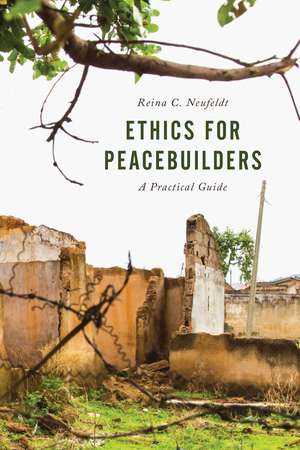
Ethics for Peacebuilders: A Practical Guide: Peace and Security in the 21st Century
Autor Reina C. Neufeldten Limba Engleză Hardback – 16 aug 2016
Written by an experienced practitioner, the book will help identify and analyze ethical problems and resolve moral value conflicts to create healthy practices. It will provide valuable guidance for thinking ethically about peacebuilding work and handling the specific dilemmas related to it.
Din seria Peace and Security in the 21st Century
- 33%
 Preț: 609.23 lei
 - 23%
 Preț: 278.75 lei
 - 23%
 Preț: 256.91 lei
 - 19%
 Preț: 320.09 lei
 - 23%
 Preț: 271.14 lei
 - 14%
 Preț: 320.35 lei
 - 24%
 Preț: 353.58 lei
 - 23%
 Preț: 279.24 lei
 - 25%
 Preț: 218.16 lei
 - 28%
 Preț: 407.47 lei
 - 23%
 Preț: 287.37 lei
 - 24%
 Preț: 352.67 lei
 - 27%
 Preț: 253.72 lei
 - 23%
 Preț: 282.98 lei
 - 23%
 Preț: 285.87 lei
 - 24%
 Preț: 223.91 lei
 - 31%
 Preț: 696.36 lei
 - 28%
 Preț: 219.75 lei
 - 19%
 Preț: 321.74 lei
 - 31%
 Preț: 698.58 lei
 - 23%
 Preț: 286.27 lei
 - 25%
 Preț: 220.96 lei
 - 25%
 Preț: 219.16 lei
 - 23%
 Preț: 275.00 lei
 - 16%
 Preț: 341.56 lei
 - 32%
 Preț: 661.57 lei
Preț: 613.23 lei
Preț vechi: 868.32 lei
-29%
Puncte Express: 920
Carte tipărită la comandă
Livrare economică 30 noiembrie-14 decembrie
Livrare prin curier în România Termenul estimat este afișat lângă disponibilitate.
Transport gratuit pentru acest produs Plată online sau ramburs, în funcție de opțiunile comenzii.
Retur gratuit în 14 zile Comandă securizată și suport în română.
Specificații
ISBN-13: 9781442264915
ISBN-10: 1442264918
Pagini: 184
Ilustrații: 8 b/w photos; 29 textboxes
Dimensiuni: 154 x 232 x 18 mm
Greutate: 0.45 kg
Editura: Bloomsbury Publishing
Colecția Rowman & Littlefield
Seria Peace and Security in the 21st Century
Locul publicării:New York, United States
ISBN-10: 1442264918
Pagini: 184
Ilustrații: 8 b/w photos; 29 textboxes
Dimensiuni: 154 x 232 x 18 mm
Greutate: 0.45 kg
Editura: Bloomsbury Publishing
Colecția Rowman & Littlefield
Seria Peace and Security in the 21st Century
Locul publicării:New York, United States
V-ar putea interesa
-
 The Glorious Art of Peace: From the Iliad to IraqJohn Gittings-19%Preț: 138.14 lei170.26 lei
 -
 Preț: 126.52 lei
 -
 Why Men FightBertrand RussellPreț: 154.88 lei
 -
 -15%Preț: 460.99 lei542.35 lei
 -
 -18%Preț: 1255.17 lei1530.69 lei
 -
 Understanding Peace: A Comprehensive IntroductionMichael Allen FoxPreț: 472.07 lei
 -
 At War's EndRoland ParisPreț: 236.30 lei
 -
 Understanding Conflict and Conflict AnalysisHo-Won Jeong-18%Preț: 699.21 lei852.69 lei
 -
 A Liberal Peace?: The Problems and Practices of PeacebuildingSusanna Campbell-17%Preț: 186.82 lei225.25 lei
Cuprins
List of Figures and Textboxes
Preface
Chapter 1: Doing Good?
Chapter 2: "Doable" Ethics in the Field
Chapter 3: Values, Values Everywhere
Chapter 4: Thinking Carefully: How Moral Theories Can Help
Chapter 5: Creative Problem-Solving When Values Conflict
Chapter 6: Nurturing Ethical Environments
Chapter 7: Doing Good Well: Talking about the Real Issues
Bibliography
Preface
Chapter 1: Doing Good?
Chapter 2: "Doable" Ethics in the Field
Chapter 3: Values, Values Everywhere
Chapter 4: Thinking Carefully: How Moral Theories Can Help
Chapter 5: Creative Problem-Solving When Values Conflict
Chapter 6: Nurturing Ethical Environments
Chapter 7: Doing Good Well: Talking about the Real Issues
Bibliography
Recenzii
Recent incidents involving sexual exploitation and corruption have highlighted what some have called the 'dark side of peacekeeping.' Less intentional are peace-keeping's 'unintended consequences,' in which operations produce negative outcomes, such as economic distortions. This book fills an important gap by going beyond documenting problems to offering guidelines for ethical behavior in peace-building operations. The book's subtitle, 'A Practical Guide,' does not do it justice. The analysis does offer more on general guidelines about how to think about the key issues and decisions than provide specific solutions. Illustrative is chapter 4, in which the author applies four moral theories to peace building and raises key questions for peace-keepers suggested by each. Nevertheless, the book is far from an abstract philosophical exercise. The chapters contain specific examples and scenarios (often set off in text boxes) as well as activities and 'thinking tasks' that focus readers on real-world applications of the elucidated principles. Particularly effective are the 'For Further Exploration' sections that conclude the chapters. This is essential reading for policy makers and upper-level peace-keeping officials, but scholars will find much of value here as well. Summing Up:Highly recommended. Upper-division undergraduates through professionals.
Neufeldt, who teaches peace and conflict studies at Conrad Grebel University, also serves as a consultant on monitoring and evaluation in peacebuilding. To this work, she brings some of the same strengths I have come to appreciate from her body of writing in that area: keen attention to power dynamics, careful consideration of process, and a gentle critique of top-down , liberal peacebuilding models in favor of localized, bottom-up, and grassroots approaches. . . . [her] thoughtful volume on applied ethics delivers a surplus of insight for students, educators, and practitioners.
In the growing field of peacebuilding, ethical practices have become necessity for each practitioner. Whether an academic institution or a civil society organization, adopting a clear set of ethical standards for peacebuilding is not only crucial, but also imperative to enhance the field's credibility, as well as to ensure effective results. This book is a pioneer text that offers practitioners and academics the tools, conceptual frameworks, and illustrations needed to be an ethical peacebuilder. The real life cases and the author's experience enhance the relevancy of the guide for all peacebuilders. It is a must for practitioners and educators.
Reina Neufeldt has illuminated a critical issue for peacebuilders, namely the ethical base of their work as it translates into practice. Her discussion is apt, thorough and practical with careful discussion of moral theory and frameworks as well as practical examples (good and bad) and tools for anticipating field based ethical challenges and addressing them. Everyone who imagines him or herself to be a peacebuilder should read this volume.
This book offers a paddle and a map to canoe through the waters of moral conflict and ethical dilemma inherent in peacebuilding. Essential reading for every student practitioner, and policymaker navigating conflict.
Neufeldt, who teaches peace and conflict studies at Conrad Grebel University, also serves as a consultant on monitoring and evaluation in peacebuilding. To this work, she brings some of the same strengths I have come to appreciate from her body of writing in that area: keen attention to power dynamics, careful consideration of process, and a gentle critique of top-down , liberal peacebuilding models in favor of localized, bottom-up, and grassroots approaches. . . . [her] thoughtful volume on applied ethics delivers a surplus of insight for students, educators, and practitioners.
In the growing field of peacebuilding, ethical practices have become necessity for each practitioner. Whether an academic institution or a civil society organization, adopting a clear set of ethical standards for peacebuilding is not only crucial, but also imperative to enhance the field's credibility, as well as to ensure effective results. This book is a pioneer text that offers practitioners and academics the tools, conceptual frameworks, and illustrations needed to be an ethical peacebuilder. The real life cases and the author's experience enhance the relevancy of the guide for all peacebuilders. It is a must for practitioners and educators.
Reina Neufeldt has illuminated a critical issue for peacebuilders, namely the ethical base of their work as it translates into practice. Her discussion is apt, thorough and practical with careful discussion of moral theory and frameworks as well as practical examples (good and bad) and tools for anticipating field based ethical challenges and addressing them. Everyone who imagines him or herself to be a peacebuilder should read this volume.
This book offers a paddle and a map to canoe through the waters of moral conflict and ethical dilemma inherent in peacebuilding. Essential reading for every student practitioner, and policymaker navigating conflict.