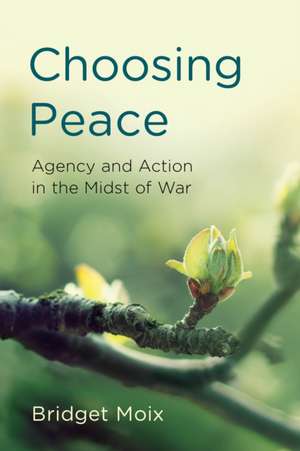
Choosing Peace: Agency and Action in the Midst of War: Peace and Security in the 21st Century
Autor Bridget Moixen Limba Engleză Paperback – 24 apr 2019
As a result, the inherent links between policies and practices of the global North, particularly the United States, where much of the professional peacebuilding community is concentrated, and the daily realities of rising violence and collapsing order experienced by communities in the global South, are glossed over or apportioned to the fields of political science or international affairs. Similarly, the daily community level efforts of people and groups within the United States and other global North countries seeking to address drivers of violence and injustice in their own communities are largely disconnected from the struggles of communities living inside recognized war zones for a more peaceful and just future.
These disconnects within the peacebuilding field have increasingly become obstacles to its further evolution and improvement. Without a serious shift in direction toward more integrated, interconnected, and intersectional understanding and approaches, the peacebuilding field threatens to become just another Western-driven industry in which powerful decision-makers, politicized funding, and large international bureaucracies sustain themselves. Reconnecting the field with its roots of community-based activism, organizing, and courageous leadership is urgently needed, and a necessary step to improving our collective efforts to build a more peaceful, just, and sustainable world. Drawing on the voices and experiences of community-based peace leaders around the world, this book envisions a new way of working together as a truly local and global peacebuilding field - one in which undoing the roots of violence and injustice is not something that takes place "in the field", but in the streets of our own neighborhoods and in solidarity with others around the world.
Din seria Peace and Security in the 21st Century
- 33%
 Preț: 609.23 lei
 - 23%
 Preț: 278.75 lei
 - 23%
 Preț: 256.91 lei
 - 19%
 Preț: 320.09 lei
 - 23%
 Preț: 271.14 lei
 - 14%
 Preț: 320.35 lei
 - 24%
 Preț: 353.58 lei
 - 23%
 Preț: 279.24 lei
 - 25%
 Preț: 218.16 lei
 - 28%
 Preț: 407.47 lei
 - 23%
 Preț: 287.37 lei
 - 24%
 Preț: 352.67 lei
 - 27%
 Preț: 253.72 lei
 - 23%
 Preț: 285.87 lei
 - 24%
 Preț: 223.91 lei
 - 31%
 Preț: 696.36 lei
 - 28%
 Preț: 219.75 lei
 - 19%
 Preț: 321.74 lei
 - 31%
 Preț: 698.58 lei
 - 23%
 Preț: 286.27 lei
 - 25%
 Preț: 220.96 lei
 - 25%
 Preț: 219.16 lei
 - 23%
 Preț: 275.00 lei
 - 16%
 Preț: 341.56 lei
 - 32%
 Preț: 661.57 lei
Preț: 282.98 lei
Preț vechi: 369.67 lei
-23%
Puncte Express: 424
Carte tipărită la comandă
Livrare economică 30 noiembrie-14 decembrie
Livrare prin curier în România Termenul estimat este afișat lângă disponibilitate.
Transport gratuit de la 400.00 lei Plată online sau ramburs, în funcție de opțiunile comenzii.
Retur gratuit în 14 zile Comandă securizată și suport în română.
Specificații
ISBN-13: 9781786609786
ISBN-10: 1786609789
Pagini: 240
Ilustrații: 4 b/w photos; 7 textboxes;
Dimensiuni: 148 x 228 x 12 mm
Greutate: 0.25 kg
Editura: Bloomsbury Publishing
Colecția Rowman & Littlefield
Seria Peace and Security in the 21st Century
Locul publicării:New York, United States
ISBN-10: 1786609789
Pagini: 240
Ilustrații: 4 b/w photos; 7 textboxes;
Dimensiuni: 148 x 228 x 12 mm
Greutate: 0.25 kg
Editura: Bloomsbury Publishing
Colecția Rowman & Littlefield
Seria Peace and Security in the 21st Century
Locul publicării:New York, United States
Cuprins
Acknowledgements
Introduction
Part I: The Problem with Peacebuilding
Chapter OneThe Story Behind this Book
Chapter TwoThe Search for Peace and the Loss of Agency
Chapter ThreeA Research Approach to Local Peacebuilding
Part II: Choosing Peace in the Midst of Violence
Chapter FourI Am Because You Are: Relational Responsibility and Peace Agency
Chapter FiveRisk and Resilience
Chapter SixIt's About Trust: Local Perspectives on International Peacebuilders
Part III: Locally Grounded, Globally Connected
Chapter SevenLocal Peacebuilding Begins at Home
Chapter EightInclusive Peacebuilding: Confronting Power, Privilege, and Racism
Chapter NineWe Are All Peacebuilders
References
Introduction
Part I: The Problem with Peacebuilding
Chapter OneThe Story Behind this Book
Chapter TwoThe Search for Peace and the Loss of Agency
Chapter ThreeA Research Approach to Local Peacebuilding
Part II: Choosing Peace in the Midst of Violence
Chapter FourI Am Because You Are: Relational Responsibility and Peace Agency
Chapter FiveRisk and Resilience
Chapter SixIt's About Trust: Local Perspectives on International Peacebuilders
Part III: Locally Grounded, Globally Connected
Chapter SevenLocal Peacebuilding Begins at Home
Chapter EightInclusive Peacebuilding: Confronting Power, Privilege, and Racism
Chapter NineWe Are All Peacebuilders
References
Recenzii
Bridget Moix has in-depth experience of how peace building actually works. She knows how individual activists, community-based groups, and locally-led civil society organizations-the people most directly experiencing the results of violent conflict and striving to transform it-remain on the margins of the more recognized international peacebuilding field. She tackles what that means in her daily work, building links between the policies and practices of the global North and the realities of communities living inside war zones struggling to build a safer and more just future. She is devoted to enabling the voices of local peace builders to be heard. Working with her, I marvel not only at the knowledge she has gained in years of hands-on experience, but the human connections she has established, and the empathy with which she communicates. This is someone to listen to; she knows.
Bridget Moix's book is a breath of fresh air in the field of conflict and peace studies. This is not yet another technical study about conflict and how to address it, but an insightful account that weds the author's research to the real people and their stories. This is an essential book for those that are looking for answers as to why everyone has the potential to become an agent of positive change and why choosing peace matters.
This book is unique: its an astounding reflection and a compelling collection from the author's combined rich and insightful cases from a theoretical basis for conflict prevention and practical experience from her work with local peacebuilders from around the world. Focusing on local efforts to stop violence and build sustainable peace.
There is a growing recognition that conflict prevention, conflict mitigation and long-term conflict transformation is most likely to succeed when it is locally led, rather than when it is imposed on communities from the outside. People living in conflict contexts should be allowed to be a part of decision-making process and drive the peacebuilding efforts-a process that looks first for the potential and capacity in the community to truly act as a voice for the people and not just as project implementers for external partners and donors.
This book will be valuable to students, scholars, practitioners, policymakers and non academic readers thanks to its clear language and illustrative case studies.
Bridget Moix's book is a breath of fresh air in the field of conflict and peace studies. This is not yet another technical study about conflict and how to address it, but an insightful account that weds the author's research to the real people and their stories. This is an essential book for those that are looking for answers as to why everyone has the potential to become an agent of positive change and why choosing peace matters.
This book is unique: its an astounding reflection and a compelling collection from the author's combined rich and insightful cases from a theoretical basis for conflict prevention and practical experience from her work with local peacebuilders from around the world. Focusing on local efforts to stop violence and build sustainable peace.
There is a growing recognition that conflict prevention, conflict mitigation and long-term conflict transformation is most likely to succeed when it is locally led, rather than when it is imposed on communities from the outside. People living in conflict contexts should be allowed to be a part of decision-making process and drive the peacebuilding efforts-a process that looks first for the potential and capacity in the community to truly act as a voice for the people and not just as project implementers for external partners and donors.
This book will be valuable to students, scholars, practitioners, policymakers and non academic readers thanks to its clear language and illustrative case studies.