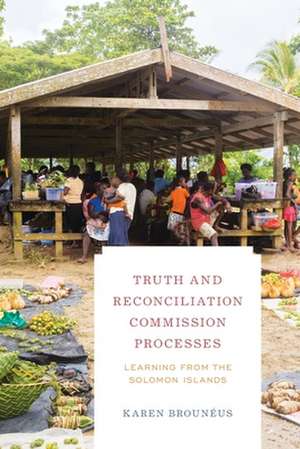
Truth and Reconciliation Commission Processes: Learning from the Solomon Islands: Peace and Security in the 21st Century
Autor Karen Brounéusen Limba Engleză Paperback – 10 noi 2021
Din seria Peace and Security in the 21st Century
- 34%
 Preț: 585.72 lei
 - 24%
 Preț: 265.32 lei
 - 25%
 Preț: 244.62 lei
 - 21%
 Preț: 305.18 lei
 - 25%
 Preț: 257.99 lei
 - 15%
 Preț: 308.09 lei
 - 24%
 Preț: 340.27 lei
 - 25%
 Preț: 264.49 lei
 - 25%
 Preț: 212.71 lei
 - 28%
 Preț: 407.47 lei
 -
 Preț: 287.49 lei
 - 24%
 Preț: 272.39 lei
 - 25%
 Preț: 340.31 lei
 - 25%
 Preț: 269.67 lei
 - 24%
 Preț: 271.73 lei
 - 26%
 Preț: 212.25 lei
 - 32%
 Preț: 663.57 lei
 - 29%
 Preț: 209.42 lei
 - 20%
 Preț: 306.46 lei
 - 32%
 Preț: 665.68 lei
 - 24%
 Preț: 272.76 lei
 - 24%
 Preț: 219.00 lei
 - 26%
 Preț: 208.20 lei
 - 24%
 Preț: 261.96 lei
 - 16%
 Preț: 329.71 lei
 - 32%
 Preț: 661.57 lei
Preț: 242.83 lei
Preț vechi: 338.94 lei
-28%
Puncte Express: 364
Carte tipărită la comandă
Livrare economică 05-19 iunie
Specificații
ISBN-13: 9781538158746
ISBN-10: 1538158744
Pagini: 142
Ilustrații: 7 b/w illustrations;2 maps; 19 tables;
Dimensiuni: 152 x 221 x 11 mm
Greutate: 0.27 kg
Editura: Bloomsbury Publishing
Colecția Rowman & Littlefield
Seria Peace and Security in the 21st Century
Locul publicării:New York, United States
ISBN-10: 1538158744
Pagini: 142
Ilustrații: 7 b/w illustrations;2 maps; 19 tables;
Dimensiuni: 152 x 221 x 11 mm
Greutate: 0.27 kg
Editura: Bloomsbury Publishing
Colecția Rowman & Littlefield
Seria Peace and Security in the 21st Century
Locul publicării:New York, United States
Cuprins
Preface
Chapter 1: Introduction
Chapter 2: TRCs, War-related Trauma and Attitudes towards Peace
Chapter 3: The Solomon Islanders in this Study
Chapter 4: Respect, Discrimination and Trust
Chapter 5: The TRC Process: A Drop in Confidence and the Lack of Kastom
Chapter 6: Coexistence and Feelings Towards Ex-combatants
Chapter 7: Wrapping Up and Looking Ahead: Designing TRCs for Peace
Bibliography
Chapter 1: Introduction
Chapter 2: TRCs, War-related Trauma and Attitudes towards Peace
Chapter 3: The Solomon Islanders in this Study
Chapter 4: Respect, Discrimination and Trust
Chapter 5: The TRC Process: A Drop in Confidence and the Lack of Kastom
Chapter 6: Coexistence and Feelings Towards Ex-combatants
Chapter 7: Wrapping Up and Looking Ahead: Designing TRCs for Peace
Bibliography
Recenzii
This study of a geographically 'small' case - the Solomon Islands in the South Pacific - on a truth and reconciliation commission after serious atrocities gives a number of insights, of value to the leaders in the society concerned, as well as to researchers and practitioners elsewhere in the world. By asking questions from research on other commissions, Dr. Brounéus is able to draw general conclusions on matters such as truth telling, open testimonies, and gender differences. Thus it is a highly valuable addition to the international literature on post-conflict reconciliation and strategies for peacebuilding and quality peace.
Combining her unique background in psychology and peace studies with in-depth case knowledge, Brounéus' book provides an innovative and timely assessment of the impact that truth and reconciliation commissions have on the individuals who engage in their proceedings. Providing original and significant insights into the contribution that TRCs make to facilitating peace and unity in the aftermath of conflict, it is a must-read for scholars of peace building and transitional justice, and for those interested in the fascinating but understudied case of the Solomon Islands.
A very honest appraisal of the complexities of negotiating peace amidst complex relationships, affinities and gendered responses. Brounéus demonstrates the dangers of ignoring kastom in the TRC process, especially where relationships and the need for secrecy are overlooked.
Offering a rare and original account of a truth and reconciliation process over time, Karen Brounéus provides unique insights through the rich analysis of qualitative and quantitative micro-level data. This book is a real treasure for practitioners, stakeholders and students of TRC processes everywhere.
Karen Brounéus's book sensitively reveals the strengths and weaknesses of the Truth and Reconcilation Committee processes in the Solomon Islands in the wake of the 'tensions' or a localised civil war. Here is the reflective social scientist at work with a clear and accessible analysis of a mountain of data that she and a team assembled from a range of techniques. The book's theoretical sections throw light on the dangers of a 'one size fits all' approach to these processes. This work will serve as a model and guide for any future commissions both in the Solomon Islands and elsewhere.
The focus on the 'implementation gap' between the task of transitional justice endeavours and the post-conflict state reaches to the heart of the transitional justice debate. There is no quick fix. It's about inclusive perseverance. Karen Brounéus, drawing on her psychological background, combines statistical and qualitative skills to understand the inevitable and unique limitations and the political intent of the TRC in the Solomon Islands. Exploring the causes, motives, and perspectives of the violent conflict she stresses the need for government to contribute to the restoration of human dignity and peace-building through economic development and the healing of psycho-social national divisions.
Undertaking her work in the context of the long line of successes and failures of truth commissions elsewhere in the world, she adds new insights into the complexities of transitional justice, the importance of cultural sensitivities and the need to monitor grass-root responses to transitional justice projects. Recognizing that no one size or design fits all situations, this book provides a useful basis for designing future commissions.
Combining her unique background in psychology and peace studies with in-depth case knowledge, Brounéus' book provides an innovative and timely assessment of the impact that truth and reconciliation commissions have on the individuals who engage in their proceedings. Providing original and significant insights into the contribution that TRCs make to facilitating peace and unity in the aftermath of conflict, it is a must-read for scholars of peace building and transitional justice, and for those interested in the fascinating but understudied case of the Solomon Islands.
A very honest appraisal of the complexities of negotiating peace amidst complex relationships, affinities and gendered responses. Brounéus demonstrates the dangers of ignoring kastom in the TRC process, especially where relationships and the need for secrecy are overlooked.
Offering a rare and original account of a truth and reconciliation process over time, Karen Brounéus provides unique insights through the rich analysis of qualitative and quantitative micro-level data. This book is a real treasure for practitioners, stakeholders and students of TRC processes everywhere.
Karen Brounéus's book sensitively reveals the strengths and weaknesses of the Truth and Reconcilation Committee processes in the Solomon Islands in the wake of the 'tensions' or a localised civil war. Here is the reflective social scientist at work with a clear and accessible analysis of a mountain of data that she and a team assembled from a range of techniques. The book's theoretical sections throw light on the dangers of a 'one size fits all' approach to these processes. This work will serve as a model and guide for any future commissions both in the Solomon Islands and elsewhere.
The focus on the 'implementation gap' between the task of transitional justice endeavours and the post-conflict state reaches to the heart of the transitional justice debate. There is no quick fix. It's about inclusive perseverance. Karen Brounéus, drawing on her psychological background, combines statistical and qualitative skills to understand the inevitable and unique limitations and the political intent of the TRC in the Solomon Islands. Exploring the causes, motives, and perspectives of the violent conflict she stresses the need for government to contribute to the restoration of human dignity and peace-building through economic development and the healing of psycho-social national divisions.
Undertaking her work in the context of the long line of successes and failures of truth commissions elsewhere in the world, she adds new insights into the complexities of transitional justice, the importance of cultural sensitivities and the need to monitor grass-root responses to transitional justice projects. Recognizing that no one size or design fits all situations, this book provides a useful basis for designing future commissions.