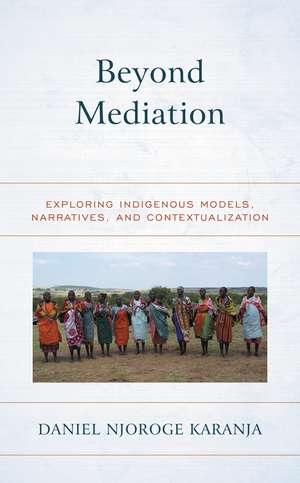
Beyond Mediation: Exploring Indigenous Models, Narratives, and Contextualization: Peace and Security in the 21st Century
Autor Daniel Njoroge Karanjaen Limba Engleză Hardback – 29 sep 2020
This book is based on the assumptions that local communities have the tools/capabilities that they need to build stable and enduring peaceful co-existence. These capacities have been weakened by the political elite and bankrupt/corrupt leadership approaches that must be rejected through empowerment and rigorous mediation brigades at the local level. The last chapter in the manuscript proposes a research center for indigenous justice, forgiveness and trauma healing in East Africa that will guarantee decades of scholarship and research around this subject in East Africa and beyond.
Din seria Peace and Security in the 21st Century
- 33%
 Preț: 609.23 lei
 - 23%
 Preț: 278.75 lei
 - 23%
 Preț: 256.91 lei
 - 19%
 Preț: 320.09 lei
 - 23%
 Preț: 271.14 lei
 - 14%
 Preț: 320.35 lei
 - 24%
 Preț: 353.58 lei
 - 23%
 Preț: 279.24 lei
 - 25%
 Preț: 218.16 lei
 - 28%
 Preț: 407.47 lei
 - 23%
 Preț: 287.37 lei
 - 24%
 Preț: 352.67 lei
 - 27%
 Preț: 253.72 lei
 - 23%
 Preț: 282.98 lei
 - 23%
 Preț: 285.87 lei
 - 24%
 Preț: 223.91 lei
 - 28%
 Preț: 219.75 lei
 - 19%
 Preț: 321.74 lei
 - 31%
 Preț: 698.58 lei
 - 23%
 Preț: 286.27 lei
 - 25%
 Preț: 220.96 lei
 - 25%
 Preț: 219.16 lei
 - 23%
 Preț: 275.00 lei
 - 16%
 Preț: 341.56 lei
 - 32%
 Preț: 661.57 lei
Preț: 696.36 lei
Preț vechi: 1004.33 lei
-31%
Puncte Express: 1045
Carte tipărită la comandă
Livrare economică 27 noiembrie-11 decembrie
Livrare prin curier în România Termenul estimat este afișat lângă disponibilitate.
Transport gratuit pentru acest produs Plată online sau ramburs, în funcție de opțiunile comenzii.
Retur gratuit în 14 zile Comandă securizată și suport în română.
Specificații
ISBN-13: 9781786610454
ISBN-10: 1786610450
Pagini: 176
Ilustrații: 1 tables;
Dimensiuni: 160 x 232 x 20 mm
Greutate: 0.49 kg
Editura: Bloomsbury Publishing
Colecția Rowman & Littlefield
Seria Peace and Security in the 21st Century
Locul publicării:New York, United States
ISBN-10: 1786610450
Pagini: 176
Ilustrații: 1 tables;
Dimensiuni: 160 x 232 x 20 mm
Greutate: 0.49 kg
Editura: Bloomsbury Publishing
Colecția Rowman & Littlefield
Seria Peace and Security in the 21st Century
Locul publicării:New York, United States
Cuprins
Introduction
Part I: Indigenous Mediation Background and Illustrations
Chapter 1: Definition of Indigenous Mediation
Chapter 2: Indigenous Mediation Models
Chapter 3: Indigenous Mediation Stories
Part II: Three Major Barriers to Indigenous Mediation
Chapter 4: Violence
Chapter 5: Injustice
Chapter 6: Un-forgiveness
Part III: Contextualization of Mediation
Chapter 7: Hybrid and Cross-Cultural Reflections
Chapter 8: Sustaining Indigenous Mediation through Narratives
Chapter 9: Localized Restorative Justice
Part IV: Building Enduring Foundations of Holistic Wellness
Chapter 10: Trauma Healing
Chapter 11: Vision 2075 and Beyond
Conclusion: Moving Beyond Mediation Matters
Glossary of Terms
References
Part I: Indigenous Mediation Background and Illustrations
Chapter 1: Definition of Indigenous Mediation
Chapter 2: Indigenous Mediation Models
Chapter 3: Indigenous Mediation Stories
Part II: Three Major Barriers to Indigenous Mediation
Chapter 4: Violence
Chapter 5: Injustice
Chapter 6: Un-forgiveness
Part III: Contextualization of Mediation
Chapter 7: Hybrid and Cross-Cultural Reflections
Chapter 8: Sustaining Indigenous Mediation through Narratives
Chapter 9: Localized Restorative Justice
Part IV: Building Enduring Foundations of Holistic Wellness
Chapter 10: Trauma Healing
Chapter 11: Vision 2075 and Beyond
Conclusion: Moving Beyond Mediation Matters
Glossary of Terms
References
Recenzii
Increasingly, the field of conflict resolution has come to understand and recognize that multiplicity of cultures and contexts ineluctably entails variability of intervention approaches. Many scholars and practitioners have urged the adoption of localized intervention methods yet there remains a dearth of detailed study of indigenous methodologies. Daniel Njoroge Karanja provides both definition of and concrete illustrations of indigenous mediation processes drawn from Africa. By utilizing proverbs to convey meaning, Karanja preserves more truly the meaning of indigenous processes in their own right rather than their assimilation into dominant paradigms. The book is a compelling read that is grounded in narratives from participants in real life conflicts. The rich personal experiences of offenders and victims are complemented with analysis from a scholar and practitioner well versed in the practices. Karanja does not stop at just analysis of process, but looks beyond to the longer term transformations that can enable persons and communities to heal from the traumas of conflict. The book will be a great teaching text as much as it will be a useful reference manual for practitioners.
Daniel Njoroge Karanja offers the reader an in-depth, inside understanding of the value of African indigenous methods of conflict resolution, reconciliation, and transformation. His research that includes indigenous proverbs, storytelling and the wisdom of elders, illustrates the art of conflict transformation. Karanja offers a model where African indigenous and Western theories of mediation are understood to be equal. The importance of indigenous proverbs and storytelling illustrates the importance of maintaining indigenous languages. Translations of proverbs lose their original understanding and value for conflict transformation. Other major themes Karanja explores are indigenous understanding of trauma, unforgiveness, deep listening, reciprocal violence and justice for both victims and offenders. Daniel Njoroge Karanja has written a book that should be widely used in university courses in conflict transformation.
If there were ever a time the world could benefit from the wisdom of indigenous mediation models; that time is now. Daniel Njoroge Karanja's new book beautifully highlights the power of stories in bringing about transformation, and the vital importance of recognizing the community context beyond the immediate parties to a conflict.
Daniel Njoroge Karanja offers the reader an in-depth, inside understanding of the value of African indigenous methods of conflict resolution, reconciliation, and transformation. His research that includes indigenous proverbs, storytelling and the wisdom of elders, illustrates the art of conflict transformation. Karanja offers a model where African indigenous and Western theories of mediation are understood to be equal. The importance of indigenous proverbs and storytelling illustrates the importance of maintaining indigenous languages. Translations of proverbs lose their original understanding and value for conflict transformation. Other major themes Karanja explores are indigenous understanding of trauma, unforgiveness, deep listening, reciprocal violence and justice for both victims and offenders. Daniel Njoroge Karanja has written a book that should be widely used in university courses in conflict transformation.
If there were ever a time the world could benefit from the wisdom of indigenous mediation models; that time is now. Daniel Njoroge Karanja's new book beautifully highlights the power of stories in bringing about transformation, and the vital importance of recognizing the community context beyond the immediate parties to a conflict.