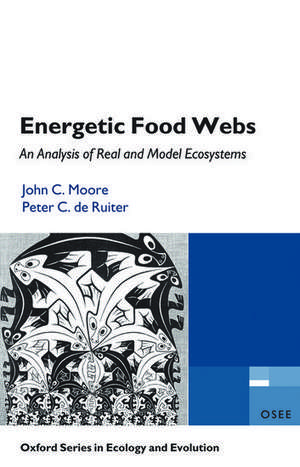
Energetic Food Webs: An analysis of real and model ecosystems: Oxford Series in Ecology and Evolution
Autor John C. Moore, Peter C. de Ruiteren Limba Engleză Hardback – 31 mai 2012
În cadrul programelor de studii avansate în ecologie și biologia sistemelor, analiza rețelelor trofice a fost mult timp divizată între studiul populațiilor și cel al fluxurilor de energie. Considerăm că Energetic Food Webs reprezintă o sinteză necesară, reușind să elimine barierele dintre ecologia comunităților și cea a ecosistemelor. Autorii John C. Moore și Peter C. de Ruiter propun o abordare integrată, ancorată în teoria sistemelor adaptative complexe, pentru a explica modul în care stabilitatea unui mediu depinde de echilibrul fin dintre aportul de energie (din surse vii sau moarte) și utilizarea acesteia de către speciile componente.
Această lucrare, publicată de OUP Oxford, se distinge prin rigoarea cu care tratează dinamica materiei și a energiei ca elemente structurante ale rețelelor reale și teoretice. Ca alternativă la volumul Food Webs de Stuart L. Pimm pentru cursurile de ecologie teoretică, textul de față aduce avantajul unei perspective moderne asupra energeticii, depășind simpla descriere a interacțiunilor de tip „cine pe cine mănâncă”. Dacă lucrările anterioare ale lui John C. Moore, precum Adaptive Food Webs, se concentrau pe implicațiile practice de management și sustenabilitate, volumul curent aprofundează mecanismele fundamentale de persistență ale sistemelor ecologice.
Limbajul este precis, specific literaturii academice de limbă engleză, fiind susținut de numeroase ilustrații care facilitează înțelegerea modelelor matematice complexe. Structura narativă a cărții ghidează cititorul de la concepte de bază spre o viziune unificată a ecologiei, oferind un argument coerent pentru studiul rețelelor trofice prin prisma energeticii, fapt confirmat și de recenziile de specialitate care subliniază capacitatea autorilor de a interpreta tiparele din literatura de profil într-un cadru conceptual unitar.
Din seria Oxford Series in Ecology and Evolution
- 15%
 Preț: 250.38 lei
 - 13%
 Preț: 349.39 lei
 - 12%
 Preț: 326.76 lei
 - 23%
 Preț: 461.75 lei
 - 24%
 Preț: 406.90 lei
 - 31%
 Preț: 436.73 lei
 - 23%
 Preț: 480.74 lei
 - 24%
 Preț: 405.48 lei
 - 35%
 Preț: 746.94 lei
 - 14%
 Preț: 381.94 lei
 - 24%
 Preț: 405.14 lei
 - 17%
 Preț: 503.44 lei
 - 23%
 Preț: 475.25 lei
 - 39%
 Preț: 344.17 lei
 - 23%
 Preț: 480.90 lei
 - 23%
 Preț: 502.25 lei
 - 8%
 Preț: 322.21 lei
 - 24%
 Preț: 404.98 lei
 - 12%
 Preț: 351.35 lei
 - 71%
 Preț: 153.32 lei
 - 36%
 Preț: 289.98 lei
 - 14%
 Preț: 643.13 lei
 - 26%
 Preț: 544.28 lei
 - 39%
 Preț: 341.14 lei
 - 31%
 Preț: 404.44 lei
 - 18%
 Preț: 497.41 lei
 - 37%
 Preț: 870.50 lei
 - 24%
 Preț: 340.66 lei
 - 23%
 Preț: 476.67 lei
 - 14%
 Preț: 596.41 lei
 - 39%
 Preț: 341.24 lei
 - 23%
 Preț: 343.33 lei
 - 25%
 Preț: 402.06 lei
 - 34%
 Preț: 950.81 lei
 - 8%
 Preț: 325.26 lei
 - 19%
 Preț: 503.04 lei
 - 29%
 Preț: 883.05 lei
Preț: 889.72 lei
Preț vechi: 1418.37 lei
-37%
Carte tipărită la comandă
Livrare economică 05-16 iunie
Specificații
ISBN-10: 0198566182
Pagini: 346
Ilustrații: Numerous illustrations
Dimensiuni: 160 x 236 x 24 mm
Greutate: 0.73 kg
Editura: OUP OXFORD
Colecția OUP Oxford
Seria Oxford Series in Ecology and Evolution
Locul publicării:Oxford, United Kingdom
V-ar putea interesa
-
 -26%Preț: 344.83 lei463.14 lei
 -
 Bayesian Inference in Dynamic Econometric ModelsLuc Bauwens-19%Preț: 456.82 lei563.69 lei
 -
 Model Selection and Multimodel InferenceDavid R. Anderson-23%Preț: 1023.82 lei1329.64 lei
 -
 Mathematical Modelling TechniquesRutherford ArisPreț: 91.80 lei
 -
 Randomized AlgorithmsRajeev Motwani-8%Preț: 572.53 lei622.31 lei
 -
 Milling SimulationWeihong Zhang-9%Preț: 948.51 lei1042.31 lei
 -
 Graphs, Maps, TreesFranco MorettiPreț: 99.61 lei
 -
 Mathematics for Modeling and Scientific ComputingThierry Goudon-9%Preț: 959.57 lei1054.48 lei
 -
 Systems Dependability AssessmentJean-Francois Aubry-9%Preț: 949.18 lei1043.06 lei
 -
 Reduced Order Methods for Modeling and Computational ReductionAlfio Quarteroni-15%Preț: 621.49 lei731.16 lei
De ce să citești această carte
Recomandăm această carte cercetătorilor și studenților la masterat care doresc să depășească viziunea clasică asupra ecologiei. Cititorul câștigă o înțelegere profundă a modului în care fluxurile de energie dictează stabilitatea unui ecosistem. Este un instrument esențial pentru oricine lucrează în modelarea rețelelor trofice, oferind un cadru teoretic solid care unifică dinamica speciilor cu ciclul materialelor.
Despre autor
John C. Moore este un cercetător proeminent în domeniul ecologiei sistemelor, cunoscut pentru abordările sale interdisciplinare. Opera sa acoperă un spectru larg, de la modelarea rețelelor trofice în Oxford Series in Ecology and Evolution, până la lucrări care explorează paradigma sistemelor ecologice în managementul resurselor naturale, precum Natural Resource Management Reimagined. Interesul său pentru structurile complexe se extinde și în zona istoriei instituționale, autorul semnând și o istorie a universităților. Această diversitate intelectuală îi permite să abordeze ecologia nu doar ca pe o disciplină biologică, ci ca pe un studiu al sistemelor adaptative complexe.