
Infectious Diseases in Primates: Behavior, Ecology and Evolution: Oxford Series in Ecology and Evolution
Autor Charles Nunn, Sonia Altizeren Limba Engleză Paperback – 27 apr 2006
Din seria Oxford Series in Ecology and Evolution
- 13%
 Preț: 277.49 lei
 - 21%
 Preț: 352.37 lei
 - 10%
 Preț: 363.95 lei
 - 22%
 Preț: 508.49 lei
 - 28%
 Preț: 453.40 lei
 - 28%
 Preț: 484.73 lei
 - 23%
 Preț: 524.21 lei
 - 29%
 Preț: 450.98 lei
 - 33%
 Preț: 1021.32 lei
 - 21%
 Preț: 420.61 lei
 - 28%
 Preț: 451.51 lei
 - 24%
 Preț: 560.26 lei
 - 23%
 Preț: 518.51 lei
 - 28%
 Preț: 380.95 lei
 - 23%
 Preț: 524.36 lei
 - 26%
 Preț: 528.08 lei
 - 11%
 Preț: 365.16 lei
 - 28%
 Preț: 451.36 lei
 - 21%
 Preț: 388.83 lei
 - 24%
 Preț: 171.42 lei
 - 20%
 Preț: 308.32 lei
 - 31%
 Preț: 864.90 lei
 - 31%
 Preț: 599.80 lei
 - 28%
 Preț: 377.77 lei
 - 29%
 Preț: 450.80 lei
 - 33%
 Preț: 961.70 lei
 - 28%
 Preț: 383.88 lei
 - 22%
 Preț: 519.99 lei
 - 31%
 Preț: 661.10 lei
 - 28%
 Preț: 377.88 lei
 - 28%
 Preț: 380.08 lei
 - 29%
 Preț: 449.07 lei
 - 33%
 Preț: 1246.13 lei
 - 11%
 Preț: 359.81 lei
 - 31%
 Preț: 535.70 lei
 - 33%
 Preț: 974.89 lei
Preț: 529.98 lei
Preț vechi: 695.73 lei
-24%
Puncte Express: 795
Carte tipărită la comandă
Livrare economică 26 noiembrie-02 decembrie
Livrare prin curier în România Termenul estimat este afișat lângă disponibilitate.
Transport gratuit pentru acest produs Plată online sau ramburs, în funcție de opțiunile comenzii.
Retur gratuit în 14 zile Comandă securizată și suport în română.
Specificații
ISBN-13: 9780198565857
ISBN-10: 0198565852
Pagini: 400
Ilustrații: 29 halftones, 58 line drawings, tables
Dimensiuni: 157 x 233 x 22 mm
Greutate: 0.71 kg
Editura: OUP OXFORD
Colecția OUP Oxford
Seria Oxford Series in Ecology and Evolution
Locul publicării:Oxford, United Kingdom
ISBN-10: 0198565852
Pagini: 400
Ilustrații: 29 halftones, 58 line drawings, tables
Dimensiuni: 157 x 233 x 22 mm
Greutate: 0.71 kg
Editura: OUP OXFORD
Colecția OUP Oxford
Seria Oxford Series in Ecology and Evolution
Locul publicării:Oxford, United Kingdom
V-ar putea interesa
-
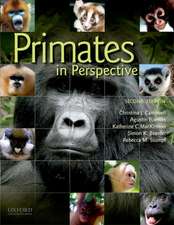 Primates in PerspectiveChristina Campbell-27%Preț: 968.49 lei1326.69 lei
 -
 The Chimpanzees of the Tai Forest: Behavioural Ecology and EvolutionChristophe Boesch-28%Preț: 454.01 lei632.52 lei
 -
 -32%Preț: 527.32 lei779.35 lei
 -
 -31%Preț: 830.16 lei1198.49 lei
 -
 -32%Preț: 714.96 lei1056.70 lei
 -
 Primate NeuroethologyMichael J. Platt-33%Preț: 2077.46 lei3081.68 lei
 -
 -30%Preț: 547.65 lei785.48 lei
 -
 Consanguinity in ContextAlan H. Bittles-22%Preț: 474.20 lei610.82 lei
 -
 Jane Goodall: 50 Years at GombeJane GoodallPreț: 167.09 lei
Recenzii
[this book] is organized in nine chapters, each building upon the last, making it an excellent text for introducing the subject of primate pathogen biology to audiences coming from divergent backgrounds, but with a shared interest in the topic. I can attest to the success of this volume in this regard, having used it to lead a graduate seminar including participants from biological anthropology, epidemiology, ecology, and veterinary medicine.
This is a useful book that includes an index, which is of practical interest for laboratories and zoos.
I would highly recommend this book to behavioural scientists, veterinarians working with nonhuman primates in biomedical, zoological or field settings and to investigators utilizing nonhuman primates in their disease programs. American Journal of Primatology 69:1 (2007)
The nine chapters of this logically structured book will appeal to ecologists, evolutionary biologists, primatologists, and especially to students in these fields seeking a better understanding of disease biology, epidemiological principals, and comparative evolutionary analyses, On the whole, the publication of this book marks, if not the birth of a new field, its transition from childhood into adolescence. EcoHealth 2007.
This innovative book provides a comprehensive synthesis of the emerging and topical field of disease ecology. I thoroughly enjoyed it and highly recommend it to those with a passion for diseases or primates.
... a structured and thoughtful synthesis of a field that has never before been unified ... On the whole, the publication of this book marks, if not the birth of a new field, its transition from childhood into adolescence.
This is a useful book that includes an index, which is of practical interest for laboratories and zoos.
I would highly recommend this book to behavioural scientists, veterinarians working with nonhuman primates in biomedical, zoological or field settings and to investigators utilizing nonhuman primates in their disease programs. American Journal of Primatology 69:1 (2007)
The nine chapters of this logically structured book will appeal to ecologists, evolutionary biologists, primatologists, and especially to students in these fields seeking a better understanding of disease biology, epidemiological principals, and comparative evolutionary analyses, On the whole, the publication of this book marks, if not the birth of a new field, its transition from childhood into adolescence. EcoHealth 2007.
This innovative book provides a comprehensive synthesis of the emerging and topical field of disease ecology. I thoroughly enjoyed it and highly recommend it to those with a passion for diseases or primates.
... a structured and thoughtful synthesis of a field that has never before been unified ... On the whole, the publication of this book marks, if not the birth of a new field, its transition from childhood into adolescence.
Notă biografică
Charles Nunn is a research scientist at the Max Planck Institute for Evolutionary Anthropology in Leipzig, Germany and an Assistant Professor in the Department of Integrative Biology at the University of California in Berkeley, USA. His research interests include primate behaviour, disease ecology and comparative biology.Sonia Altizer is an Assistant Professor at the Institute of Ecology of the University of Georgia, USA . Her research focuses on the ecology and evolution of host-pathogen interactions in wild animal populations.