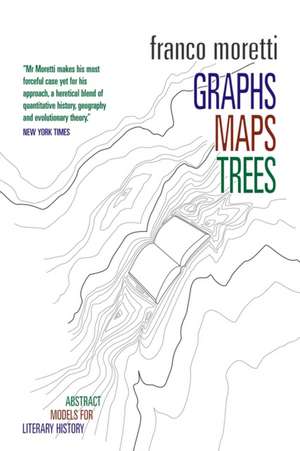
Graphs, Maps, Trees
Autor Franco Morettien Limba Engleză Paperback – 17 sep 2007
Preț: 104.58 lei
Puncte Express: 157
Carte tipărită la comandă
Livrare economică 27 noiembrie-11 decembrie
Livrare prin curier în România Termenul estimat este afișat lângă disponibilitate.
Transport gratuit de la 400.00 lei Plată online sau ramburs, în funcție de opțiunile comenzii.
Retur gratuit în 14 zile Comandă securizată și suport în română.
Specificații
ISBN-13: 9781844671854
ISBN-10: 1844671852
Pagini: 128
Ilustrații: Illustrations, maps
Dimensiuni: 146 x 212 x 10 mm
Greutate: 0.15 kg
Editura: VERSO
Locul publicării:United Kingdom
ISBN-10: 1844671852
Pagini: 128
Ilustrații: Illustrations, maps
Dimensiuni: 146 x 212 x 10 mm
Greutate: 0.15 kg
Editura: VERSO
Locul publicării:United Kingdom
V-ar putea interesa
-
 -9%Preț: 2502.51 lei2750.00 lei
 -
 Elements of Mathematical EcologyMark Kot-11%Preț: 653.96 lei734.79 lei
 -
 Modelling for Field BiologistsHanna Kokko-5%Preț: 430.87 lei453.55 lei
 -
 Dynamic Data AssimilationJohn M. Lewis-14%Preț: 1474.34 lei1714.34 lei
 -
 PercolationBela Bollobás-11%Preț: 705.36 lei792.54 lei
 -
 The Novel, Volume 1Franco MorettiPreț: 444.33 lei
 -
 The Novel, Volume 2Franco MorettiPreț: 446.71 lei
 -
 Fiction of NarrativeHayden WhitePreț: 275.65 lei
 -
 Signs Taken for WondersFranco MorettiPreț: 174.57 lei
 -
 Atlas of the European NovelFranco MorettiPreț: 155.94 lei
 -
 The Way of the WorldFranco MorettiPreț: 170.33 lei
 -
 Models of Wave MemorySerguey KashchenkoPreț: 389.23 lei
 -
 -15%Preț: 613.62 lei721.90 lei
 -
 Preț: 490.21 lei
Notă biografică
Franco Moretti is a Professor Emeritus at Stanford, where he founded the Center for the Study of the Novel and the Literary Lab. He writes regularly for New Left Review and is a Permanent Fellow of the Wissenschaftskolleg zu Berlin. He is the author of, among other books, Far Country, The Bourgeois and Graphs, Maps, Trees. His work has been translated into more than twenty languages. His book Distant Reading won the 2013 National Book Critics Circle Award for Criticism.
Recenzii
“It’s a rare literary critic who attracts so much public attention, and there’s a good reason: few are as hell-bent on rethinking the way we talk about literature.”—Times Literary Supplement
“The great iconoclast of literary criticism ... Moretti’s discourse, as has often been noted, is marked by the same subtlety and unpredictability as his fellow Italian, Umberto Eco.”—Guardian
“Mr. Moretti makes his most forceful case yet for his approach, a heretical blend of quantitative history, geography and evolutionary theory.”—New York Times
“The great iconoclast of literary criticism ... Moretti’s discourse, as has often been noted, is marked by the same subtlety and unpredictability as his fellow Italian, Umberto Eco.”—Guardian
“Mr. Moretti makes his most forceful case yet for his approach, a heretical blend of quantitative history, geography and evolutionary theory.”—New York Times