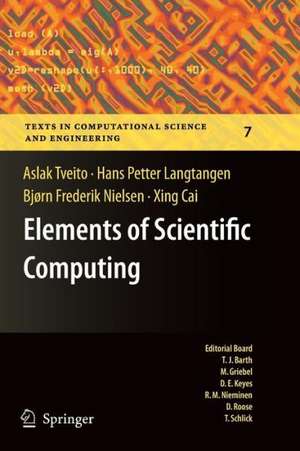
Elements of Scientific Computing: Texts in Computational Science and Engineering, cartea 7
Autor Aslak Tveito, Hans Petter Langtangen, Bjørn Frederik Nielsen, Xing Caien Limba Engleză Paperback – 7 noi 2012
Notăm cu interes modul în care Elements of Scientific Computing reușește să sintetizeze trecerea de la știința bazată exclusiv pe experiment și teorie la cea contemporană, dominată de simulări computaționale. Structura și metodologia acestui volum, publicat de Springer, sunt concepute pentru a ghida studentul de la primii pași în rezolvarea integralelor și a ecuațiilor diferențiale ordinare către probleme complexe de estimare a parametrilor și analiză a ecuațiilor de difuzie. Organizarea materialului reflectă o progresie logică, culminând cu o prezentare succintă a calculului paralel, element esențial în peisajul tehnologic actual. Suntem de părere că forța acestui text rezidă în echilibrul dintre rigoarea analitică și implementarea practică. Comparabil cu An Introduction to Computational Science de Allen Holder în rigurozitate, volumul de față se distinge printr-o orientare mai pronunțată către aplicabilitatea inter-disciplinară, fiind actualizat pentru nevoile specifice ale cercetării moderne din geofizică, chimie sau bioinginerie. În contextul operei autorilor, observăm o continuitate tematică evidentă; Hans Petter Langtangen, de exemplu, își extinde viziunea pedagogică din A Primer on Scientific Programming with Python, trecând de la învățarea limbajului de programare la aplicarea acestuia în metode numerice avansate. Dacă în Introduction to Partial Differential Equations accentul era pus pe modelarea matematică pură, aici Aslak Tveito și colaboratorii săi prioritizează „ideile care pot fi transferate”, oferind cititorului instrumentele necesare pentru a construi și înțelege software-ul științific.
Din seria Texts in Computational Science and Engineering
- 15%
 Preț: 604.33 lei
 -
 Preț: 401.66 lei
 - 20%
 Preț: 651.64 lei
 - 20%
 Preț: 351.40 lei
 - 15%
 Preț: 670.42 lei
 - 20%
 Preț: 664.34 lei
 -
 Preț: 401.98 lei
 -
 Preț: 444.14 lei
 -
 Preț: 422.62 lei
 -
 Preț: 402.04 lei
 -
 Preț: 468.16 lei
 -
 Preț: 510.96 lei
 - 15%
 Preț: 628.85 lei
 - 15%
 Preț: 529.60 lei
 -
 Preț: 396.25 lei
 -
 Preț: 397.18 lei
 -
 Preț: 390.50 lei
 - 15%
 Preț: 486.86 lei
 -
 Preț: 400.17 lei
 -
 Preț: 472.77 lei
 - 20%
 Preț: 325.15 lei
 -
 Preț: 502.82 lei
 -
 Preț: 393.74 lei
 - 15%
 Preț: 593.84 lei
Preț: 402.42 lei
Carte tipărită la comandă
Livrare economică 26 noiembrie-10 decembrie
Specificații
ISBN-10: 3642265197
Pagini: 480
Ilustrații: XII, 468 p. 86 illus.
Dimensiuni: 155 x 235 x 26 mm
Greutate: 0.72 kg
Ediția:2010
Editura: Springer
Colecția Texts in Computational Science and Engineering
Seria Texts in Computational Science and Engineering
Locul publicării:Berlin, Heidelberg, Germany
V-ar putea interesa
-
 -20%Preț: 676.98 lei846.22 lei
 -
 Introduction to Partial Differential EquationsAslak TveitoPreț: 398.21 lei
 -
 Mathematics Without BoundariesPanos M. Pardalos-15%Preț: 689.33 lei810.98 lei
 -
 Graph TheoryJen Blackwood-15%Preț: 632.42 lei744.03 lei
 -
 Key Concepts in Graph TheoryJen Blackwood-15%Preț: 579.00 lei681.17 lei
 -
 -15%Preț: 680.13 lei800.15 lei
 -
 -15%Preț: 689.10 lei810.71 lei
 -
 Scaling of Differential EquationsHans Petter LangtangenPreț: 174.17 lei
 -
 Solving PDEs in PythonHans Petter LangtangenPreț: 177.22 lei
 -
 Advanced Topics in Computational Partial Differential EquationsHans Petter LangtangenPreț: 415.11 lei
 -
 Boundary Integral EquationsGeorge C. Hsiao-15%Preț: 665.99 lei783.52 lei
 -
 C^\infinity - Differentiable SpacesJuan A. Navarro GonzálezPreț: 335.80 lei
 -
 -15%Preț: 638.81 lei751.54 lei
 -
 Algorithm Theory - SWAT 2004Torben HagerupPreț: 389.60 lei
 -
 Numerical Solution of Partial Differential Equations on Parallel ComputersAre Magnus Bruaset-18%Preț: 912.91 lei1113.31 lei
 -
 Computing the Electrical Activity in the HeartJoakim Sundnes-15%Preț: 728.67 lei857.25 lei
 -
 Einführung in partielle DifferentialgleichungenAslak TveitoPreț: 279.18 lei
 -
 Wavelets in Numerical SimulationKarsten UrbanPreț: 385.28 lei
 -
 -15%Preț: 669.69 lei787.87 lei
 -
 Computational Turbulent Incompressible FlowJohan HoffmanPreț: 416.93 lei
 -
 Numerical Computation 2: Methods, Software, and AnalysisChristoph W. UeberhuberPreț: 387.82 lei
 -
 Numerical Computation 1Christoph W. UeberhuberPreț: 397.70 lei
 -
 Preț: 260.48 lei
 -
 -15%Preț: 666.11 lei783.66 lei
 -
 Monte Carlo and Quasi-Monte Carlo Methods 2010Leszek Plaskota-18%Preț: 1008.53 lei1229.92 lei
 -
 Simula Research LaboratoryAslak Tveito-15%Preț: 663.31 lei780.37 lei
 -
 -18%Preț: 709.98 lei865.82 lei
 -
 CLASSICAL ORTHOGONAL POLYNOMIALS, THEDoman Brian George Spencer-15%Preț: 534.90 lei629.29 lei
 -
 Preț: 419.31 lei
Public țintă
Lower undergraduateDe ce să citești această carte
Recomandăm această carte studenților din anii timpurii ai facultăților de profil real care doresc să stăpânească fundamentele numerice înainte de specializare. Cititorul câștigă o înțelegere clară a modului în care algoritmii matematici sunt traduși în cod funcțional pentru rezolvarea problemelor din lumea reală. Este un punct de plecare solid pentru oricine dorește să utilizeze computerele ca laboratoare virtuale de experimentare.
Despre autor
Echipa de autori este formată din cercetători și pedagogi de renume, afiliați unor instituții precum Simula Research Laboratory. Aslak Tveito și regretatul Hans Petter Langtangen sunt figuri centrale în comunitatea de calcul științific, recunoscuți pentru eforturile lor de a moderniza curriculumul universitar prin integrarea programării în predarea matematicii. Hans Petter Langtangen a fost un pionier în utilizarea limbajului Python pentru aplicații științifice, iar contribuțiile sale în seria Texts in Computational Science and Engineering rămân puncte de referință. Alături de Bjørn Frederik Nielsen și Xing Cai, aceștia au creat resurse educaționale care pun bazele cercetării computaționale moderne.
Descriere scurtă
Cuprins
Recenzii
“This gentle introduction to scientific computing aims to convey the basic ideas, principles and techniques of computational science to undergraduates in mathematics, science and engineering. … The real strength of the text is its adroit mix of analytical and numerical, theoretical and practical. … This is a top-notch book on scientific computing written with clarity … and a good sense of what students need to learn. It is among the best books in this area that I have seen.” (William J. Satzer, The Mathematical Association of America, February, 2011)
“The text flows nicely, and Tveito (Simula Research Laboratory, Norway) and colleagues thoroughly explain different subjects in meaningful steps. In addition to exercises at the end of each chapter, an instructive ‘Projects’ section allows readers to practice new concepts. … Overall, this textbook is a welcome addition to a small set of books currently available in scientific computing, an expanding area for undergraduate course development in many US colleges. Summing Up: Recommended. Lower-division undergraduates through researchers/faculty.” (D. Papamichail, Choice, Vol. 48 (9), May, 2011)
“This book is part of Springer’s Texts in Computational Science and Engineering series, so it is written for students. … chapters more or less serve as a limited introduction to computational mathematics: they cover basic algorithms in numerical integration, initial-value problems for scalar ODEs, initial-value problems for two-component ODEs, rootfinding in one or two dimensions, and least squares approximations using constants, lines, and parabolas.” (Toby Driscoll, SIAM Review, Vol. 53 (4), 2011)
“In this appealing book the authors introduce to basic principles of numerical calculations which every engineer or scientist working with computers should be familiar with. … a very good selection of topics treated and presented importantmethods in a gentle style … .” (Rudolf Gorenflo, Zentralblatt MATH, Vol. 1220, 2011)