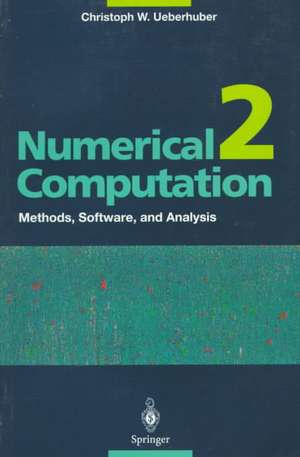
Numerical Computation 2: Methods, Software, and Analysis
Autor Christoph W. Ueberhuberen Limba Engleză Paperback – 27 feb 1997
Preț: 387.82 lei
Puncte Express: 582
Carte tipărită la comandă
Livrare economică 28 noiembrie-12 decembrie
Livrare prin curier în România Termenul estimat este afișat lângă disponibilitate.
Transport gratuit de la 400.00 lei Plată online sau ramburs, în funcție de opțiunile comenzii.
Retur gratuit în 14 zile Comandă securizată și suport în română.
Specificații
ISBN-13: 9783540620570
ISBN-10: 3540620575
Pagini: 516
Ilustrații: XVI, 496 p. 8 illus.
Dimensiuni: 155 x 235 x 27 mm
Greutate: 0.77 kg
Ediția:Softcover reprint of the original 1st ed. 1997
Editura: Springer Berlin, Heidelberg
Colecția Springer
Locul publicării:Berlin, Heidelberg, Germany
ISBN-10: 3540620575
Pagini: 516
Ilustrații: XVI, 496 p. 8 illus.
Dimensiuni: 155 x 235 x 27 mm
Greutate: 0.77 kg
Ediția:Softcover reprint of the original 1st ed. 1997
Editura: Springer Berlin, Heidelberg
Colecția Springer
Locul publicării:Berlin, Heidelberg, Germany
V-ar putea interesa
-
 Number Words and Number SymbolsKarl MenningerPreț: 176.38 lei
 -
 Combinatorial ReasoningDuane W. DeTemple-27%Preț: 836.81 lei1146.31 lei
 -
 Undocumented Secrets of MATLAB-Java ProgrammingYair M. Altman-20%Preț: 1569.93 lei1962.41 lei
 -
 Adaptive Moving Mesh MethodsWeizhang HuangPreț: 405.90 lei
 -
 Numerical Methods for Fluid DynamicsDale R. Durran-15%Preț: 599.52 lei705.32 lei
 -
 Computational StatisticsJames E. Gentle-15%Preț: 611.13 lei718.98 lei
 -
 Pell and Pell-Lucas Numbers with ApplicationsThomas KoshyPreț: 558.37 lei
 -
 Mathematics: All That MattersMike Askew-25%Preț: 95.03 lei127.14 lei
 -
 The Mathematics of Coordinated InferenceChristopher S. HardinPreț: 397.87 lei
 -
 -18%Preț: 1401.61 lei1709.28 lei
 -
 Solving Ordinary Differential Equations IErnst Hairer-19%Preț: 470.63 lei581.02 lei
Public țintă
ResearchCuprins
10 Best Approximation.- 10.1 Mathematical Foundations.- 10.2 Continuous Least Squares Approximation.- 10.3 Discrete Least Squares Approximation.- 10.4 Uniform Best Approximation.- 10.5 Approximation Algorithms.- 10.6 Approximation Software for Special Functions.- 11 The Fourier Transform.- 11.1 Background.- 11.2 Mathematical Foundations.- 11.3 Trigonometric Interpolation.- 11.4 Convolution.- 11.5 Manipulation of the Signal Spectrum.- 11.6 DFT Algorithms.- 11.7 FFT Software Packages.- 11.8 FFT Routines in Software Libraries.- 11.9 Other FFT Programs.- 12 Numerical Integration.- 12.1 Fundamentals of Integration.- 12.2 Preprocessing of Integration Problems.- 12.3 Univariate Integration Formulas.- 12.4 Multivariate Integration Formulas.- 12.5 Integration Algorithms.- 13 Systems of Linear Equations.- 13.1 Design Stage.- 13.2 Realization Stage.- 13.3 Verification Stage.- 13.4 Mathematical Foundations.- 13.5 Special Properties of Matrices.- 13.6 Special Types of Matrices.- 13.7 Singular Value Decomposition.- 13.8 The Condition of Linear Systems.- 13.9 Condition of Least Squares Problems.- 13.10 Condition Analysis Using the SVD.- 13.11 Direct Methods.- 13.12 Special Types of Linear Systems.- 13.13 Assessment of the Accuracy Achieved.- 13.14 Methods for Least Squares Problems.- 13.15 LAPACK—The Fundamental Linear Algebra Package.- 13.16 LAPACK Black Box Programs.- 13.17 LAPACK Computational Routines.- 13.18 LAPACK Documentation.- 13.19 LAPACK Storage Schemes.- 13.20 Block Size for Block Algorithms.- 13.21 LAPACK Variants and Extensions.- 14 Nonlinear Equations.- 14.1 Iterative Methods.- 14.2 Nonlinear Scalar Equations.- 14.3 Systems of Nonlinear Equations.- 14.4 Nonlinear Data Fitting.- 15 Eigenvalues and Eigenvectors.- 15.1 Mathematical Foundations.- 15.2 Condition ofEigenvalue Problems.- 15.3 The Power Method.- 15.4 The QR Algorithm.- 15.5 The Diagonal Reduction.- 15.6 The Hessenberg Reduction.- 15.7 LAPACK Programs.- 16 Large, Sparse Linear Systems.- 16.1 Storage Schemes for Iterative Methods.- 16.2 Storage Schemes for Symmetric Matrices.- 16.3 Storage Schemes for Direct Methods.- 16.4 Comparison of Storage Schemes.- 16.5 Direct Methods.- 16.6 Iterative Methods.- 16.7 Minimization Methods.- 16.8 Stationary Iterative Methods.- 16.9 Non-Stationary Iterative Methods.- 16.10 Preconditioning.- 16.11 Matrix-Vector Products.- 16.12 Parallelism.- 16.13 Selecting an Iterative Method.- 16.14 Software for Sparse Systems.- 16.15 Basic Software.- 16.16 Dedicated Software Packages.- 16.17 Routines from Software Libraries.- 17 Random Numbers.- 17.1 Random Number Generators.- 17.2 The Generation of Uniform Random Numbers.- 17.3 The Generation of Non-uniform Random Numbers.- 17.4 Testing Random Number Generators.- 17.5 Software for Generating Random Numbers.- Glossary of Notation.- Author Index.
Recenzii
"The two volumes can be highly recommended for newcomers in the area as well as for people working for a long time in or with computer numerics."
EUROSIM - Simulation News Europe
"... This book is highly recommended to students, scientists, anad engineers interested in the numerical solution of mathematical problems. It is very useful as a handbook for both newcomers and experts. Every science/engineering/mathematics/computer science library should have a copy of this book."
Matti Vuorinen, Mathematical Reviews 2003
EUROSIM - Simulation News Europe
"... This book is highly recommended to students, scientists, anad engineers interested in the numerical solution of mathematical problems. It is very useful as a handbook for both newcomers and experts. Every science/engineering/mathematics/computer science library should have a copy of this book."
Matti Vuorinen, Mathematical Reviews 2003