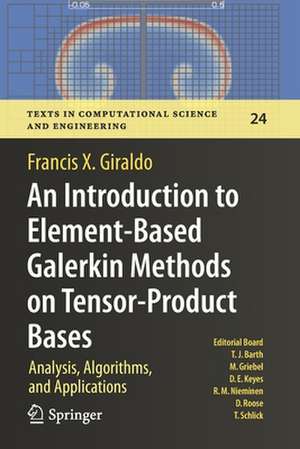
An Introduction to Element-Based Galerkin Methods on Tensor-Product Bases: Texts in Computational Science and Engineering, cartea 24
Autor Francis X. Giraldoen Limba Engleză Paperback – noi 2021
Observăm în literatura academică dedicată analizei numerice o abundență de tratate care prioritizează rigoarea matematică a spațiilor de funcții în detrimentul implementării practice. Volumul An Introduction to Element-Based Galerkin Methods on Tensor-Product Bases, semnat de Francis X. Giraldo, vine să completeze exact această lacună, oferind o punte între fundamentul teoretic solid și scrierea efectivă de cod pentru rezolvarea ecuațiilor cu derivate parțiale (PDE). Considerăm că relevanța acestui manual rezidă în focalizarea sa pe bazele de tip produs tensorial, limitând complexitatea geometrică la elemente de linie, patrulatere și cuburi pentru a permite o înțelegere profundă a structurii matricelor rezultate.
Structura volumului urmărește o progresie logică, de la motivarea metodelor și interpolarea unidimensională, până la tehnici avansate de integrare numerică și metode Galerkin discontinue hibridizate. Această organizare didactică transformă capitolele în unități de învățare aplicate, unde cititorul învață nu doar „de ce” funcționează o metodă, ci mai ales „cum” să construiască algoritmii necesari. Lucrarea completează perspectiva oferită de Numerical Approximation of Partial Differential Equations de Alfio Quarteroni, adăugând un accent pronunțat pe aspectele algoritmice și pe tranziția de la funcțiile de bază nodale la cele modale, acolo unde textul lui Quarteroni rămâne preponderent în sfera analizei de convergență și stabilitate.
Prin includerea unor exemple ce pot servi drept proiecte pentru studenți, Francis X. Giraldo transformă acest volum într-un instrument pedagogic esențial pentru curriculumul de calcul științific. Recomandăm acest titlu ca resursă principală pentru cursurile de licență avansată sau masterat care vizează metodele de element finit și spectral.
Din seria Texts in Computational Science and Engineering
- 19%
 Preț: 562.25 lei
 -
 Preț: 386.54 lei
 - 20%
 Preț: 351.40 lei
 - 15%
 Preț: 576.47 lei
 - 20%
 Preț: 636.47 lei
 -
 Preț: 372.74 lei
 -
 Preț: 413.82 lei
 -
 Preț: 425.27 lei
 -
 Preț: 438.33 lei
 -
 Preț: 477.67 lei
 - 15%
 Preț: 586.88 lei
 -
 Preț: 381.35 lei
 -
 Preț: 380.40 lei
 -
 Preț: 374.46 lei
 -
 Preț: 382.10 lei
 -
 Preț: 464.80 lei
 - 20%
 Preț: 325.15 lei
 -
 Preț: 479.25 lei
 -
 Preț: 383.60 lei
 -
 Preț: 376.01 lei
 - 15%
 Preț: 565.00 lei
 - 20%
 Preț: 513.02 lei
Preț: 489.82 lei
Carte tipărită la comandă
Livrare economică 10-24 iunie
Specificații
ISBN-10: 3030550710
Pagini: 588
Ilustrații: XXVI, 559 p. 171 illus., 168 illus. in color.
Dimensiuni: 155 x 235 x 32 mm
Greutate: 0.88 kg
Ediția:1st ed. 2020
Editura: Springer
Colecția Texts in Computational Science and Engineering
Seria Texts in Computational Science and Engineering
Locul publicării:Cham, Switzerland
V-ar putea interesa
-
 -18%Preț: 1623.89 lei1980.35 lei
 -
 Modern Dynamical Systems and ApplicationsMichael Brin-14%Preț: 758.05 lei881.45 lei
 -
 Quantum Theory of the Third KindStephen BlahaPreț: 362.83 lei
 -
 Nonlinear Evolution Equations That Change TypeBarbara L. Keyfitz-15%Preț: 613.77 lei722.09 lei
 -
 -15%Preț: 610.74 lei718.53 lei
 -
 -18%Preț: 929.84 lei1133.94 lei
 -
 -15%Preț: 450.27 lei529.73 lei
 -
 -18%Preț: 1087.47 lei1326.17 lei
 -
 Spectral and Dynamical Stability of Nonlinear WavesTodd Kapitula-15%Preț: 574.43 lei675.79 lei
 -
 Overconvergence in Complex ApproximationSorin G. Gal-59%Preț: 324.52 lei797.62 lei
 -
 Much Ado About CalculusR. L. WilsonPreț: 403.03 lei
 -
 Recent developments in the Navier-Stokes problemPierre Gilles Lemarie-Rieusset-18%Preț: 1414.95 lei1725.55 lei
 -
 Progress in Partial Differential EquationsMichael Reissig-18%Preț: 913.04 lei1113.46 lei
 -
 Preț: 338.75 lei
 -
 -15%Preț: 621.67 lei731.37 lei
 -
 Preț: 366.49 lei
De ce să citești această carte
Recomandăm această carte studenților și cercetătorilor care doresc să treacă de la teoria ecuațiilor cu derivate parțiale la implementarea lor numerică. Cititorul câștigă o înțelegere clară a modului în care se construiesc matricile pentru metodele Galerkin continue și discontinue. Este o alegere excelentă deoarece oferă algoritmi concreți și proiecte aplicate, facilitând dezvoltarea propriilor programe de simulare numerică în 1D, 2D și 3D.
Despre autor
Francis X. Giraldo este un expert recunoscut în domeniul matematicii computaționale, cu o experiență vastă în dezvoltarea metodelor numerice pentru dinamica fluidelor și modelarea atmosferică. Contribuțiile sale se concentrează pe eficientizarea metodelor Galerkin pe arhitecturi de calcul de înaltă performanță. În acest volum publicat de Springer în seria Texts in Computational Science and Engineering, autorul își distilează experiența de cercetare într-un format accesibil, adaptat nevoilor educaționale contemporane ale inginerilor și matematicienilor.
Cuprins
Systems of Hyperbolic Equations.- 1D Continuous Galerkin Methods for Elliptic Equations.- 1D Discontinuous Galerkin Methods for Elliptic Equations.- Two-Dimensional Problems.- Interpolation in Multiple Dimensions.- Numerical Integration in Multiple Dimensions.- 2D Continuous Galerkin Methods for Elliptic Equations.- 2D Discontinuous Galerkin Methods for Elliptic Equations.- 2D Unified Continuous and Discontinuous Galerkin Methods for Elliptic Equations.- 2D Continuous Galerkin Methods for Hyperbolic Equations.- 2D Discontinuous Galerkin Methods for Hyperbolic Equations.- 2D Continuous/Discontinuous Galerkin Methods for Hyperbolic Equations.- Advanced Topics.- Stabilization of High-Order Methods.- Adaptive Mesh Refinement.- Time Integration.- 1D Hybridizable Discontinuous Galerkin Method.- Classification of Partial Differential Equations and Vector Notation.- Jacobi Polynomials.- Data Structures.