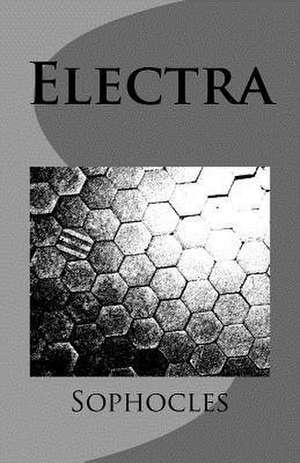
Electra
Autor Sophoclesen Limba Engleză Paperback
Preț: 42.55 lei
Puncte Express: 64
Carte disponibilă
Livrare economică 05-19 noiembrie
Livrare prin curier în România Termenul estimat este afișat lângă disponibilitate.
Transport gratuit de la 400.00 lei Plată online sau ramburs, în funcție de opțiunile comenzii.
Retur gratuit în 14 zile Comandă securizată și suport în română.
Specificații
ISBN-13: 9781532880902
ISBN-10: 1532880901
Pagini: 50
Dimensiuni: 140 x 216 x 3 mm
Greutate: 0.07 kg
ISBN-10: 1532880901
Pagini: 50
Dimensiuni: 140 x 216 x 3 mm
Greutate: 0.07 kg
V-ar putea interesa
-
 The Theban PlaysSophocles-20%Preț: 57.10 lei71.10 lei
 -
 The Oresteian TrilogyAeschylus-32%Preț: 62.94 lei92.17 lei
 -
 Electra and Other PlaysSophocles-30%Preț: 66.10 lei94.06 lei
 -
 Greek TragedyAeschylus-30%Preț: 64.98 lei93.40 lei
 -
 Preț: 100.41 lei
 -
 Antigone; Oedipus the King; ElectraSophocles-19%Preț: 52.23 lei64.47 lei
 -
 OresteiaAeschylus-18%Preț: 53.90 lei65.46 lei
 -
 Oedipus the King, Second EditionSophoclesPreț: 65.45 lei
 -
 Preț: 176.89 lei
 -
 House of NamesColm Tòibìn-26%Preț: 58.24 lei78.82 lei
 -
 An OresteiaAeschylusPreț: 105.88 lei
 -
 MedeaEuripides-11%Preț: 78.95 lei89.16 lei
 -
 -25%Preț: 59.44 lei79.75 lei
 -
 Medea and Other PlaysEuripidesPreț: 43.30 lei
 -
 The Three Theban PlaysSophoclesPreț: 45.74 lei
 -
 AgamemnonAeschylusPreț: 38.67 lei
 -
 Preț: 77.91 lei
 -
 ElectraMarianne MacdonaldPreț: 27.78 lei
Descriere
Descriere de la o altă ediție sau format:
Sophocles' Electra tells the story of the revenge Orestes and Electra take on their mother, Clytemnestra, for the murder of their father Agamemnon, after he returns from the Trojan War. In Sophocles' depiction of this myth, Electra admits that her actions are shameful even though they are just. Anne Carson a renowned poet, and Michael Shaw, a respected classicist, combine their talents to create this new addition to the Greek Tragedy in New Translations series. Each play in the series, meant for the non-specialist reader, is preceded by a critical introduction and is accompanied by notes designed to clarify obscure references and to explain the conventions of the Athenian stage.
Sophocles' Electra tells the story of the revenge Orestes and Electra take on their mother, Clytemnestra, for the murder of their father Agamemnon, after he returns from the Trojan War. In Sophocles' depiction of this myth, Electra admits that her actions are shameful even though they are just. Anne Carson a renowned poet, and Michael Shaw, a respected classicist, combine their talents to create this new addition to the Greek Tragedy in New Translations series. Each play in the series, meant for the non-specialist reader, is preceded by a critical introduction and is accompanied by notes designed to clarify obscure references and to explain the conventions of the Athenian stage.
Recenzii
Roisman's book can serve as a very useful introduction for a newcomer to Classics and Greek tragedy and is well suited for a non-language student without ancient Greek. Also a beginning ancient Greek language student will find Roisman's translation helpful in many instances for working through Sophocles' original because of the faithfulness of her translation. . . .
- Elke Steinmeyer, Bryn Mawr Classical Review 2009.04.34
A translation, suitable for courses in ancient drama, Greek drama, woman in drama, as taught in departments of Classics at colleges and universities.
Notă biografică
Sophocles (496-406 BC) was one of the three great tragic playwrights of ancient Greece; he wrote 123 plays during a career of 60 years and was still writing at the age of 90. Only seven tragedies survive, of which the most famous is Oedipus Rex.