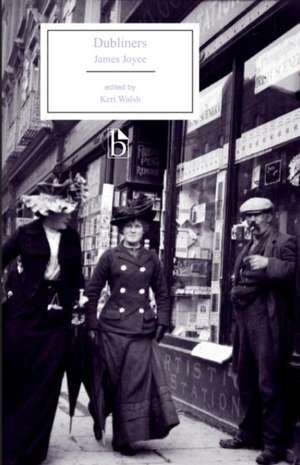
Dubliners
Autor James Joyce Editat de Keri Walshen Limba Engleză Paperback – 11 iul 2016
Poate oare un singur moment de iluminare să răscumpere o viață marcată de paralizie socială și rutină? Notăm cu interes cum Dubliners nu este doar o colecție de cincisprezece povestiri, ci o hartă morală a unui oraș surprins la răscrucea istoriei. James Joyce construiește aici un portret naturalist al clasei de mijloc irlandeze, înlocuind judecățile morale directe, întâlnite la autori precum Charles Dickens, cu o observație fină, aproape chirurgicală, a detaliului cotidian. Considerăm că forța acestui volum rezidă în conceptul de „epifanie” — acea clipă în care personajele experimentează o înțelegere profundă, dar adesea tardivă, a propriei condiții. Dacă Ulysses v-a captivat prin complexitatea sa enciclopedică și fluxul conștiinței, Dubliners extinde experiența în direcția unei simplități rafinate, oferind rădăcinile multor personaje care vor popula capodopera sa ulterioară. Credem că organizarea volumului este esențială pentru înțelegerea viziunii autorului: cuprinsul reflectă o progresie biologică și spirituală, pornind de la inocența din „The Sisters” sau „Araby”, trecând prin dilemele maturității în „A Painful Case”, și culminând cu meditația existențială din „The Dead”. Spre deosebire de James Joyce: Poems, unde temele intime precum gelozia sunt explorate liric, aici ele sunt ancorate în geografia precisă a străzilor din Dublin, transformând orașul într-un personaj colectiv ce exercită o presiune constantă asupra voinței individuale. Stilul este sobru, Joyce lăsând obiectele și gesturile să vorbească, o tehnică ce prefigurează modernismul radical din A Portrait of the Artist as a Young Man.
Preț: 153.88 lei
Preț vechi: 186.61 lei
-18%
Carte disponibilă
Livrare economică 02-16 noiembrie
Livrare express 17-23 octombrie pentru 60.27 lei
Specificații
ISBN-10: 1554811228
Pagini: 336
Dimensiuni: 140 x 216 x 16 mm
Greutate: 0.38 kg
Editura: BROADVIEW PR
Colecția Broadview Press
Locul publicării:Peterborough, Canada
V-ar putea interesa
-
 BelovedToni Morrison-18%Preț: 59.33 lei72.43 lei
 -
 The Old Man and the SeaErnest Hemingway-29%Preț: 44.76 lei63.27 lei
 -
 Animal FarmGeorge OrwellPreț: 70.70 lei
 -
 The Heart is a Lonely HunterCarson McCullers-25%Preț: 59.66 lei79.55 lei
 -
 I, ClaudiusRobert Graves-36%Preț: 60.71 lei94.17 lei
 -
 The Spy and the TraitorBen Macintyre-25%Preț: 64.45 lei85.81 lei
 -
 In Order to LiveYeonmi Park-26%Preț: 63.03 lei84.99 lei
 -
 Ficciones / FictionsJorge Luis BorgesPreț: 99.64 lei
 -
 El Aleph / The AlephJorge Luis BorgesPreț: 100.67 lei
 -
 Stranger in a Strange LandRobert A. Heinlein-24%Preț: 72.23 lei95.60 lei
 -
 -23%Preț: 62.43 lei81.52 lei
 -
 Collected Stories of Carson McCullersCarson McCullersPreț: 115.81 lei
 -
 The Feast of the GoatMario Vargas LlosaPreț: 81.10 lei
 -
 Selected StoriesNathaniel HawthornePreț: 206.68 lei
 -
 2001: A Space OdysseyArthur Charles Clarke-26%Preț: 58.70 lei79.30 lei
 -
 -16%Preț: 60.89 lei72.42 lei
 -
 Preț: 52.09 lei
 -
 WavesVirginia WoolfPreț: 36.30 lei
 -
 UlyssesJames JoycePreț: 41.38 lei
 -
 David CopperfieldCharles DickensPreț: 39.94 lei
 -
 Hunchback of Notre-DameVictor HugoPreț: 38.68 lei
 -
 The Concise Art of SeductionRobert Greene-19%Preț: 63.61 lei78.70 lei
De ce să citești această carte
Recomandăm această ediție revizuită oricărui cititor care dorește să descopere originile modernismului literar. Prin Dubliners, câștigați nu doar o serie de portrete umane memorabile, ci și acces la momentele de „epifanie” joyceene care au revoluționat proza scurtă. Este lectura ideală pentru cei care apreciază realismul psihologic și vor să înțeleagă cum mediul urban modelează identitatea individuală, totul într-o limbă engleză de o precizie uluitoare.
Despre autor
James Joyce (1882–1941) a fost un romancier și poet irlandez, figură centrală a avangardei moderniste și unul dintre cei mai influenți scriitori ai secolului XX. Născut în Dublin, Joyce și-a petrecut cea mai mare parte a vieții în exil autoimpus în orașe precum Trieste, Paris și Zürich, însă întreaga sa operă a rămas ancorată în universul orașului natal. Renumit pentru tehnica fluxului conștiinței din Ulysses și pentru experimentele lingvistice radicale din Finnegans Wake, Joyce a debutat în proză cu volumul de povestiri Dubliners, demonstrând o capacitate extraordinară de a surprinde esența condiției umane prin detalii aparent banale.
Descriere
This new edition’s historical appendices include contemporary reviews (among them one by Ezra Pound) and materials on religion, the struggle for Irish independence, and Dublin’s musical and performance culture.
Recenzii
This new edition’s historical appendices include contemporary reviews (among them one by Ezra Pound) and materials on religion, the struggle for Irish independence, and Dublin’s musical and performance culture.
“Keri Walsh’s Broadview edition of Dubliners will deepen and enliven any reader’s experience of Joyce’s book. Included here are extensive appendices of primary materials that contextualize Joyce’s fictional world in terms of Ireland’s social, cultural, religious, and economic history, and in terms of the book’s troubled publication history, its early reception, and its place in literary history. Walsh’s introductory essay lays out the stakes of Joyce’s fraught relationship with Dublin and its denizens with clarity, concision, wit, and readability. Nowhere else have I read Joyce’s early life and work so essentially distilled, and rarely have I read Dubliners so artfully described. I expect Walsh’s Broadview edition of Dubliners to be around for a long time to come.” — Michael Rubenstein, Stony Brook University
“Keri Walsh, as we already know from her collection of Sylvia Beach’s letters, is an archivist who blends the conscience of an ethnographer with the touch of a lover. She has achieved something genuinely exhilarating in this edition of Dubliners — transformed us into Joyce’s contemporaries while simultaneously renewing the book as a contemporary text, richly teachable and learnable, for twenty-first century readers, students, and scholars.” — Saikat Majumdar, author of Prose of the World: Modernism and the Banality of Empire
“In an age when anthologized literary may give students the impression that the texts they are given to study arrived already canonized, Walsh’s approach—the provision of text, subtext, pretext, and context—allows an appreciation of the contingency of both creation and reputation, and is therefore an approach full of merit.” —Stephen Whittaker, James Joyce Literary Supplement
“Walsh’s entertaining prose moves competently and gracefully among many aspects of Dublin life and Irish history that have an immediate bearing on the stories … Deftly juggling and ordering so many layers of concerns, Walsh’s essay gives and ideal opening performance, drawing out questions and alerting readers to the details and controversies of the stories while refraining from editorializing or providing a simple, singular answer. In this sense, it makes a nicely polished critical looking glass that opens up many reflective possibilities for readers of Dubliners … The stories are evenly and skillfully annotated by Walsh; the level and depth of her notes also sustain the historical and cultural contexts developed in the critical essay and supplementary materials … Her annotative style is disciplined and concise, providing just the right amount of information about archaic vocabulary or arcane allusions. At their best, her annotations show readers the active interpretive choices that confront them in particular moments.” — Greg Winston, James Joyce Quarterly
Cuprins
Introduction
James Joyce: A Brief Chronology
A Note on the Text
Dubliners
- The Sisters
- An Encounter
- Araby
- Eveline
- After the Race
- Two Gallants
- The Boarding House
- A Little Cloud
- Counterparts
- Clay
- A Painful Case
- Ivy Day in the Committee Room
- A Mother
- Grace
- The Dead
- 1. Times Literary Supplement (18 June 1914)
- 2. From Athenaeum (20 June 1914)
- 3. From New Statesman (27 June 1914)
- 4. Everyman Review (3 July 1914)
- 5. Academy (11 July 1914)
- 6. From Ezra Pound, “Dubliners and Mr. James Joyce,” The Egoist (15 July 1914)
- 7. Irish Book Lover (November 1914)
- 1. From Matthew Arnold, “On the Study of Celtic Literature” (1867)
- 2. From Padraic Colum, “With James Joyce in Ireland,” The New York Times Book Review (11 June 1922)
- 3. From Henry James, “The Story-Teller at Large: Mr. Henry Harland,” The Fortnightly Review (April 1898)
- 4. From Émile Zola, Preface to Thérèse Raquin: A Realistic Novel (1887)
- 5. Caroline Sheridan Norton, “The Arab’s Farewell to His Horse” (1830)
- 6. From W.B. Yeats, “Ireland and the Arts” (1901)
- 7. From John Eglinton, “The Philosophy of the Celtic Movement” (1918)
- 1. From Augusta Gregory, “West Irish Ballads” (1903)
- 2. Charles Dibdin, “The Lass that Loves a Sailor” (1811)
- 3. George Linley, “Arrayed for the Bridal” (1835)
- 4. Anonymous, “The Lass of Aughrim” (date unknown)
- 5. Alfred Bunn and Michael William Balfe, “I Dreamt I Dwelt in Marble Halls” (“The Dream”) (1843)
- 6. “Dougherty’s Boarding House” (1909)
- 1. From Rev. Michael J. Henry, “A Century of Irish Emigration” (1900)
- 2. From Maud Gonne, “Ways of Checking Emigration,” United Irishman (15 October 1901)
- 3. Philip Francis Little, “Farewell to the Land,” The New Ireland Review (September 1901)
- 4. From Sophie Raffalovich O’brien, “Parents and Children” (1904)
- 1. From Charles Stewart Parnell’s Address in Cork, Cork Examiner (22 January 1885)
- 2. From Katharine Tynan, “The Parnell Split” (1912)
- 3. From Filson Young, “Holy Ireland” (1903)
- 4. Maud Gonne, “The Famine Queen,” United Irishman (7 April 1900)
- 5. From Michael J.F. McCarthy, “In Catholic Dublin” (1903)
Textul de pe ultima copertă
Today, however, the stories are admired for their intense and masterly dissection of "dear dirty Dublin," and for the economy and grace with which Joyce invested this youthful fiction. From "The Sisters," the first story, illuminating a young boy's initial encounter with death, through the final piece, "The Dead," considered a masterpiece of the form, these tales represent, as Joyce himself explained, a chapter in the moral history of Ireland that would give the Irish "one good look at themselves." But in the end the stories are not just about the Irish; they represent moments of revelation common to all people.
Now readers can enjoy all 15 stories in this inexpensive collection, which also functions as an excellent, accessible introduction to the work of one of the 20th century's most influential writers. "Dubliners" is reprinted here, complete and unabridged, from a standard edition."
Notă biografică
Extras
There was no hope for him this time: it was the third stroke. Night after night I had passed the house (it was vacation time) and studied the lighted square of window: and night after night I had found it lighted in the same way, faintly and evenly. If he was dead, I thought, I would see the reflection of candles on the darkened blind for I knew that two candles must be set at the head of a corpse. He had often said to me: "I am not long for this world," and I had thought his words idle. Now I knew they were true. Every night as I gazed up at the window I said softly to myself the word paralysis. It had always sounded strangely in my ears, like the word gnomon in the Euclid and the word simony in the Catechism. But now it sounded to me like the name of some maleficent and sinful being. It filled me with fear, and yet I longed to be nearer to it and to look upon its deadly work.
Old Cotter was sitting at the fire, smoking, when I came downstairs to supper. While my aunt was ladling out my stirabout he said, as if returning to some former remark of his: "No, I wouldn't say he was exactly . . . but there was something queer . . . there was something uncanny about him. I'll tell you my opinion. . . ." He began to puff at his pipe, no doubt arranging his opinion in his mind. Tiresome old fool! When we knew him first he used to be rather interesting, talking of faints and worms; but I soon grew tired of him and his endless stories about the distillery.
"I have my own theory about it," he said. "I think it was one of those . . . peculiar cases. . . . But it's hard to say. . . ." He began to puff again at his pipe without giving us his theory. My uncle saw me staring and said to me: "Well, so your old friend is gone, you'll be sorry to hear."
"Who?" said I.
"Father Flynn."
"Is he dead?"
"Mr. Cotter here has just told us. He was passing by the house."
I knew that I was under observation so I continued eating as if the news had not interested me. My uncle explained to old Cotter.
"The youngster and he were great friends. The old chap taught him a great deal, mind you; and they say he had a great wish for him."
"God have mercy on his soul," said my aunt piously.
Old Cotter looked at me for a while. I felt that his little beady black eyes were examining me but I would not satisfy him by looking up from my plate. He returned to his pipe and finally spat rudely into the grate.
"I wouldn't like children of mine," he said, "to have too much to say to a man like that."
"How do you mean, Mr. Cotter?" asked my aunt.
"What I mean is," said old Cotter, "it's bad for children. My idea is: let a young lad run about and play with young lads of his own age and not be . . . Am I right, Jack?"
"That's my principle, too," said my uncle. "Let him learn to box his corner. That's what I'm always saying to that Rosicrucian there: take exercise. Why, when I was a nipper every morning of my life I had a cold bath, winter and summer. And that's what stands to me now. Education is all very fine and large. . . . Mr. Cotter
might take a pick of that leg of mutton," he added to my aunt.
"No, no, not for me," said old Cotter.
My aunt brought the dish from the safe and put it on the table. "But why do you think it's not good for children, Mr. Cotter?" she asked.
"It's bad for children," said old Cotter, "because their minds are so impressionable. When children see things like that, you know, it has an effect..."
I crammed my mouth with stirabout for fear I might give utterance to my anger. Tiresome old red-nosed imbecile!
It was late when I fell asleep. Though I was angry with old Cotter for alluding to me as a child, I puzzled my head to extract meaning from his unfinished sentences. In the dark of my room I imagined that I saw again the heavy grey face of the paralytic. I drew the blankets over my head and tried to think of Christmas. But the grey face still followed me. It murmured; and I understood that it desired to confess something. I felt my soul receding into some pleasant and vicious region; and there again I found it waiting for me. It began to confess to me in a murmuring voice and I wondered why it smiled continually and why the lips were so moist with spittle. But then I remembered that it had died of paralysis and I felt that I too was smiling feebly as if to absolve the simoniac of his sin.
The next morning after breakfast I went down to look at the little house in Great Britain Street. It was an unassuming shop, registered under the vague name of Drapery. The drapery consisted mainly of children's bootees and umbrellas; and on ordinary days a notice used to hang in the window, saying: Umbrellas Re-covered. No notice was visible now for the shutters were up. A crape bouquet was tied to the door-knocker with ribbon. Two poor women and a telegram boy were reading the card pinned on the crape. I also approached and read:
July 1st, 1895
The Rev. James Flynn (formerly of S. Catherine's Church,
Meath Street), aged sixty-five years.
R. I. P.
The reading of the card persuaded me that he was dead and I was disturbed to find myself at check. Had he not been dead I would have gone into the little dark room behind the shop to find him sitting in his arm-chair by the fire, nearly smothered in his great-coat. Perhaps my aunt would have given me a packet of High Toast for him and this present would have roused him from his stupefied doze. It was always I who emptied the packet into his black snuff-box for his hands trembled too much to allow him to do this without spilling half the snuff about the floor. Even as he raised his large trembling hand to his nose little clouds of smoke dribbled through his fingers over the front of his coat. It may have been these constant showers of snuff which gave his ancient priestly garments their green faded look for the red handkerchief, blackened, as it always was, with the snuff-stains of a week, with which he tried to brush away the fallen grains, was quite inefficacious.
I wished to go in and look at him but I had not the courage to knock. I walked away slowly along the sunny side of the street, reading all the theatrical advertisements in the shop-windows as I went. I found it strange that neither I nor the day seemed in a mourning mood and I felt even annoyed at discovering in myself a sensation of freedom as if I had been freed from something by his death. I wondered at this for, as my uncle had said the night before, he had taught me a great deal. He had studied in the Irish college in Rome and he had taught me to pronounce Latin properly. He had told me stories about the catacombs and about Napoleon Bonaparte, and he had explained to me the meaning of the different ceremonies of the Mass and of the different vestments worn by the priest. Sometimes he had amused himself by putting difficult questions to me, asking me what one should do in certain circumstances or whether such and such sins were mortal or venial or only imperfections. His questions showed me how complex and mysterious were certain institutions of the Church which I had always regarded as the simplest acts. The duties of the priest towards the Eucharist and towards the secrecy of the confessional seemed so grave to me that I wondered how anybody had ever found in himself the courage to undertake them; and I was not surprised when he told me that the fathers of the Church had written books as thick as the Post Office Directory and as closely printed as the law notices in the newspaper, elucidating all these intricate questions. Often when I thought of this I could make no answer or only a very foolish and halting one upon which he used to smile and nod his head twice or thrice. Sometimes he used to put me through the responses of the Mass which he had made me learn by heart; and, as I pattered, he used to smile pensively and nod his head, now and then pushing huge pinches of snuff up each nostril alternately. When he smiled he used to uncover his big discoloured teeth and let his tongue lie upon his lower lip--a habit which had made me feel uneasy in the beginning of our acquaintance before I knew him well.
As I walked along in the sun I remembered old Cotter's words and tried to remember what had happened afterwards in the dream. I remembered that I had noticed long velvet curtains and a swinging lamp of antique fashion. I felt that I had been very far away, in some land where the customs were strange--in Persia, I thought. . . . But I could not remember the end of the dream.
In the evening my aunt took me with her to visit the house of mourning. It was after sunset; but the window-panes of the houses that looked to the west reflected the tawny gold of a great bank of clouds. Nannie received us in the hall; and, as it would have been unseemly to have shouted at her, my aunt shook hands with her for all. The old woman pointed upwards interrogatively and, on my aunt's nodding, proceeded to toil up the narrow staircase before us, her bowed head being scarcely above the level of the banister-rail. At the first landing she stopped and beckoned us forward encouragingly towards the open door of the dead-room. My aunt went in and the old woman, seeing that I hesitated to enter, began to beckon to me again repeatedly with her hand.
I went in on tiptoe. The room through the lace end of the blind was suffused with dusky golden light amid which the candles looked like pale thin flames. He had been coffined. Nannie gave the lead and we three knelt down at the foot of the bed. I pretended to pray but I could not gather my thoughts because the old woman's mutterings distracted me. I noticed how clumsily her skirt was hooked at the back and how the heels of her cloth boots were trodden down all to one side. The fancy came to me that the old priest was smiling as he lay there in his coffin.
But no. When we rose and went up to the head of the bed I saw that he was not smiling. There he lay, solemn and copious, vested as for the altar, his large hands loosely retaining a chalice. His face was very truculent, grey and massive, with black cavernous nostrils and circled by a scanty white fur. There was a heavy odour in the room--the flowers.
We crossed ourselves and came away. In the little room downstairs we found Eliza seated in his arm-chair in state. I groped my way towards my usual chair in the corner while Nannie went to the sideboard and brought out a decanter of sherry and some wine-glasses. She set these on the table and invited us to take a little glass of wine. Then, at her sister's bidding, she filled out the sherry into the glasses and passed them to us. She pressed me to take some cream crackers also but I declined because I thought I would make too much noise eating them. She seemed to be somewhat disappointed at my refusal and went over quietly to the sofa where she sat down behind her sister. No one spoke: we all gazed at the empty fireplace.
My aunt waited until Eliza sighed and then said: "Ah, well, he's gone to a better world."
Eliza sighed again and bowed her head in assent. My aunt fingered the stem of her wine-glass before sipping a little. "Did he . . . peacefully?" she asked.
"Oh, quite peacefully, ma'am," said Eliza. "You couldn't tell when the breath went out of him. He had a beautiful death, God be praised."
"And everything . . . ?"
"Father O'Rourke was in with him a Tuesday and anointed him and prepared him and all."
"He knew then?"
"He was quite resigned."
"He looks quite resigned," said my aunt.
"That's what the woman we had in to wash him said. She said he just looked as if he was asleep, he looked that peaceful and resigned. No one would think he'd make such a beautiful corpse."
"Yes, indeed," said my aunt.
She sipped a little more from her glass and said:
"Well, Miss Flynn, at any rate it must be a great comfort for you to know that you did all you could for him. You were both very kind to him, I must say."
Eliza smoothed her dress over her knees.
"Ah, poor James!" she said. "God knows we done all we could, as poor as we are--we wouldn't see him want anything while he was in it."
Nannie had leaned her head against the sofa-pillow and seemed about to fall asleep.
"There's poor Nannie," said Eliza, looking at her, "she's wore out. All the work we had, she and me, getting in the woman to wash him and then laying him out and then the coffin and then arranging about the Mass in the chapel. Only for Father O'Rourke I don't know what we'd done at all. It was him brought us all them flowers and them two candlesticks out of the chapel and wrote out the notice for the Freeman's General and took charge of all the papers for the cemetery and poor James's insurance."
"Wasn't that gooda of him?" said my aunt.
Eliza closed her eyes and shook her head slowly. "Ah, there's no friends like the old friends," she said, "when all is said and done, no friends that a body can trust."
"Indeed, that's true," said my aunt. "And I'm sure now that he's gone to his eternal reward he won't forget you and all your kindness to him."
"Ah, poor James!" said Eliza. "He was no great trouble to us. You wouldn't hear him in the house any more than now. Still, I know he's gone and all to that. . . ."
"It's when it's all over that you'll miss him," said my aunt.
"I know that," said Eliza. "I won't be bringing him in his cup of beef-tea any more, nor you, ma'am, sending him his snuff. Ah, poor James!"
She stopped, as if she were communing with the past, and then said shrewdly:
"Mind you, I noticed there was something queer coming over him latterly. Whenever I'd bring in his soup to him there I'd find him with his breviary fallen to the floor, lying back in the chair and his mouth open."
From the Paperback edition.