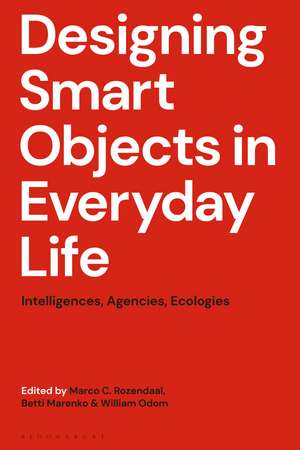
Designing Smart Objects in Everyday Life: Intelligences, Agencies, Ecologies: Bloomsbury Visual Arts
Editat de Marco C. Rozendaal, Betti Marenko, William Odomen Limba Engleză Hardback – 12 aug 2021
By offering a critical assessment on the growing place of smart technology in everyday environments, this book outlines a transdisciplinary research agenda for the future of 'smartness' to help define, envision, and inspire future collaborative design practices. These essays propose an understanding and design of smart objects that embrace their hybrid nature as shifting and blending tools, agents, machines, or even 'creatures'. Authors argue that smart objects have the potential to enter into multiple kinds of relationships with humans, and form complex human-nonhuman ecologies that are both meaningful and empowering in the context of everyday life. This book also shines a light on the hidden infrastructures behind the functioning of smart objects with stirring debates tackling questions of technology, human values, and economic and ecological impact.
Whether you are a design scholar, design practitioner or design activist this book will inspire through offering theoretical insights, design concepts and practical ways on how to engage in this research agenda for future smartness.
Din seria Bloomsbury Visual Arts
- 33%
 Preț: 118.78 lei
 - 36%
 Preț: 565.96 lei
 - 19%
 Preț: 186.85 lei
 - 35%
 Preț: 571.05 lei
 - 30%
 Preț: 526.48 lei
 - 35%
 Preț: 572.92 lei
 - 28%
 Preț: 202.84 lei
 - 30%
 Preț: 523.63 lei
 - 16%
 Preț: 160.36 lei
 - 6%
 Preț: 231.52 lei
 - 9%
 Preț: 244.61 lei
 - 34%
 Preț: 233.62 lei
 - 35%
 Preț: 610.08 lei
 - 17%
 Preț: 184.45 lei
 - 31%
 Preț: 455.20 lei
 - 48%
 Preț: 123.91 lei
 - 32%
 Preț: 601.53 lei
 - 36%
 Preț: 565.15 lei
 - 44%
 Preț: 158.94 lei
 - 23%
 Preț: 191.39 lei
 - 16%
 Preț: 162.81 lei
 - 26%
 Preț: 190.34 lei
 - 22%
 Preț: 207.67 lei
 - 24%
 Preț: 162.59 lei
 - 25%
 Preț: 215.17 lei
 - 18%
 Preț: 180.93 lei
 - 22%
 Preț: 221.88 lei
 - 31%
 Preț: 612.17 lei
 - 25%
 Preț: 212.63 lei
 - 36%
 Preț: 553.25 lei
 - 35%
 Preț: 607.68 lei
 - 9%
 Preț: 303.14 lei
 - 30%
 Preț: 544.72 lei
 - 34%
 Preț: 106.70 lei
 - 27%
 Preț: 214.46 lei
 -
 Preț: 317.03 lei
 - 23%
 Preț: 186.77 lei
 - 26%
 Preț: 218.79 lei
 - 31%
 Preț: 741.79 lei
 - 35%
 Preț: 637.35 lei
 - 32%
 Preț: 553.58 lei
 - 27%
 Preț: 193.31 lei
 - 30%
 Preț: 527.16 lei
 - 32%
 Preț: 554.37 lei
 - 25%
 Preț: 211.42 lei
 - 21%
 Preț: 267.18 lei
 - 30%
 Preț: 582.78 lei
 - 20%
 Preț: 344.66 lei
 - 26%
 Preț: 220.06 lei
Preț: 551.24 lei
Preț vechi: 864.48 lei
-36%
Puncte Express: 827
Carte disponibilă
Livrare economică 16-30 noiembrie
Livrare prin curier în România Termenul estimat este afișat lângă disponibilitate.
Transport gratuit pentru acest produs Plată online sau ramburs, în funcție de opțiunile comenzii.
Retur gratuit în 14 zile Comandă securizată și suport în română.
Specificații
ISBN-13: 9781350160125
ISBN-10: 1350160121
Pagini: 224
Ilustrații: 14 bw illus
Dimensiuni: 158 x 236 x 16 mm
Greutate: 0.5 kg
Editura: Bloomsbury Publishing
Colecția Bloomsbury Visual Arts
Seria Bloomsbury Visual Arts
Locul publicării:London, United Kingdom
ISBN-10: 1350160121
Pagini: 224
Ilustrații: 14 bw illus
Dimensiuni: 158 x 236 x 16 mm
Greutate: 0.5 kg
Editura: Bloomsbury Publishing
Colecția Bloomsbury Visual Arts
Seria Bloomsbury Visual Arts
Locul publicării:London, United Kingdom
V-ar putea interesa
-
 Shared WisdomAlex PentlandPreț: 153.35 lei
 -
 Preț: 393.50 lei
 -
 More-Than-Human Design in PracticeAnton Poikolainen RosénPreț: 365.62 lei
 -
 The Power of Design and Convergence of AITai Lee Siang-20%Preț: 419.95 lei524.93 lei
 -
 Preț: 122.17 lei
 -
 -17%Preț: 214.86 lei258.09 lei
 -
 -13%Preț: 213.04 lei244.24 lei
 -
 Design Philosophy after the Technology TurnDr Fernando Secomandi-32%Preț: 567.84 lei832.73 lei
 -
 Designing the Domestic PosthumanColbey Emmerson Reid-21%Preț: 184.85 lei235.43 lei
 -
 The Care of ThingsJerome DenisPreț: 237.50 lei
 -
 Preț: 140.14 lei
 -
 A Studious Use: Designing From The UndercommonsGiovanni Marmont-18%Preț: 135.71 lei166.13 lei
 -
 -18%Preț: 88.10 lei107.57 lei
 -
 Radical TechnologiesAdam GreenfieldPreț: 78.19 lei
 -
 The Social Object: Apprehending Materiality for Industrial Design PracticeSoumitri Varadarajan-23%Preț: 706.02 lei916.90 lei
 -
 Design Behind InteractionUmberto Tolino-20%Preț: 325.03 lei406.29 lei
 -
 -18%Preț: 354.33 lei432.82 lei
 -
 Interface Cultures: Artistic Aspects of InteractionChrista Sommerer-22%Preț: 266.86 lei340.81 lei
 -
 -15%Preț: 473.36 lei556.89 lei
Cuprins
Foreword
Introduction
Perspectives
1. An Illustrated Field Guide to Fungal AI for Designers, David Kirk (Northumbria University, UK), Effie Le Moignan and David Verweij (Newcastle University, UK)
2. Dramaturgy of Devices: Theatre as Perspective on the Design of Smart Objects, Maaike Bleeker (Utrecht University, the Netherlands) and Marco C. Rozendaal (TU Delft, the Netherlands)
3. The Telling of Things: Imagining With, Through and About Machines, Kristina Andersen (Eindhoven University of Technology, the Netherlands) and Tobias Revell (London College of Communication, UK)
Interactions
4. What are you? Negotiating Relationships with Smart Objects in Intra-Action, Christopher Frauenberger (TU Wien, Austria)
5. The Dynamic Agency of Smart Objects, Jelle van Dijk (University of Twente, the Netherlands) and Evert van Beek (TU Delft, the Netherlands)
6. What can Actor-Network Theory Reveal about the Socio-Technological Implications of Delivery Robots? Nazli Cila (TU Delft, the Netherlands) and Carl DiSalvo (Georgia Institute of Technology, USA)
Methodologies
7. Sketching and Prototyping Smart Objects, Philip van Allen (ArtCenter College of Design, USA)
8. Co-Designing and Co-Speculating on Different Forms of Domestic Smart Things , William Odom (Simon Fraser University, Canada), Arne Berge (Technische Universität Chemnitz, Germany) and Dries De Roeck (Studio Dott, Belgium)
Critical Understandings
9. Marx in the Smart Living Room: What Would a Marx-Oriented Approach to Smart Objects Be Like? Betti Marenko (Central Saint Martins, UK) and Pim Haselager (Radboud University Nijmegen, the Netherlands)
10. Not a Research Agenda for Smart Objects, Ann Light (University of Sussex, UK and Malmö University, Finland)
11. Towards Wise Objects: The Value of Knowing When to Quit, Pim Haselager (Radboud University Nijmegen, the Netherlands)
Conclusion
Index
Introduction
Perspectives
1. An Illustrated Field Guide to Fungal AI for Designers, David Kirk (Northumbria University, UK), Effie Le Moignan and David Verweij (Newcastle University, UK)
2. Dramaturgy of Devices: Theatre as Perspective on the Design of Smart Objects, Maaike Bleeker (Utrecht University, the Netherlands) and Marco C. Rozendaal (TU Delft, the Netherlands)
3. The Telling of Things: Imagining With, Through and About Machines, Kristina Andersen (Eindhoven University of Technology, the Netherlands) and Tobias Revell (London College of Communication, UK)
Interactions
4. What are you? Negotiating Relationships with Smart Objects in Intra-Action, Christopher Frauenberger (TU Wien, Austria)
5. The Dynamic Agency of Smart Objects, Jelle van Dijk (University of Twente, the Netherlands) and Evert van Beek (TU Delft, the Netherlands)
6. What can Actor-Network Theory Reveal about the Socio-Technological Implications of Delivery Robots? Nazli Cila (TU Delft, the Netherlands) and Carl DiSalvo (Georgia Institute of Technology, USA)
Methodologies
7. Sketching and Prototyping Smart Objects, Philip van Allen (ArtCenter College of Design, USA)
8. Co-Designing and Co-Speculating on Different Forms of Domestic Smart Things , William Odom (Simon Fraser University, Canada), Arne Berge (Technische Universität Chemnitz, Germany) and Dries De Roeck (Studio Dott, Belgium)
Critical Understandings
9. Marx in the Smart Living Room: What Would a Marx-Oriented Approach to Smart Objects Be Like? Betti Marenko (Central Saint Martins, UK) and Pim Haselager (Radboud University Nijmegen, the Netherlands)
10. Not a Research Agenda for Smart Objects, Ann Light (University of Sussex, UK and Malmö University, Finland)
11. Towards Wise Objects: The Value of Knowing When to Quit, Pim Haselager (Radboud University Nijmegen, the Netherlands)
Conclusion
Index
Recenzii
Designing Smart Objects in Everyday Life is a compelling study of the intelligences, agencies, and ecologies of "smart objects," which are responsive, online devices. The editors and authors apply rich insights about our interrelationships with smart objects to fresh ways of designing them. The various essays in this collection exemplify the corollary processes of putting theory into practice and imagination into objects. This collection will be a great asset to any designer or scholar aspiring to push the boundaries of what design can be.
The time when we could think of computational technology as something we simply use is over. The question now is how to live, and live well, with this technology as new breeds of smart objects bring artificial agency at an unprecedented scale into everyday life. To prepare design for this challenge we need to understand the dynamics, not just the static features, of this emerging landscape. We need to understand how perspectives and practices come together and form new trajectories. And that is precisely why we need this book. This is not just a snapshot, it's a collaborative choreography.
Designing objects that can learn, act and relate to humans and non-humans well is a monumental challenge. This collection provides much-needed starting points for an interaction design research agenda for addressing that challenge through expanding possibilities for thinking, making and critiquing "smart objects" and the ecologies in which they live. A sense of curiosity and care infuses the book, sparking imagination but also cultivating sensibilities for the messy implications and non-neutral consequences of things we might design and live with. It is important reading for anyone wanting to develop a wise approach to the design of smart objects.
This book took me on a roller-coaster ride through different perspectives, ideas, approaches, theory and examples. Starting from a "more than human" perspective, the book introduces, deepens, alienates, critiques, and speculates on the future of the design space of smart objects in everyday life. In doing so, it offers a compelling research agenda for connected and smart IoT. I thoroughly enjoyed reading the book and highly recommend it.
The time when we could think of computational technology as something we simply use is over. The question now is how to live, and live well, with this technology as new breeds of smart objects bring artificial agency at an unprecedented scale into everyday life. To prepare design for this challenge we need to understand the dynamics, not just the static features, of this emerging landscape. We need to understand how perspectives and practices come together and form new trajectories. And that is precisely why we need this book. This is not just a snapshot, it's a collaborative choreography.
Designing objects that can learn, act and relate to humans and non-humans well is a monumental challenge. This collection provides much-needed starting points for an interaction design research agenda for addressing that challenge through expanding possibilities for thinking, making and critiquing "smart objects" and the ecologies in which they live. A sense of curiosity and care infuses the book, sparking imagination but also cultivating sensibilities for the messy implications and non-neutral consequences of things we might design and live with. It is important reading for anyone wanting to develop a wise approach to the design of smart objects.
This book took me on a roller-coaster ride through different perspectives, ideas, approaches, theory and examples. Starting from a "more than human" perspective, the book introduces, deepens, alienates, critiques, and speculates on the future of the design space of smart objects in everyday life. In doing so, it offers a compelling research agenda for connected and smart IoT. I thoroughly enjoyed reading the book and highly recommend it.