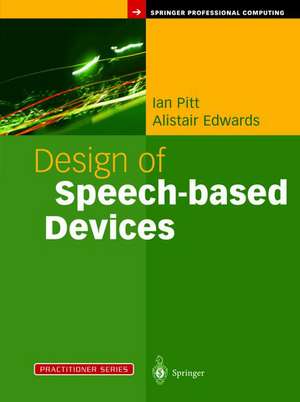
Design of Speech-based Devices: A Practical Guide: Practitioner Series
Autor Ian Pitt, Alistair Edwardsen Limba Engleză Hardback – 30 oct 2002
However, the use of speech has not been universally successful, possibly because the speech interaction is poorly designed. Speech is fundamentally different from text, and a lot of the problems may arise due to simplified text-to-speech conversion. Design of Speech-based Devices considers the problems associated with speech interaction, and offers practical solutions.
| Toate formatele și edițiile | Preț | Express |
|---|---|---|
| Paperback (1) | 316.43 lei 6-8 săpt. | |
| SPRINGER LONDON – 3 oct 2012 | 316.43 lei 6-8 săpt. | |
| Hardback (1) | 323.86 lei 6-8 săpt. | |
| SPRINGER LONDON – 30 oct 2002 | 323.86 lei 6-8 săpt. |
Din seria Practitioner Series
- 20%
 Preț: 317.55 lei
 - 20%
 Preț: 324.68 lei
 - 20%
 Preț: 620.20 lei
 - 20%
 Preț: 320.86 lei
 - 20%
 Preț: 324.03 lei
 - 20%
 Preț: 319.60 lei
 - 20%
 Preț: 313.87 lei
 - 20%
 Preț: 331.62 lei
 - 20%
 Preț: 318.00 lei
 - 20%
 Preț: 320.37 lei
 - 15%
 Preț: 621.97 lei
 - 20%
 Preț: 319.60 lei
 - 20%
 Preț: 317.23 lei
 - 20%
 Preț: 315.31 lei
 - 20%
 Preț: 315.80 lei
 - 20%
 Preț: 328.94 lei
 - 20%
 Preț: 315.93 lei
 - 20%
 Preț: 318.97 lei
 - 20%
 Preț: 313.74 lei
 - 15%
 Preț: 622.11 lei
 -
 Preț: 369.16 lei
 - 20%
 Preț: 341.61 lei
Preț: 323.86 lei
Preț vechi: 404.83 lei
-20% Nou
Puncte Express: 486
Preț estimativ în valută:
57.30€ • 66.86$ • 50.10£
57.30€ • 66.86$ • 50.10£
Carte tipărită la comandă
Livrare economică 17-31 ianuarie 26
Preluare comenzi: 021 569.72.76
Specificații
ISBN-13: 9781852334369
ISBN-10: 1852334363
Pagini: 196
Ilustrații: XI, 179 p.
Dimensiuni: 178 x 254 x 16 mm
Greutate: 0.54 kg
Ediția:2003
Editura: SPRINGER LONDON
Colecția Springer
Seria Practitioner Series
Locul publicării:London, United Kingdom
ISBN-10: 1852334363
Pagini: 196
Ilustrații: XI, 179 p.
Dimensiuni: 178 x 254 x 16 mm
Greutate: 0.54 kg
Ediția:2003
Editura: SPRINGER LONDON
Colecția Springer
Seria Practitioner Series
Locul publicării:London, United Kingdom
V-ar putea interesa
-
 -39%Preț: 182.68 lei297.30 lei
 -
 Human-in-the-Loop Simulations: Methods and PracticeLing Rothrock-20%Preț: 623.39 lei779.23 lei
 -
 Game Analytics: Maximizing the Value of Player DataMagy Seif El-Nasr-20%Preț: 759.71 lei949.63 lei
 -
 Experience Design: Concepts and Case StudiesPeter Benz-17%Preț: 233.26 lei279.96 lei
 -
 Designers, Users and JusticeTurkka Keinonen-39%Preț: 727.22 lei1191.55 lei
 -
 This is Service Design DoingMarc Stickdorn-20%Preț: 247.82 lei309.77 lei
 -
 Haptic Devices for Studies on Human Grasp and RehabilitationAlessandro Altobelli-20%Preț: 617.84 lei772.29 lei
 -
 -20%Preț: 853.85 lei1067.31 lei
 -
 -20%Preț: 894.76 lei1118.45 lei
 -
 -20%Preț: 316.59 lei395.75 lei
 -
 -20%Preț: 353.14 lei441.41 lei
 -
 Brain-Computer Interface Research: A State-of-the-Art Summary 5Christoph Guger-20%Preț: 312.62 lei390.78 lei
 -
 -20%Preț: 657.45 lei821.81 lei
 -
 -20%Preț: 975.27 lei1219.09 lei
 -
 -20%Preț: 317.05 lei396.31 lei
 -
 -20%Preț: 979.25 lei1224.06 lei
 -
 -20%Preț: 552.18 lei690.23 lei
 -
 -20%Preț: 315.48 lei394.35 lei
 -
 -20%Preț: 639.25 lei799.07 lei
 -
 -20%Preț: 402.28 lei502.84 lei
 -
 -20%Preț: 328.94 lei411.17 lei
 -
 Preț: 389.65 lei
Public țintă
Professional/practitionerCuprins
1 Introduction.- 1.1 Evolution of Speech Synthesis.- 1.2 Text to Speech.- 1.3 Copy Synthesis.- 1.4 Applications.- 1.5 Applications for Blind People.- 1.6 Limitations of Current Design Methods.- 2 Background and Previous Research.- 2.1 Pausing and Rhythm.- 2.2 Intonation.- 2.3 New versus Given Information.- 2.4 Length of Utterance.- 2.5 Meaning: More than Semantics.- 2.6 Effects of Speech Quality.- 2.7 Summary and Conclusions.- 3 Interaction Design.- 3.1 Differences Between Visual and Auditory Interfaces.- 3.2 User Selection versus Designer direction.- 3.3 Determining Relevance.- 3.4 The Role of Expectation.- 3.5 Giving the Listener Control.- 3.6 Conclusions.- 4 Dialogue Design.- 4.1 Choosing Speech or Non-speech Presentation.- 4.2 Designing Non-speech Responses.- 4.3 Designing Speech Segments.- 4.4 Major and Minor Sentences.- 4.5 Example of Designing Utterances for an Interactive System.- 4.6 Choice of Phrasing.- 4.7.1 Avoiding Ambiguity.- 4.8 Personality.- 4.9 Presenting Numbers.- 4.10 Summary.- 5 Presenting Individual Speech Dialogues.- 5.1 Intonation Patterns in Spoken English.- 5.2 Statements.- 5.3 Questions.- 5.4 Directives.- 5.5 Summary.- 6 Presenting Lists and Menus.- 6.1 Problems Posed by Spoken Lists.- 6.2 Organizing Lists and Menus to Aid Memorization.- 6.3 List Size and Memorability.- 6.4 A Speech-based, List-searching Tool.- 6.5 Using Prosody to Convey Structure and Context.- 6.6 Using Priming Information.- 6.7 Providing Summaries and Overviews.- 6.8 Summary.- 7 Case Studies.- 7.1 Introduction.- 7.2 Evaluation of the Trafficmaster Freeway.- 7.3 The SpeakEasy NT Voicemail System.- 7.4 Design of a Speaking Video Recorder Interface.- 7.5 Conclusions.- 8 Future Trends.- 8.1 Introduction.- 8.2 Technology.- 8.3 Speech as an Alternative Channel of Communication.- 8.4 Applications for Users with Special Needs.- 8.5 Speech and Mobile Devices.- 8.6 Avatars.- 8.7 Unsolved Problems and Issues.- 8.8 Conclusions.- Appendix A: List of Homophones.- Appendix B: Words with More than One Meaning.- Appendix C: Words with More than One Pronunciation.- References.
Caracteristici
Provides practical guidance when designing speech-based systems Includes case studies which examine real-life (good and bad) examples Discusses the design of speech-based devices - what information should be communicated, and how Explains how information should be presented as speech – what rhythm, pausing and intonation should be used Considers current research directions in speech technology, probable future developments and problems that remain unsolved