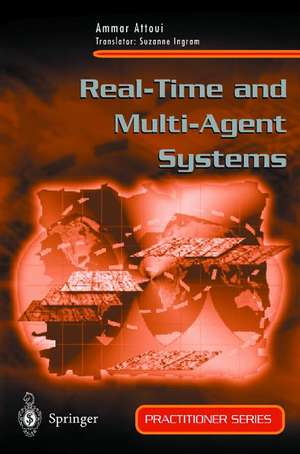
Real-Time and Multi-Agent Systems: Practitioner Series
Autor Ammar Attoui Traducere de S. Ingramen Limba Engleză Paperback – 22 sep 2000
Din seria Practitioner Series
- 20%
 Preț: 323.21 lei
 - 20%
 Preț: 620.38 lei
 - 20%
 Preț: 321.98 lei
 - 20%
 Preț: 325.07 lei
 - 20%
 Preț: 319.60 lei
 - 20%
 Preț: 315.26 lei
 - 20%
 Preț: 331.81 lei
 - 20%
 Preț: 318.00 lei
 - 20%
 Preț: 321.18 lei
 - 20%
 Preț: 346.64 lei
 - 20%
 Preț: 318.73 lei
 - 20%
 Preț: 334.59 lei
 - 20%
 Preț: 330.76 lei
 - 20%
 Preț: 317.49 lei
 - 20%
 Preț: 317.29 lei
 - 20%
 Preț: 315.77 lei
 - 20%
 Preț: 318.97 lei
 - 20%
 Preț: 315.64 lei
 - 20%
 Preț: 630.27 lei
 -
 Preț: 369.16 lei
 - 20%
 Preț: 630.77 lei
Preț: 328.94 lei
Preț vechi: 411.17 lei
-20%
Puncte Express: 493
Carte tipărită la comandă
Livrare economică 26 noiembrie-10 decembrie
Livrare prin curier în România Termenul estimat este afișat lângă disponibilitate.
Transport gratuit de la 400.00 lei Plată online sau ramburs, în funcție de opțiunile comenzii.
Retur gratuit în 14 zile Comandă securizată și suport în română.
Specificații
ISBN-13: 9781852332525
ISBN-10: 1852332522
Pagini: 488
Ilustrații: XX, 461 p. 282 illus.
Dimensiuni: 155 x 235 x 26 mm
Greutate: 0.68 kg
Ediția:Softcover reprint of the original 1st ed. 2000
Editura: SPRINGER LONDON
Colecția Springer
Seria Practitioner Series
Locul publicării:London, United Kingdom
ISBN-10: 1852332522
Pagini: 488
Ilustrații: XX, 461 p. 282 illus.
Dimensiuni: 155 x 235 x 26 mm
Greutate: 0.68 kg
Ediția:Softcover reprint of the original 1st ed. 2000
Editura: SPRINGER LONDON
Colecția Springer
Seria Practitioner Series
Locul publicării:London, United Kingdom
V-ar putea interesa
-
 -39%Preț: 182.02 lei299.58 lei
 -
 MultiprocessingVijay K Naik-20%Preț: 669.00 lei836.24 lei
 -
 The Java Ee Architect's HandbookDerek C Ashmore-20%Preț: 164.65 lei205.81 lei
 -
 Cloud ComputingArshdeep Bahga-20%Preț: 336.44 lei420.55 lei
 -
 Big Data Science & AnalyticsArshdeep Bahga-20%Preț: 432.51 lei540.64 lei
 -
 -35%Preț: 290.64 lei448.33 lei
 -
 Handbook of Distributed Sensor NetworksMarvin Heather-20%Preț: 762.36 lei952.95 lei
 -
 Measuring Organisational EfficiencyEva Kasparova-20%Preț: 121.17 lei151.46 lei
 -
 Tools for High Performance Computing 2014Christoph Niethammer-20%Preț: 363.84 lei454.79 lei
 -
 Tools for High Performance Computing 2015Andreas Knüpfer-20%Preț: 678.33 lei847.92 lei
 -
 Preț: 275.76 lei
 -
 CONCUR 2003 - Concurrency TheoryRoberto Amadio-20%Preț: 348.02 lei435.02 lei
 -
 CONCUR 2001 - Concurrency TheoryKim G. Larsen-20%Preț: 337.51 lei421.89 lei
 -
 -20%Preț: 316.23 lei395.28 lei
 -
 Parallelization in Inference SystemsBertram Fronhöfer-20%Preț: 326.68 lei408.36 lei
 -
 Parallel ComputationLaszlo Böszörmenyi-20%Preț: 319.92 lei399.90 lei
 -
 Solving Irregularly Structured Problems in ParallelAfonso Ferreira-20%Preț: 328.49 lei410.62 lei
 -
 CONCUR'99. Concurrency TheoryJos C. M. Baeten-15%Preț: 634.01 lei745.90 lei
Public țintă
Professional/practitionerCuprins
1. Problems Encountered with Distributed Systems.- 1.1 Definition of a Distributed Multi-Agent Application.- 1.2 Development of Remote Processing Systems.- 1.3 Architecture of Remote Processing Systems.- 1.4 Distributed Applications.- 1.5 Distributed System Properties.- 1.6 Activity Management in a Distributed Context.- 1.7 Process Synchronization and Resource Management.- 1.8 Validation Protocols for Global Applications.- 1.9 Fault Tolerance, Security and Protection.- 1.10 Conclusion.- 2. Interaction Models.- 2.1 New Generation Distributed Software Architecture.- 2.2 Event-Oriented Concurrent and Distributed Programming.- 2.3 Massively Parallel Processors and Distributed Programming.- 2.4 Basic Principles of Distributed Programming.- 2.5 The Method of Analysis for a Multi-Agent Application.- 2.6 Communication Channels.- 2.7 Elements of a High-Level Distributed Programming Language.- 2.8 Anonymous Communication.- 2.9 Hoare Monitors: High-Level Synchronization and Communication Tools for Parallel Machines with a Global Memory.- 2.10 The Corba Norm.- 2.11 Conclusion.- 3. PVM: Parallel Programming Tools.- 3.1 PVM Presented.- 3.2 PVM Installation.- 3.3 The User Interface or PVM Primitives.- 4. Distributed Programming under Unix.- 4.1 Unix and the Client-Server Model.- 4.2 Unix Tools for Distributed Data-Processing.- 4.3 IP Interfaces.- 4.4 TCP and UDP Data Transmission Protocols.- 4.5 Unix Tools for Distributed Programming.- 4.6 Sockets.- 4.7 Conclusion.- 5. Principles of Real-Time Data-Processing.- 5.1 Structure and Function of an Automated System.- 5.2 Combinatorial Automated Systems.- 5.3 Sequential Automated Systems.- 5.4 The GRAFCET: Synthesis Tool for Industrial Automated Systems.- 5.5 Technological Options for the Implementation of the Command Part.- 5.6 Digital Control Systems for Processes.- 5.7 The Need for an Adapted Specification Methodology.- 5.8 Process Dynamics.- 5.9 Periodic and Aperiodic Tasks.- 5.10 Basic Functions of Real-Time Kernels.- 5.11 Local Industrial Networks.- 5.12 The Development Environment of VxWorks Real-Time Applications.- 5.13 The Environment of a Multi-Agent Real-Time Application.- 5.14 Tools for the Development and Co-verification of Embedded Systems.- 5.15 CORBA Telecommunications.- 6. Prolog III and Real-Time System Engineering.- 6.1 Impact of Formal Specifications on Software Development.- 6.2 Reminder of Discrete Event Systems.- 6.3 Prolog III and the Study of Simple Real-Time Systems.- 6.4 Specification Methodology of Complex MSS Systems.- 6.5 Conclusion.- 6.6 Project 1: Modelling Distributed Systems.- 7. Parallel Image Processing.- 7.1 Presentation.- 7.2 Implementation.- 8. Client-Server Applications under Unix.- 8.1 Presentation.- 8.2 Implementation.- 8.3 Mini Project 1: “An Event Management System”.- 8.4 Mini Project 2: “A VxWorks Version of the Temporal Constraint Manager”.- 8.5 The Sources of the Temporal Constraint Management System.- 9. Control of a Product Processing Chain.- 9.1 Functioning.- 9.2 Analysis and Specification using the SA/RT (SA/SD) Method.- 9.3 Design and Implementation of the Command Part.- 10. Management of Persistent Objects.- 10.1 Presentation.- 10.2 The Object Manager (OM).- Appendix 1: Problems with Hardware-Software Layer Coupling in a Data-Processing System.- A1.1 The Target Machine.- Appendix 2: Basic Principles of Peripheral Handlers.- A2.1 Presentation.- A2.2 General Notes on Programming.- A2.3 Communication between the Kernel and the Handler.- A2.4 Installation Procedure of a New Handler under Unix.- Appendix 3: Process Management.- A3.1 Introduction.-A3.2 Scheduler Implementation Principle.- A3.3 The Scheduler and the Internal Synchronization of Handlers.- Appendix 4: Management of the Central Memory.- A4.1 The Part Supported by Hardware.- A4.2 The Paging Mechanism.- A4.3 The Segmentation Mechanism.- A4.4 Characteristics of Segment Systems.- A4.5 386 Selectors.- A4.6 Segment Descriptors.- A4.7 The Part Supported by the Kernel.- Appendix 5: Introduction to Prolog III.- A5.1 Functioning of a Logic Program.- A5.2 Prolog III.- A5.3 Accepted Expressions.- A5.4 Conclusion.- Bibligraphy.
Caracteristici
A good introduction/practitioner's guide to distributed programming Contains lots of complete examples