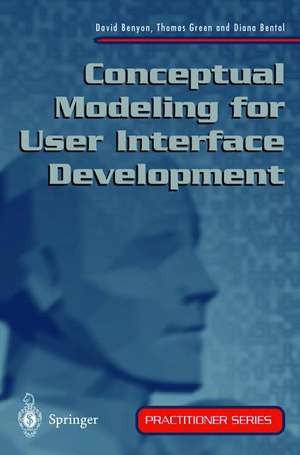
Conceptual Modeling for User Interface Development: Practitioner Series
Autor David Benyon, Thomas Green, Diana Bentalen Limba Engleză Paperback – 11 iun 1999
Din seria Practitioner Series
- 20%
 Preț: 323.21 lei
 - 20%
 Preț: 620.38 lei
 - 20%
 Preț: 321.98 lei
 - 20%
 Preț: 325.07 lei
 - 20%
 Preț: 319.60 lei
 - 20%
 Preț: 315.26 lei
 - 20%
 Preț: 331.81 lei
 - 20%
 Preț: 318.00 lei
 - 20%
 Preț: 321.18 lei
 - 20%
 Preț: 346.64 lei
 - 20%
 Preț: 318.73 lei
 - 20%
 Preț: 334.59 lei
 - 20%
 Preț: 330.76 lei
 - 20%
 Preț: 317.29 lei
 - 20%
 Preț: 328.94 lei
 - 20%
 Preț: 315.77 lei
 - 20%
 Preț: 318.97 lei
 - 20%
 Preț: 315.64 lei
 - 20%
 Preț: 630.27 lei
 -
 Preț: 369.16 lei
 - 20%
 Preț: 630.77 lei
Preț: 317.49 lei
Preț vechi: 396.87 lei
-20%
Puncte Express: 476
Carte tipărită la comandă
Livrare economică 26 noiembrie-10 decembrie
Livrare prin curier în România Termenul estimat este afișat lângă disponibilitate.
Transport gratuit de la 400.00 lei Plată online sau ramburs, în funcție de opțiunile comenzii.
Retur gratuit în 14 zile Comandă securizată și suport în română.
Specificații
ISBN-13: 9781852330095
ISBN-10: 1852330090
Pagini: 204
Ilustrații: XIII, 187 p. 13 illus.
Dimensiuni: 155 x 235 x 12 mm
Greutate: 0.32 kg
Ediția:Softcover reprint of the original 1st ed. 1999
Editura: Springer
Colecția Practitioner Series
Seria Practitioner Series
Locul publicării:London, United Kingdom
ISBN-10: 1852330090
Pagini: 204
Ilustrații: XIII, 187 p. 13 illus.
Dimensiuni: 155 x 235 x 12 mm
Greutate: 0.32 kg
Ediția:Softcover reprint of the original 1st ed. 1999
Editura: Springer
Colecția Practitioner Series
Seria Practitioner Series
Locul publicării:London, United Kingdom
V-ar putea interesa
-
 Domain Knowledge for Interactive System DesignAlistair G Sutcliffe-20%Preț: 1317.15 lei1646.44 lei
 -
 -27%Preț: 676.09 lei926.15 lei
 -
 Software Modeling and DesignHassan Gomaa-20%Preț: 665.25 lei831.56 lei
 -
 Domain Modelling for Interactive Systems DesignDavid Benyon-20%Preț: 1012.88 lei1266.09 lei
 -
 KanbanDavid J. Anderson-20%Preț: 264.20 lei330.25 lei
 -
 The Human Side of AgileGil BrozaPreț: 271.68 lei
 -
 Software EngineeringRuneson-20%Preț: 471.15 lei588.94 lei
 -
 Professional GitBrent Laster-20%Preț: 256.78 lei320.97 lei
 -
 Python AlgorithmsMagnus Lie Hetland-20%Preț: 468.00 lei584.99 lei
 -
 The Definitive Guide to HTML5 WebSocketVanessa Wang-20%Preț: 372.28 lei465.36 lei
 -
 Head First AgileAndrew Stellman-20%Preț: 343.20 lei429.00 lei
 -
 Continuous Delivery with Visual Studio ALM 2015Mathias Olausson-20%Preț: 299.70 lei374.63 lei
 -
 Butterfly In A Glass BottleThomas GreenPreț: 155.83 lei
 -
 Design It! : Pragmatic ProgrammersMicahel Keeling-20%Preț: 257.50 lei321.87 lei
 -
 Mastering ServiceNow - Second EditionMartin Wood-20%Preț: 368.74 lei460.93 lei
 -
 Reliable Software Technologies -- Ada-Europe 2006Luís Miguel Pinho-20%Preț: 320.14 lei400.17 lei
 -
 Recent Trends in Data Type SpecificationHartmut Ehrig-20%Preț: 338.45 lei423.07 lei
 -
 Principles and Practice of Constraint Programming - CP'96Eugene C. Freuder-20%Preț: 337.51 lei421.89 lei
 -
 Software Process TechnologyVolker Gruhn-20%Preț: 328.20 lei410.26 lei
 -
 Models in Software EngineeringMichel R. V. Chaudron-20%Preț: 328.29 lei410.37 lei
 -
 Hardware and Software: Verification and TestingHana Chockler-20%Preț: 318.48 lei398.10 lei
 -
 Agile Processes in Software Engineering and Extreme ProgrammingPekka Abrahamsson-20%Preț: 334.80 lei418.50 lei
 -
 Coordination Models and LanguagesJohn Field-20%Preț: 336.09 lei420.10 lei
Public țintă
Professional/practitionerCuprins
1. Modeling in User Interface Development.- 1.1 User Interface Development.- 1.2 Principles of Design.- 1.3 Models in Design.- 1.4 User Interface Development: The Functional View.- 1.5 Models of Dynamics.- 1.6 Models of Structure.- 1.7 The Role of ERMIA in User Interface Development.- 2. An Introduction to ERMIA.- 2.1 Evaluating Designs and Devices.- 2.2 ERMIA in a Nutshell.- 2.3 Information Artefacts.- 2.4 The Uses of ERMIA.- 3. The Components of an ERMIA Model.- 3.1 The Components.- 3.2 Entity.- 3.3 Relationship.- 3.4 Attribute.- 3.5 Entity, Relationship or Attribute?.- 3.6 Example: A Database of Papers Submitted to a Conference.- 3.7 Example: Telephone Network.- 4. Conceptual and Perceptual ERMIAs.- 4.1 The Information to Be Displayed versus the Display Itself.- 4.2 Manifest and Conceptual Entities and Relationships.- 4.3 Perceptually-coded Attributes.- 4.4 Example: A List Viewport.- 4.5 Distributed Conceptual Information.- 4.6 Comparing Different User Views.- 5. Searching for Information.- 5.1 Information Can Be Hard to Find.- 5.2 The Five Types of Entity Store.- 5.3 Example: The List of Flowers Revisited.- 5.4 Searching More Complex Structures.- 6. Dealing with Complex Relationships.- 6.1 Decomposing Many-to-Many Relationships.- 6.2 Different Manifest Structures Lead to Different Search.- 6.3 Making Many-to-Many Relationships Easy to Explore.- 6.4 Example: A Drum Machine Pattern Sequencer.- 6.5 Fossil Silt.- 7. Standard Structures and Safe Paths.- 7.1 Standard Structures for Search.- 7.2 Safe Trails.- 7.3 Connection Traps.- 7.4 Short Cut Keys.- 8. Representing Different Views.- 8.1 Levels of Information Artefacts.- 8.2 Example: Currency Exchange.- 8.3 Different Views Facilitate Different Tasks.- 8.4 Representing Mental Models.- 9. Developing ERMIAs.- 9.1 ERMIA as aLanguage for Design.- 9.2 Heuristics for ERMIA.- 9.3 Methodology for ERMIA.- 9.4 Case Study: The Oven Hob Problem.- 9.5 Building the ERMIA.- 10. Practical ERMIA Modeling.- 10.1 The Appointments Diary.- 10.2 The Alarm Clock.- 10.3 The ATM.- 11. Case Study.- 11.1 The Domain.- 11.2 Conceptual ERMIA of XBarnacle.- 11.3 A Perceptual ERMIA of the XBarnacle Interface.- 11.4 Using ERMIA to Identify Potential Usability Problems.- 11.5 Did the problems materialize?.- 11.6 Introducing critics: XBarnacle.- 12. Conclusions.- 12.1 ERMIA and Other Techniques.- 12.2 Choosing a Modeling Method.- 12.3 Usability Issues.- 12.4 Future Developments.- Solutions to Exercises.- Summary of Notation.- Resources.
Caracteristici
It presents an insight into some of the most important ideas in human-computer interaction Introduces the novel technique of Entity-Relationship-Modelling and shows how the technique can be applied to interface issues Uses a tutorial style, so that the technique can be picked up and used by the reader