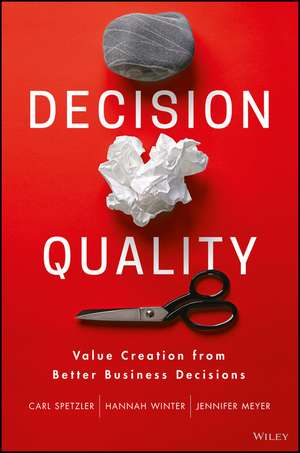
Decision Quality
Autor Carl Spetzler, Hannah Winter, Jennifer Meyeren Limba Engleză Hardback – 7 mar 2016
Considerăm că majoritatea liderilor de business se bazează pe intuiție sau pe modelul „suficient de bun”, însă Decision Quality demonstrează că succesul sustenabil este rezultatul unui proces riguros, nu al norocului. Dr. Carl Spetzler, alături de Hannah Winter și Jennifer Meyer, propune o schimbare de paradigmă: calitatea unei decizii trebuie evaluată în momentul luării ei, nu prin prisma rezultatului final, care poate fi influențat de factori externi necontrolabili. Descoperim aici un cadru de lucru structurat în șase piloni esențiali, de la definirea corectă a problemei și crearea de alternative atractive, până la clarificarea valorilor și obținerea consensului din partea partenerilor. Merită menționat că autorii nu se limitează la teorie; ei oferă instrumente analitice pentru a naviga prin incertitudine și pentru a evita capcanele cognitive care sabotează frecvent procesul deliberativ. Ca și Ruben Ugarte în Bulletproof Decisions, autorii distilează experiență reală în principii acționabile, oferind o metodă sistematică pentru a gestiona complexitatea deciziilor strategice. Diferența majoră rezidă în profunzimea academică a lui Spetzler, care reușește să transforme știința deciziei într-un ghid practic pentru corporații. Textul este dens, orientat spre eficiență, fiind ideal pentru cei care doresc să elimine subiectivismul din consiliile de administrație. Structura clară și studiile de caz derivate din decenii de consultanță fac din această lucrare publicată de Wiley un instrument indispensabil pentru orice manager care urmărește să maximizeze valoarea organizației prin alegeri fundamentate.
Preț: 183.32 lei
Carte disponibilă
Livrare economică 18 decembrie 26 - 01 ianuarie 27
Livrare express 04-10 decembrie pentru 30.35 lei
Specificații
ISBN-10: 1119144671
Pagini: 256
Dimensiuni: 164 x 238 x 27 mm
Greutate: 0.41 kg
Editura: Wiley
Locul publicării:Hoboken, United States
V-ar putea interesa
-
 Thinking, Fast and SlowDaniel Kahneman-25%Preț: 92.12 lei123.57 leiRecomandat
-
 On the EdgeNate SilverPreț: 109.29 lei
-
 -25%Preț: 92.75 lei122.97 lei
-
 Thinking In BetsAnnie Duke-19%Preț: 104.02 lei127.82 lei
-
 Preț: 122.43 lei
-
 ClarityJamie SmartPreț: 89.06 lei
-
 The Elements of ChoiceEric J. JohnsonPreț: 94.74 lei
-
 Lean Change ManagmentJason LittlePreț: 176.07 lei
-
 Business AnalysisSteven P Blais-8%Preț: 473.80 lei515.01 lei
-
 Service Design for BusinessBen ReasonPreț: 156.43 lei
-
 Five Star Service: How to deliver exceptional customer serviceMichael HeppellPreț: 95.87 lei
-
 Decision Maker's Playbook, TheJulia DharPreț: 123.79 lei
-
 Preț: 136.46 lei
-
 Why Work Sucks & How To Fix ItCali ResslerPreț: 115.24 lei
-
 HBR Guide to Making Better DecisionsHarvard Business ReviewPreț: 120.68 lei
-
 Judgement at Work: Making Better ChoicesAndrew Likierman-17%Preț: 71.36 lei86.46 lei
-
 Built To LastJames Collins-22%Preț: 156.31 lei200.94 lei
-
 -20%Preț: 96.90 lei120.79 lei
-
 DecisiveChip Heath-23%Preț: 71.61 lei93.47 lei
-
 Preț: 35.00 lei
-
 -18%Preț: 100.09 lei121.80 lei
De ce să citești această carte
Această carte se adresează executivilor și managerilor care doresc să transforme luarea deciziilor dintr-o artă subiectivă într-o disciplină riguroasă. Veți învăța să identificați alternativele superioare și să separați calitatea procesului de hazardul rezultatului. Este un câștig cert pentru oricine dorește să reducă riscul de eroare în decizii strategice mari, oferind un avantaj competitiv prin claritate și structură.
Descriere scurtă
Notă biografică
HANNAH WINTER is a partner, strategy consultant, and educator with SDG, where she leads the firm's 10-year education partnership with Stanford in strategic decision making.
JENNIFER MEYER leads client engagements at SDG, resulting in hundreds of millions of dollars in added value through better strategic decisions.
More at Strategic Decisions Group's website
www.sdg.com
Cuprins
Preface xv
Part I The Decision Quality Framework 1
1 The Power of Decisions 3
Decision Quality: A Framework for Better Decisions 4
Decision Skills Can Be Learned 5
Decisions versus Outcomes 6
Key Points to Remember 8
Endnotes 9
2 The Requirements for Decision Quality 11
The Appropriate Frame 13
Creative Alternatives 13
Relevant and Reliable Information 14
Clear Values and Tradeoffs 15
Sound Reasoning 16
Commitment to Action 16
Judging the Quality of a Decision 17
Key Points to Remember 19
Endnotes 19
3 Getting to Decision Quality 21
Declaring the Need for a Decision 21
Setting the Decision Agenda 23
Understanding the Destination of Decision Quality 23
Avoiding Decision Traps and Biases 24
Designing the Decision Process through Diagnosis 25
Tailoring to Fit the Decision 30
Key Points to Remember 32
Endnotes 33
Part II The Six Requirements for DQ 35
4 The Appropriate Frame 37
A Friday Afternoon Dilemma 37
The Key Components of a Frame 39
Framing the Friday Afternoon Dilemma 41
An Extended Example: The House Decision 42
Developing an Appropriate Frame 43
The Decision Hierarchy: A Tool for Framing 44
Things That Can Go Wrong 46
Judging the Quality of a Decision Frame 47
Key Points to Remember 49
Endnotes 49
5 Creative Alternatives 51
Characteristics of Good Alternatives 53
The Strategy Table: A Tool for Defining Alternatives 56
Things That Can Go Wrong 57
Judging the Quality of Alternatives 60
Key Points to Remember 63
Endnotes 64
6 Relevant and Reliable Information 65
Information from a Decision Perspective 65
An Extended Example: Michael's Job Choice 67
Structuring the Relevant Information in a Decision 68
The Decision Tree: A Tool for Structuring a Decision 68
What is Reliable? 72
Things That Can Go Wrong 74
Judging the Quality of Information 75
Key Points to Remember 78
Endnotes 79
7 Clear Values and Tradeoffs 81
Values and Tradeoffs for Decisions 82
Michael's Values and Tradeoffs 82
Values in a Business Context 85
Making Tradeoffs in Business Decisions 86
Things That Can Go Wrong 88
Judging the Quality of Values 89
Key Points to Remember 91
Endnotes 91
8 Sound Reasoning 93
Reasoning for Michael's Job Decision 94
Reasoning in More Complex Decisions 97
The Relevance Diagram: A Tool for Structuring Complex Decisions 97
The Decision Model: A Tool for Analyzing Complex Decisions 98
The Tornado Diagram: A Tool for Displaying the Relevance of Information 99
Flying Bars: A Tool for Displaying Overall Uncertainty 102
Things That Can Go Wrong 103
When to Get Help with Reasoning 104
The Power of Iterating from a Simple Start 105
Judging the Quality of Reasoning 105
Key Points to Remember 109
Endnotes 110
9 Commitment to Action 111
Two Mindsets: Decision and Action 111
Commitment through Participation and Ownership 113
Conscious Commitment 115
Things That Can Go Wrong 115
Judging the Quality of Commitment to Action 117
Key Points to Remember 119
Part III How to Achieve DQ 121
10 Biases and Traps in Decision Making 123
Mechanisms of the Mind 123
Protection of Mindset 126
Personality and Habits 128
Faulty Reasoning 130
Automatic Associations and Relative Thinking 133
Social Influences 137
Summing Up 138
Endnotes 139
11 Megabiases that Undermine DQ 143
DQ and Megabiases 144
Megabias #1: Narrow Framing 144
Megabias #2: The Illusion of DQ 147
Megabias #3: The Agreement Trap 149
Megabias #4: The Comfort Zone Megabias 150
Megabias #5: The Advocacy/Approval Myth 152
General Guidelines for Avoiding Megabiases 154
Endnotes 154
12 Achieving Quality in Strategic Decisions 157
The Dialogue Decision Process 158
Four Phases of Dialogue 161
Every Decision Situation is Different 163
Advantages of the DDP 164
13 Achieving Quality in Significant Decisions 169
The DQ Appraisal Cycle: Iterating Our Way to DQ 170
The DQ Appraisal Cycle in Action: Robin's Career Crossroads 176
Summing Up 187
Part IV The Journey to DQ 189
14 The Amoco Unleaded Gasoline Decision 191
Getting Started on the Unleaded Decision 194
Seeking Greater Clarity on the Key Uncertainty 196
Competing Reports 198
The Bottom Line 201
Decades of Experience in Improving Value 202
Endnote 203
15 Building Organizational Decision Quality 205
Organizational DQ 207
The Components of ODQ 207
Reaching ODQ 209
Chevron's Journey to ODQ 212
Taking the First Step 213
Endnote 214
16 Embarking on the DQ Journey 215
What Next? 216
References 219
About the Authors 223
Index 225