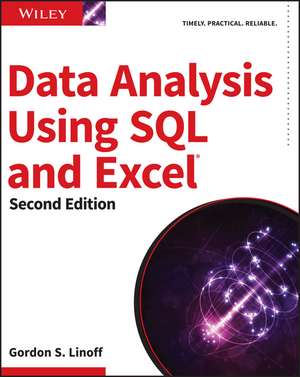
Data Analysis Using SQL and Excel, 2nd Edition
Autor Gordon S Linoffen Limba Engleză Paperback – 24 oct 2017
Descoperim în această a doua ediție revizuită a lucrării Data Analysis Using SQL and Excel, 2nd Edition un ghid pragmatic care demonstrează că analiza sofisticată a datelor nu necesită întotdeauna software-uri costisitoare de tip black-box. Aplicabilitatea practică este punctul central: autorul Gordon S Linoff ne arată cum să transformăm datele brute din tabele în informații de business utilizabile, folosind doar limbajul SQL pentru interogare și Excel pentru prezentare și analiză statistică. Observăm o progresie logică a dificultății, structurată în 14 capitole. Primele secțiuni pun bazele explorării datelor și statisticii elementare, evoluând rapid spre tehnici avansate. Găsim aici capitole detaliate despre analiza de supraviețuire pentru înțelegerea retenției clienților (churn), analiza coșului de cumpărături (market basket analysis) și modele de regresie liniară. Această ediție aduce peste 100 de pagini noi, acoperind cele mai recente funcționalități ale ambelor instrumente și punând un accent deosebit pe performanța interogărilor, esențială în lucrul cu volume mari de date. Cartea reprezintă o alternativă la Learn Data Mining Through Excel pentru cursurile de analiză a datelor sau business intelligence, cu avantajul major al integrării SQL. În timp ce alte titluri se concentrează exclusiv pe vizualizare sau pe un singur instrument, Gordon S Linoff construiește o punte între baza de date și raportul final. Această abordare continuă viziunea autorului din lucrarea sa fundamentală, Data Mining Techniques, însă o adaptează pentru utilizatorul care are nevoie de rezultate imediate pe propriul desktop, fără a trece prin complexitatea limbajelor R sau Python.
Preț: 388.97 lei
Carte disponibilă
Livrare economică 08-22 august
Specificații
ISBN-10: 111902143X
Pagini: 800
Dimensiuni: 187 x 233 x 43 mm
Greutate: 1.33 kg
Ediția:2nd Revised edition
Editura: Wiley
Locul publicării:Hoboken, United States
V-ar putea interesa
-
 SQL Queries for Mere MortalsJohn Viescas-20%Preț: 329.78 lei412.22 lei
 -
 Landscapes of CommunismOwen Hatherley-28%Preț: 87.38 lei121.58 lei
 -
 Molecular Biology: A Very Short IntroductionAysha Divan-21%Preț: 55.07 lei70.00 lei
 -
 The New Oxford Shakespeare: Modern Critical Edition: The Complete WorksWilliam Shakespeare-17%Preț: 400.16 lei482.17 lei
 -
 Plant Evolution: An Introduction to the History of LifeKarl J. NiklasPreț: 348.86 lei
 -
 Princeton Companion to MathematicsTimothy Gowers-16%Preț: 663.75 lei790.18 lei
 -
 Fundamentals of LightningVladimir A. Rakov-11%Preț: 524.66 lei589.51 lei
 -
 Bioinformatics for BiologistsPavel Pevzner-8%Preț: 517.67 lei562.68 lei
 -
 Marketing AnalyticsWayne L. Winston-20%Preț: 278.37 lei347.95 lei
 -
 Paleoecology – Past, Present and FutureDJ Bottjer-23%Preț: 438.06 lei568.91 lei
 -
 -28%Preț: 298.45 lei414.02 lei
 -
 GIS FundamentalsStephen Wise-8%Preț: 468.95 lei509.73 lei
 -
 Excel Automate ReportCeyvian C-20%Preț: 158.21 lei197.76 lei
 -
 MySQL for the Internet of ThingsCharles Bell-20%Preț: 231.29 lei289.11 lei
 -
 Learning SQL: Generate, Manipulate, and Retrieve DataAlan Beaulieu-20%Preț: 316.22 lei395.27 lei
 -
 SQL for Data AnalysisCathy Tanimura-20%Preț: 314.36 lei392.95 lei
 -
 The Definitive Guide to DaxMarco Russo-20%Preț: 312.78 lei390.98 lei
 -
 Mathematical ModellingMatti HeiliöPreț: 461.86 lei
 -
 Algebra for CryptologistsAlko R. MeijerPreț: 526.70 lei
 -
 Business Analytics with R and PythonDavid L. Olson-20%Preț: 405.64 lei507.05 lei
Public țintă
Business managers, data analysts, data miners, DBAs. Their level of technical expertise may range from MBAs who know Excel but little about databases to data miners who are not familiar with the capabilities of these toolsDe ce să citești această carte
Recomandăm această carte analiștilor de business și managerilor care doresc să extragă valoare din date fără a depinde de departamentele tehnice. Cititorul câștigă competențe duble: stăpânirea SQL pentru extragerea precisă a datelor și utilizarea Excel pentru modelare statistică avansată. Este o resursă esențială pentru oricine dorește să înțeleagă comportamentul clienților și să optimizeze performanța comercială folosind instrumente deja disponibile în orice corporație.
Despre autor
Gordon S. Linoff este un expert recunoscut la nivel internațional în domeniul minării datelor aplicate în afaceri. Este co-fondator al Data Miners, o firmă de consultanță specializată în analiza comportamentului clienților. Opera sa include titluri de referință precum Data Mining Techniques, considerată una dintre cele mai influente introduceri în domeniu. Prin lucrările sale, Linoff a contribuit la transformarea data mining-ului dintr-o disciplină de laborator într-un instrument strategic indispensabil pentru mediul de business modern, punând accent pe claritatea metodologică și pe rezultatele măsurabile.
Descriere scurtă
Data Analysis Using SQL and Excel, 2nd Edition shows you how to perform a wide range of sophisticated analyses using these simple tools, sparing you the significant expense of proprietary data mining tools like SAS.
- Understand core analytic techniques that work with SQL and Excel
- Ensure your analytic approach gets you the results you need
- Design and perform your analysis using SQL and Excel
Descriere
Learn to perform sophisticated data analysis using SQL and Excel
SQL is the essential language for querying databases, and Excel is the most popular tool for data presentation and analysis. Combined, they create a powerful, accessible tool for business data analysis. Many important types of analysis do not require complex and expensive data mining tools. The answers are on your desktop.
This no–nonsense guide, written by a leading expert on business data mining, shows you how to design and perform sophisticated data analysis using SQL and Excel. The highly regarded first edition has been revised to cover the newest enhancements to SQL and Excel, including new techniques and real–world examples. This edition features the up–to–date information business managers and data analysts need.
The book begins with the basics of SQL for data mining, Excel to present results, and simple ideas from statistics to understand your data. Core analytic techniques are explained as you learn to run them on real data using Excel and SQL. The chapters progress from basic queries to increasingly detailed applications as you learn why and when to perform specific types of analysis, how to design and perform them, and powerful ways of presenting the results. Each step explains the business context, the technical approach, and the implementation in these familiar tools.
As you progress, you′ll discover the importance of geography, how to chart changes in data over time, how to use survival analysis to understand customer tenure and churn, and the factors that affect survival. You will explore methods for analyzing customer purchases patterns, market basket analysis, and association rules. Included are important data mining models in SQL, linear regression models, naive Bayesian models, information on building a customer signature, methods for analyzing results, including cumulative gains charts and ROC charts, best practices for using SQL, and getting the best performance for your queries.
With more than 100 pages of new material, the fully revised second edition of Data Analysis Using SQL and Excel enables you to:
- Understand core analytic techniques that work with SQL and Excel
- Analyze and interpret data in a table
- Present data professionally in Excel charts
- Apply the chi–square measure and other important statistical techniques in both SQL and Excel
- Understand best practices for SQL queries, with a chapter devoted to performance
- Use survival analysis to understand time–to–event problems, both for single events and for repeated events
- Use market basket analysis to understand purchasing behavior
- Identify the analytic approach that gets the result you′re looking for
- Avoid common pitfalls
- Maximize the value of the data you have about your customers and your business
The companion website includes datasets for all examples in the book as well as related Excel spreadsheets.
www.wiley.com/go/dataanalysisusingsqlandexcel2e
Cuprins
Foreword xxxiii
Introduction xxxvii
Chapter 1 A Data Miner Looks at SQL 1
Chapter 2 What s in a Table? Getting Started with Data Exploration 49
Chapter 3 How Different Is Different? 97
Chapter 4 Where Is It All Happening? Location, Location, Location 145
Chapter 5 It s a Matter of Time 197
Chapter 6 How Long Will Customers Last? Survival Analysis to Understand Customers and Their Value 255
Chapter 7 Factors Affecting Survival: The What and Why of Customer Tenure 315
Chapter 8 Customer Purchases and Other Repeated Events 367
Chapter 9 What s in a Shopping Cart? Market Basket Analysis 421
Chapter 10 Association Rules and Beyond 465
Chapter 11 Data Mining Models in SQL 507
Chapter 12 The Best–Fit Line: Linear Regression Models 561
Chapter 13 Building Customer Signatures for Further Analysis 609
Chapter 14 Performance Is the Issue: Using SQL Effectively 655
Appendix Equivalent Constructs Among Databases 703
Index 731
Notă biografică
GORDON S. LINOFF has been working with databases for more decades than he cares to admit. He starting learning about SQL by memorizing the SQL 92 standard while leading a development team (at the now–defunct Thinking Machines Corporation) writing the first high–performance database focused on the complex queries needed for decision support.
After that endeavor, Gordon co–founded Data Miners in 1998, a consulting practice devoted to data mining, analytics, and big data. A constant theme in his work is data and often data in relational databases. His SQL skills have only gotten stronger over the years. In 2014, he was the top contributor to Stack Overflow, the leading question–and–answer–site for technical questions.
His other books include the bestselling Data Mining Techniques, Third Edition; Mastering Data Mining; and Mining the Web which focus on data mining and analysis. This book follows on the popularity of the first edition, with a practical focus on how to actually get and interpret results.