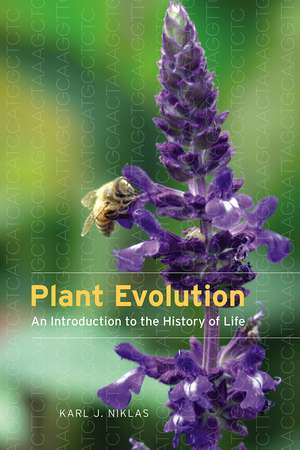
Plant Evolution: An Introduction to the History of Life
Autor Karl J. Niklasen Limba Engleză Paperback – 12 aug 2016
Recomandăm Plant Evolution ca o resursă fundamentală pentru studenții avansați, cercetătorii în botanică și practicienii din biologia evolutivă care doresc să corecteze perspectiva adesea antropocentrică sau zoocentrică asupra istoriei vieții. Remarcăm faptul că, deși plantele reprezintă peste 90% din biomasa vizibilă a planetei, teoriile evolutive actuale sunt construite predominant pe modele animale. Karl J. Niklas demonstrează riguros că plantele, prin modul lor unic de creștere și reproducere, necesită o reevaluare a conceptelor de speciație și dezvoltare.
Considerăm că forța acestui volum rezidă în capacitatea de a sintetiza domenii vaste, de la paleobotanică la genetica populațiilor. Structura cărții este una progresivă: debutează cu originile vieții și colonizarea uscatului, trece prin mecanismele genetice și biofizice ale evoluției, și culminează cu analiza macroevoluției și a multicellularității. Comparabil cu Evolutionary Biology de Mitchell B. Cruzan în rigurozitate, volumul lui Niklas se distinge prin actualizarea masivă a datelor de biologie moleculară din ultimul deceniu, oferind o perspectivă mai tehnică asupra rețelelor de reglare genetică.
Această lucrare reprezintă o evoluție firească în opera autorului, făcând trecerea de la biomecanică și alometrie — teme explorate în Plant Biomechanics și Plant Allometry — către o sinteză teoretică globală. Față de lucrarea sa anterioară, The Evolutionary Biology of Plants, acest titlu nou rafinează simulările computerizate și le integrează cu descoperiri recente despre modul în care formele vegetale răspund legilor fizice și presiunilor ecologice. Este o analiză densă, susținută de o iconografie bogată, esențială pentru înțelegerea mecanismelor care au modelat biosfera.
Preț: 390.70 lei
Carte disponibilă
Livrare economică 06-20 noiembrie
Livrare express 22-28 octombrie pentru 68.17 lei
Specificații
ISBN-10: 022634214X
Pagini: 560
Ilustrații: 144 color plates, 16 halftones, 24 line drawings, 20 tables
Dimensiuni: 152 x 229 x 36 mm
Greutate: 1.23 kg
Ediția:1
Editura: University of Chicago Press
Colecția University of Chicago Press
V-ar putea interesa
-
 ConsumedHarry WallopPreț: 114.87 lei
 -
 Statistics for Geography and Environmental ScienceRichard HarrisPreț: 414.87 lei
 -
 Landscapes of CommunismOwen Hatherley-27%Preț: 88.53 lei121.37 lei
 -
 Women's Writing on the First World WarAgnès Cardinal-19%Preț: 300.59 lei369.57 lei
 -
 Molecular Biology: A Very Short IntroductionAysha Divan-20%Preț: 57.15 lei71.12 lei
 -
 The New Oxford Shakespeare: Modern Critical Edition: The Complete WorksWilliam Shakespeare-16%Preț: 413.39 lei489.84 lei
 -
 Princeton Companion to MathematicsTimothy Gowers-16%Preț: 674.23 lei802.65 lei
 -
 Fundamentals of LightningVladimir A. Rakov-11%Preț: 564.52 lei634.30 lei
 -
 Bioinformatics for BiologistsPavel Pevzner-19%Preț: 613.67 lei757.62 lei
 -
 PaleoecologyDavid J. Bottjer-23%Preț: 471.96 lei612.94 lei
 -
 Data Analysis Using SQL and ExcelGordon S LinoffPreț: 408.25 lei
 -
 The Cultural Moment in TourismLaurajane SmithPreț: 482.99 lei
 -
 GIS FundamentalsStephen Wise-8%Preț: 468.11 lei508.81 lei
 -
 Preț: 494.17 lei
 -
 MySQL for the Internet of ThingsCharles Bell-20%Preț: 231.29 lei289.11 lei
 -
 Reality Television and ClassHelen Wood-24%Preț: 236.43 lei310.11 lei
 -
 Mathematical ModellingMatti HeiliöPreț: 475.25 lei
 -
 Algebra for CryptologistsAlko R. MeijerPreț: 547.14 lei
De ce să citești această carte
Această carte este o investiție intelectuală necesară pentru oricine dorește să înțeleagă evoluția dincolo de modelul animal. Cititorul câștigă o perspectivă integrată asupra modului în care genetica, biofizica și ecologia se întrepătrund pentru a explica diversitatea vegetală. Este o resursă rară care combină rigoarea matematică cu datele moleculare de ultimă oră, oferind instrumentele necesare pentru a preda sau a cerceta biologia plantelor la un nivel academic superior.
Despre autor
Karl J. Niklas este profesor de biologie vegetală (titular al catedrei Liberty Hyde Bailey) în cadrul Departamentului de Biologie Vegetală de la Cornell University. Cariera sa de prestigiu este marcată de o abordare interdisciplinară, fiind recunoscut pentru aplicarea principiilor matematice și fizice în studiul formelor de viață. A publicat lucrări fundamentale la University of Chicago Press, precum Plant Biomechanics și Plant Allometry, consolidându-și reputația de lider în studiul evoluției, morfologiei și fiziologiei plantelor prin prisma legilor biofizice.
Descriere scurtă
Tapping such wide-ranging topics as genetics, gene regulatory networks, phenotype mapping, and multicellularity, as well as paleobotany, Karl J. Niklas’s Plant Evolution offers fresh insight into these differences. Following up on his landmark book The Evolutionary Biology of Plants—in which he drew on cutting-edge computer simulations that used plants as models to illuminate key evolutionary theories—Niklas incorporates data from more than a decade of new research in the flourishing field of molecular biology, conveying not only why the study of evolution is so important, but also why the study of plants is essential to our understanding of evolutionary processes. Niklas shows us that investigating the intricacies of plant development, the diversification of early vascular land plants, and larger patterns in plant evolution is not just a botanical pursuit: it is vital to our comprehension of the history of all life on this green planet.
Notă biografică
Cuprins
Chapter 1: Origins and Early Events
Chapter 2: The Invasion of Land and Air
Chapter 3: Population Genetics, Adaptation, and Evolution
Chapter 4: Development and Evolution
Chapter 5: Speciation and Microevolution
Chapter 6: Macroevolution
Chapter 7: The Evolution of Multicellularity
Chapter 8: Biophysics and Evolution
Chapter 9: Ecology and Evolution
Index