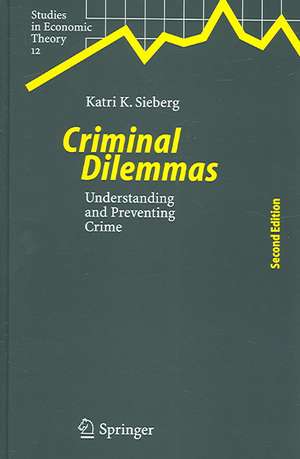
Criminal Dilemmas: Understanding and Preventing Crime: Studies in Economic Theory, cartea 12
Autor Katri K. Siebergen Limba Engleză Hardback – 8 iun 2005
In the new edition, a chapter on police corruption has been added. The Gangs chapter has been updated and focuses more on evaluating competing hypotheses about gang organization and activity.
Din seria Studies in Economic Theory
- 18%
 Preț: 988.03 lei
 -
 Preț: 410.76 lei
 - 18%
 Preț: 915.58 lei
 -
 Preț: 374.30 lei
 - 15%
 Preț: 659.45 lei
 - 15%
 Preț: 669.62 lei
 -
 Preț: 389.02 lei
 - 18%
 Preț: 1284.78 lei
 - 18%
 Preț: 1192.79 lei
 - 15%
 Preț: 663.36 lei
 - 15%
 Preț: 619.61 lei
 - 15%
 Preț: 664.01 lei
 - 15%
 Preț: 639.42 lei
 - 15%
 Preț: 619.91 lei
 - 15%
 Preț: 620.86 lei
 - 18%
 Preț: 918.30 lei
 - 15%
 Preț: 618.19 lei
 - 18%
 Preț: 914.06 lei
 - 15%
 Preț: 615.02 lei
 - 18%
 Preț: 1060.58 lei
 - 15%
 Preț: 651.93 lei
 - 15%
 Preț: 663.68 lei
 - 15%
 Preț: 676.20 lei
 -
 Preț: 404.63 lei
 - 18%
 Preț: 984.26 lei
 - 15%
 Preț: 642.59 lei
 - 18%
 Preț: 993.74 lei
 - 15%
 Preț: 673.85 lei
Preț: 374.91 lei
Puncte Express: 562
Carte tipărită la comandă
Livrare economică 08-22 decembrie
Livrare prin curier în România Termenul estimat este afișat lângă disponibilitate.
Transport gratuit de la 400.00 lei Plată online sau ramburs, în funcție de opțiunile comenzii.
Retur gratuit în 14 zile Comandă securizată și suport în română.
Specificații
ISBN-13: 9783540240099
ISBN-10: 3540240098
Pagini: 228
Ilustrații: XXII, 200 p.
Dimensiuni: 155 x 235 x 20 mm
Greutate: 0.45 kg
Ediția:2nd ed. 2005
Editura: Springer Berlin, Heidelberg
Colecția Springer
Seria Studies in Economic Theory
Locul publicării:Berlin, Heidelberg, Germany
ISBN-10: 3540240098
Pagini: 228
Ilustrații: XXII, 200 p.
Dimensiuni: 155 x 235 x 20 mm
Greutate: 0.45 kg
Ediția:2nd ed. 2005
Editura: Springer Berlin, Heidelberg
Colecția Springer
Seria Studies in Economic Theory
Locul publicării:Berlin, Heidelberg, Germany
V-ar putea interesa
-
 Forensic CasebookN E Genge-25%Preț: 120.58 lei159.96 lei
 -
 The Russian Mafia: Private Protection in a New Market EconomyFederico Varese-28%Preț: 409.42 lei567.21 lei
 -
 -12%Preț: 135.74 lei154.15 leiRecomandat
 -
 -25%Preț: 82.08 lei108.86 lei
 -
 Crime in an Insecure WorldRichard V EricsonPreț: 207.26 lei
 -
 Mr SmileyHoward Marks-34%Preț: 51.76 lei78.09 lei
 -
 -27%Preț: 1798.41 lei2450.11 lei
 -
 Tarmac WarriorBilly CribbPreț: 43.92 lei
 -
 Forensic PsychologyJoanna AdlerPreț: 404.50 lei
 -
 Basic Principles of Forensic ChemistryJaved I. Khan-5%Preț: 1072.83 lei1129.29 lei
 -
 Guantanamo and Other Cases of Enforced Medical TreatmentMirko Daniel GarasicPreț: 378.35 lei
Public țintă
GraduateCuprins
Alternative Sentencing.- Private Prisons.- Prostitution.- Drugs.- Gangs.- Gun Control.- Police.
Caracteristici
An analysis of criminal behavior from the perspectives of rational choice theory Leading to suggestions for criminal policy Includes supplementary material: sn.pub/extras