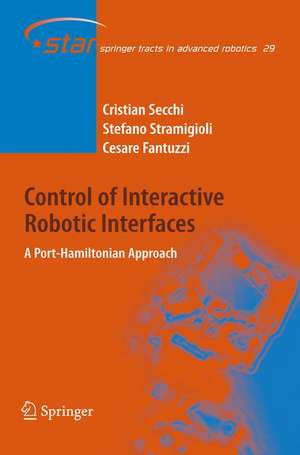
Control of Interactive Robotic Interfaces: Springer Tracts in Advanced Robotics, cartea 29
Autor Cristian Secchi, Stefano Stramigioli, Cesare Fantuzzien Limba Engleză Hardback – 15 feb 2007
Thanks to its generality, the port-Hamiltonian formalism allows to model and control also complex interactive robotic interfaces in a very natural way. In this book, a port-Hamiltonian approach for regulating the interaction between a robot and a local environment, a virtual environment (i.e. haptic interfaces) and a remote environment (i.e. bilateral telemanipulation systems) is developed.
Din seria Springer Tracts in Advanced Robotics
- 15%
 Preț: 430.39 lei
 - 18%
 Preț: 945.29 lei
 - 18%
 Preț: 924.60 lei
 -
 Preț: 460.34 lei
 -
 Preț: 434.53 lei
 - 15%
 Preț: 664.95 lei
 - 18%
 Preț: 812.83 lei
 - 20%
 Preț: 598.05 lei
 - 15%
 Preț: 664.24 lei
 - 18%
 Preț: 1030.20 lei
 - 18%
 Preț: 702.09 lei
 - 18%
 Preț: 1185.81 lei
 - 18%
 Preț: 914.52 lei
 - 15%
 Preț: 615.35 lei
 - 18%
 Preț: 1772.67 lei
 - 18%
 Preț: 856.49 lei
 - 18%
 Preț: 960.16 lei
 - 18%
 Preț: 748.16 lei
 - 20%
 Preț: 1006.30 lei
 - 15%
 Preț: 661.64 lei
 - 18%
 Preț: 946.97 lei
 - 15%
 Preț: 689.78 lei
 - 18%
 Preț: 981.70 lei
 - 15%
 Preț: 663.25 lei
 - 18%
 Preț: 806.73 lei
 - 18%
 Preț: 994.17 lei
 - 15%
 Preț: 683.19 lei
 - 15%
 Preț: 678.81 lei
 - 18%
 Preț: 1010.02 lei
 - 15%
 Preț: 673.55 lei
 - 18%
 Preț: 1018.07 lei
 - 18%
 Preț: 982.36 lei
 - 15%
 Preț: 663.90 lei
 - 15%
 Preț: 677.51 lei
 - 24%
 Preț: 926.35 lei
Preț: 982.96 lei
Preț vechi: 1198.73 lei
-18%
Puncte Express: 1474
Carte tipărită la comandă
Livrare economică 28 noiembrie-12 decembrie
Livrare prin curier în România Termenul estimat este afișat lângă disponibilitate.
Transport gratuit pentru acest produs Plată online sau ramburs, în funcție de opțiunile comenzii.
Retur gratuit în 14 zile Comandă securizată și suport în română.
Specificații
ISBN-13: 9783540497127
ISBN-10: 3540497129
Pagini: 260
Ilustrații: XXIII, 233 p. 86 illus.
Dimensiuni: 160 x 241 x 19 mm
Greutate: 0.51 kg
Ediția:2007
Editura: Springer
Colecția Springer Tracts in Advanced Robotics
Seria Springer Tracts in Advanced Robotics
Locul publicării:Berlin, Heidelberg, Germany
ISBN-10: 3540497129
Pagini: 260
Ilustrații: XXIII, 233 p. 86 illus.
Dimensiuni: 160 x 241 x 19 mm
Greutate: 0.51 kg
Ediția:2007
Editura: Springer
Colecția Springer Tracts in Advanced Robotics
Seria Springer Tracts in Advanced Robotics
Locul publicării:Berlin, Heidelberg, Germany
V-ar putea interesa
-
 Joysticks to HapticsLost in CultPreț: 266.56 lei
 -
 Learning for Adaptive and Reactive Robot ControlAude Billard-14%Preț: 560.09 lei651.27 lei
 -
 Formal Methods for Multi-Agent Feedback Control SystemsDimos V. Dimarogonas-20%Preț: 609.25 lei761.56 lei
 -
 -9%Preț: 832.11 lei914.41 lei
 -
 Robot EcologyMagnus Egerstedt-14%Preț: 528.68 lei614.75 lei
 -
 Preț: 186.67 lei
 -
 Robot Modeling and Control, Second EditionM. Vidyasagar-23%Preț: 914.40 lei1187.52 lei
 -
 Introduction to Robotics, Global EditionJohn Craig-9%Preț: 596.70 lei655.72 lei
 -
 -23%Preț: 1294.93 lei1681.72 lei
 -
 Human-Friendly Robotics 2022Pablo Borja-24%Preț: 1233.60 lei1623.15 lei
 -
 Robust and Adaptive ControlEugene LavretskyPreț: 533.14 lei
 -
 A Stable and Transparent Framework for Adaptive Shared Control of RobotsRibin Balachandran-24%Preț: 681.71 lei896.98 lei
 -
 -15%Preț: 671.61 lei790.12 lei
 -
 Automotive Air ConditioningQuansheng Zhang-9%Preț: 712.95 lei783.46 lei
 -
 Robotics Goes MOOCBruno SicilianoPreț: 404.01 lei
 -
 -24%Preț: 1187.07 lei1561.94 lei
 -
 Human Motion Awareness and Robot TeleoperationHonghao Lyu-18%Preț: 1111.98 lei1356.06 lei
 -
 Control of Underactuated ManipulatorsJundong Wu-24%Preț: 939.56 lei1236.26 lei
 -
 Control Design for Haptic SystemsSuyong Kim-18%Preț: 752.57 lei917.77 lei
Public țintă
ResearchCuprins
Physical Modeling and Port-Hamiltonian Systems.- Control of Port-Hamiltonian Systems.- A Port-Hamiltonian Approach to the Control of Interaction.- Port-Hamiltonian Based Bilateral Telemanipulation.- Transparency in Port-Hamiltonian Based Telemanipulation.
Recenzii
From the reviews:
"This book deals with the important problem of modeling and controlling the interaction between two physical systems—from one side the robot and from the other side its environment. … It is a suitable tool to formally model physical systems based on the energy concept and its relations. The authors introduce the energy-based control to the modeling and controlling phase of interactive robotics interfaces. … The theoretical considerations and solutions are well interpreted with some practical examples." (Aleksander Michal Nawrat, Mathematical Reviews, Issue 2008 f)
"This book deals with the important problem of modeling and controlling the interaction between two physical systems—from one side the robot and from the other side its environment. … It is a suitable tool to formally model physical systems based on the energy concept and its relations. The authors introduce the energy-based control to the modeling and controlling phase of interactive robotics interfaces. … The theoretical considerations and solutions are well interpreted with some practical examples." (Aleksander Michal Nawrat, Mathematical Reviews, Issue 2008 f)
Textul de pe ultima copertă
When two physical systems (e.g. a robot and its environment) interact they exchange energy through localized ports and, in order to control their interaction, it is necessary to control the exchanged energy.
The port-Hamiltonian formalism provides a general framework for modeling physical systems based on the concepts of energy, interconnection and power ports which describe the phenomena of energy storage, energy exchange and external interaction respectively.
This monograph deals with energy based control of interactive robotic interfaces and the port-Hamiltonian framework is exploited both for modeling and controlling interactive robotic interfaces. Using the port-Hamiltonian framework, it is possible to identify the energetic properties that have to be controlled in order to achieve a desired interactive behavior and it is possible to build a port-Hamiltonian controller that properly regulates the robotic interface by shaping its energetic properties.
Thanks to its generality, the port-Hamiltonian formalism allows to model and control also complex interactive robotic interfaces in a very natural way. In this book, a port-Hamiltonian approach for regulating the interaction between a robot and a local environment, a virtual environment (i.e. haptic interfaces) and a remote environment (i.e. bilateral telemanipulation systems) is developed.
The port-Hamiltonian formalism provides a general framework for modeling physical systems based on the concepts of energy, interconnection and power ports which describe the phenomena of energy storage, energy exchange and external interaction respectively.
This monograph deals with energy based control of interactive robotic interfaces and the port-Hamiltonian framework is exploited both for modeling and controlling interactive robotic interfaces. Using the port-Hamiltonian framework, it is possible to identify the energetic properties that have to be controlled in order to achieve a desired interactive behavior and it is possible to build a port-Hamiltonian controller that properly regulates the robotic interface by shaping its energetic properties.
Thanks to its generality, the port-Hamiltonian formalism allows to model and control also complex interactive robotic interfaces in a very natural way. In this book, a port-Hamiltonian approach for regulating the interaction between a robot and a local environment, a virtual environment (i.e. haptic interfaces) and a remote environment (i.e. bilateral telemanipulation systems) is developed.
Caracteristici
An energy oriented analysis and control synthesis of interactive robotic interfaces, from a single robot to multi-robot systems for interacting with real and virtual, possibly unstructured, environments