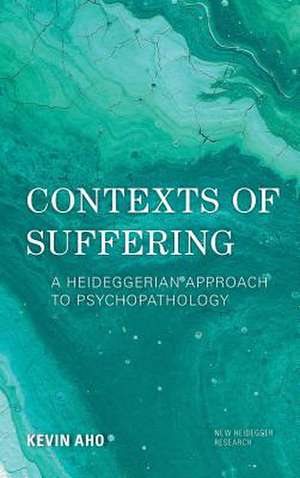
Contexts of Suffering: A Heideggerian Approach to Psychopathology: New Heidegger Research
Autor Kevin Ahoen Limba Engleză Paperback – 26 aug 2019
Din seria New Heidegger Research
- 21%
 Preț: 289.64 lei
 - 23%
 Preț: 259.47 lei
 - 27%
 Preț: 284.87 lei
 - 33%
 Preț: 794.27 lei
 - 19%
 Preț: 331.02 lei
 - 29%
 Preț: 347.76 lei
 - 45%
 Preț: 503.78 lei
 - 27%
 Preț: 283.29 lei
 - 28%
 Preț: 223.43 lei
 - 23%
 Preț: 328.48 lei
 - 19%
 Preț: 331.43 lei
 - 29%
 Preț: 346.24 lei
 - 24%
 Preț: 269.14 lei
 - 19%
 Preț: 332.57 lei
 - 16%
 Preț: 334.63 lei
 - 26%
 Preț: 286.94 lei
 - 26%
 Preț: 259.28 lei
 - 28%
 Preț: 219.46 lei
 - 28%
 Preț: 220.15 lei
 - 26%
 Preț: 280.84 lei
 - 22%
 Preț: 319.95 lei
 - 27%
 Preț: 252.91 lei
 - 27%
 Preț: 282.40 lei
 - 34%
 Preț: 948.77 lei
 - 32%
 Preț: 552.38 lei
 - 22%
 Preț: 316.87 lei
 - 34%
 Preț: 598.59 lei
Preț: 326.92 lei
Preț vechi: 405.68 lei
-19%
Puncte Express: 490
Carte tipărită la comandă
Livrare economică 13-27 noiembrie
Livrare prin curier în România Termenul estimat este afișat lângă disponibilitate.
Transport gratuit de la 400.00 lei Plată online sau ramburs, în funcție de opțiunile comenzii.
Retur gratuit în 14 zile Comandă securizată și suport în română.
Specificații
ISBN-13: 9781786611888
ISBN-10: 1786611880
Pagini: 320
Dimensiuni: 148 x 238 x 12 mm
Greutate: 0.25 kg
Editura: Bloomsbury Publishing
Colecția Rowman & Littlefield
Seria New Heidegger Research
Locul publicării:New York, United States
ISBN-10: 1786611880
Pagini: 320
Dimensiuni: 148 x 238 x 12 mm
Greutate: 0.25 kg
Editura: Bloomsbury Publishing
Colecția Rowman & Littlefield
Seria New Heidegger Research
Locul publicării:New York, United States
Cuprins
Introduction / Part I: Phenomenology and the Limits of Contemporary Psychopathology / 1. Medicalizing Mental Illness / 2. Heidegger and the Structures of Subjectivity / Part II: Structural Breakdowns: Space, Time, and Understanding / 3. Disturbances of Spatiality / 4. Disturbances of Temporality / 5. The Death of Meaning / Part III: Hermeneutic Psychiatry: Situating Mental Illness / 6. What is Hermeneutic Psychiatry? / 7. Situating Social Anxiety / 8. Situating Neurasthenia / 9. Situating Rage / Conclusion / Bibliography / Index
Recenzii
Kevin Aho's "Contexts of Suffering" sheds light on problems suffered especially during the coronavirus pandemic of 2020. His book is a powerful example of transdisciplinary work at its most effective, particularly when applied to urgent problems in contemporary life. This work goes beyond a merely academic work of scholarship. It is a convincing study of Heidegger, to be sure, but also a very personal study of illness in general, and gives a profound response to the over-emphasis on biomedical psychiatry.
In brief, the book is a rewarding read but also challenging, for reasons that will become apparent to the reader. Very much in keeping with the author's admirable ability to render more complex Heideggerian ideas into clear and understandable language, I found the text at all times easy to absorb, illuminating those aspects of Heidegger's work that might seem intractable and even disorienting.. [H]is writing carries us along with admirable skill and understanding in a way that one can only come to expect of a Heidegger scholar of the first order.
Contexts of Suffering is a superb addition to the philosophy of mental health, and specifically the nature of psychiatric problems. Heidegger, for many, is a guiding light in such approaches and Aho provides a masterful overview of how his work, and that of phenomenology and hermeneutics in general, can inform mental health practice and research and relates to the author's own experiences.
Aho has done us all a great service with this bold and immensely important work. Utilizing Heideggerian phenomenology and hermeneutics, he not only exposes the reductive, medicalizing, and indeed dangerous practices of American psychiatry today, but also envisions a healthier path forward wherein psychiatrists can treat the patient as a holistic and relational person by empathically entering the patient's world.
The reader will be shaken by the reporting and educated by the analyses in Contexts of Suffering. While the shortcomings of psychiatry are legion, Aho does not point fingers or wail sanctimoniously. Instead, he carefully examines and describes the many complicated dimensions of common psychiatric disorders. Aho is at his best when giving existential-phenomenological descriptions of experience-particularly suffering.
Aho draws on the existential-phenomenological tradition to dismantle the assumptions of a reductive biological psychiatry and explore how interweaving networks of social and personal meaning inform definitions of psychopathology. In so doing, he reconfigures those diagnosed with mental disorders as historically-situated, self-interpreting beings. This book is an excellent teaching tool for introductory courses in the philosophy of psychiatry.
Kevin Aho draws on Heideggerian phenomenology and hermeneutics to critique the over-medicalization of mental suffering. With his careful attention to the socio-cultural constitution of illness, Aho enriches our understanding of both somatic illness and psychopathology. His book will be of interest not only to phenomenologists, but to anyone unsatisfied with psychiatry's strictly biological approach to disorder.
In brief, the book is a rewarding read but also challenging, for reasons that will become apparent to the reader. Very much in keeping with the author's admirable ability to render more complex Heideggerian ideas into clear and understandable language, I found the text at all times easy to absorb, illuminating those aspects of Heidegger's work that might seem intractable and even disorienting.. [H]is writing carries us along with admirable skill and understanding in a way that one can only come to expect of a Heidegger scholar of the first order.
Contexts of Suffering is a superb addition to the philosophy of mental health, and specifically the nature of psychiatric problems. Heidegger, for many, is a guiding light in such approaches and Aho provides a masterful overview of how his work, and that of phenomenology and hermeneutics in general, can inform mental health practice and research and relates to the author's own experiences.
Aho has done us all a great service with this bold and immensely important work. Utilizing Heideggerian phenomenology and hermeneutics, he not only exposes the reductive, medicalizing, and indeed dangerous practices of American psychiatry today, but also envisions a healthier path forward wherein psychiatrists can treat the patient as a holistic and relational person by empathically entering the patient's world.
The reader will be shaken by the reporting and educated by the analyses in Contexts of Suffering. While the shortcomings of psychiatry are legion, Aho does not point fingers or wail sanctimoniously. Instead, he carefully examines and describes the many complicated dimensions of common psychiatric disorders. Aho is at his best when giving existential-phenomenological descriptions of experience-particularly suffering.
Aho draws on the existential-phenomenological tradition to dismantle the assumptions of a reductive biological psychiatry and explore how interweaving networks of social and personal meaning inform definitions of psychopathology. In so doing, he reconfigures those diagnosed with mental disorders as historically-situated, self-interpreting beings. This book is an excellent teaching tool for introductory courses in the philosophy of psychiatry.
Kevin Aho draws on Heideggerian phenomenology and hermeneutics to critique the over-medicalization of mental suffering. With his careful attention to the socio-cultural constitution of illness, Aho enriches our understanding of both somatic illness and psychopathology. His book will be of interest not only to phenomenologists, but to anyone unsatisfied with psychiatry's strictly biological approach to disorder.