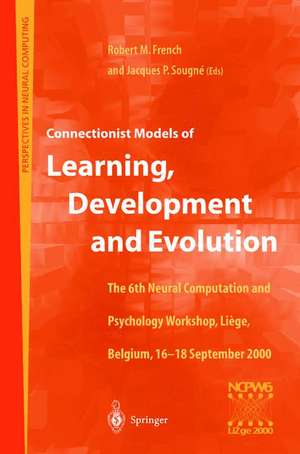
Connectionist Models of Learning, Development and Evolution: Proceedings of the Sixth Neural Computation and Psychology Workshop, Liège, Belgium, 16–18 September 2000: Perspectives in Neural Computing
Editat de Robert M. French, Jacques P. Sougneen Limba Engleză Paperback – 23 mar 2001
Din seria Perspectives in Neural Computing
- 20%
 Preț: 959.23 lei
 - 20%
 Preț: 670.60 lei
 - 20%
 Preț: 1162.68 lei
 - 20%
 Preț: 952.45 lei
 - 20%
 Preț: 623.39 lei
 - 20%
 Preț: 653.01 lei
 - 20%
 Preț: 951.34 lei
 - 20%
 Preț: 314.86 lei
 - 20%
 Preț: 326.42 lei
 - 20%
 Preț: 614.83 lei
 - 20%
 Preț: 623.52 lei
 - 20%
 Preț: 322.74 lei
 - 20%
 Preț: 648.12 lei
 - 20%
 Preț: 622.77 lei
 - 20%
 Preț: 616.72 lei
 - 20%
 Preț: 330.98 lei
 - 20%
 Preț: 315.26 lei
 - 20%
 Preț: 618.64 lei
 - 20%
 Preț: 430.44 lei
 - 20%
 Preț: 621.49 lei
 - 18%
 Preț: 755.90 lei
 - 20%
 Preț: 314.22 lei
 - 20%
 Preț: 655.02 lei
 - 20%
 Preț: 652.26 lei
 - 20%
 Preț: 657.14 lei
 - 20%
 Preț: 652.38 lei
 - 20%
 Preț: 337.80 lei
 - 20%
 Preț: 335.02 lei
 - 20%
 Preț: 323.10 lei
Preț: 619.12 lei
Preț vechi: 728.38 lei
-15%
Puncte Express: 929
Carte tipărită la comandă
Livrare economică 28 noiembrie-12 decembrie
Livrare prin curier în România Termenul estimat este afișat lângă disponibilitate.
Transport gratuit pentru acest produs Plată online sau ramburs, în funcție de opțiunile comenzii.
Retur gratuit în 14 zile Comandă securizată și suport în română.
Specificații
ISBN-13: 9781852333546
ISBN-10: 1852333545
Pagini: 340
Ilustrații: XVI, 322 p. 86 illus.
Dimensiuni: 155 x 235 x 18 mm
Greutate: 0.52 kg
Ediția:Softcover reprint of the original 1st ed. 2001
Editura: SPRINGER LONDON
Colecția Springer
Seria Perspectives in Neural Computing
Locul publicării:London, United Kingdom
ISBN-10: 1852333545
Pagini: 340
Ilustrații: XVI, 322 p. 86 illus.
Dimensiuni: 155 x 235 x 18 mm
Greutate: 0.52 kg
Ediția:Softcover reprint of the original 1st ed. 2001
Editura: SPRINGER LONDON
Colecția Springer
Seria Perspectives in Neural Computing
Locul publicării:London, United Kingdom
V-ar putea interesa
-
 -28%Preț: 371.61 lei519.08 lei
 -
 Agency and Self-Awareness: Issues in Philosophy and PsychologyJohannes Roessler-28%Preț: 429.08 lei596.20 lei
 -
 Consciousness and the WorldBrian O'Shaughnessy-27%Preț: 391.60 lei536.22 lei
 -
 Thinking about ConsciousnessDavid Papineau-28%Preț: 413.26 lei574.98 lei
 -
 -5%Preț: 416.11 lei438.01 lei
 -
 On the Nature of the PsycheC. G. JungPreț: 140.64 lei
 -
 Preț: 165.97 lei
 -
 -13%Preț: 240.76 lei275.24 lei
 -
 Make it StickPeter C. BrownPreț: 240.97 lei
 -
 Brain RulesJohn MedinaPreț: 94.98 lei
 -
 Soft-WiredDr Michael Merzenich PhdPreț: 99.38 lei
 -
 Consciousness: States, Mechanisms & DisordersAndrea Eugenio Cavanna-27%Preț: 1252.07 lei1704.22 lei
Public țintă
ResearchCuprins
SECTION I: Neural Basis of Cognition.- 1. Applying Neuroanatomical Distinctions to Connectionist Cognitive Modelling.- 2. Pseudopatterns and Dual-Network Memory Models: Advantages and Shortcomings.- 3. A Learning Algorithm for Synfue Chains.- 4. Towards a Spatio-Temporal Analysis Tool for fMRI Data: An Application to Depth-from-Motion Processing in Humans.- 5. A Simple Model Exhtbiting Scalar Timing.- 6. Modularity and Specialized Learning in the Organization of Behaviour.- 7. Modeling Modulatory Aspects in Association Processes.- 8. Recognition of Novelty Made Easy: Constraints of Channel Capacity on Generative Networks.- 9. A Biologically Plausible Maturation of an ART Network.- SECTION II: Development and Category Learning.- 10. Developing Knowledge about Living Things: A Connectionist Investigation.- 11. Paying Attention to Relevant Dimensions: A Localist Approach.- 12. Coordinating Multiple Sensory Modalities While Learning to Reach.- 13. Modelling Cognitive Development with Constructivist Neural Networks.- 14. Learning Action Affordances and Action Schemas.- 15. A Three-Layer Configural Cue Model ofCategory Learning Rates.- 16. A Revival of Turing’s Forgotten Connectionist Ideas: Exploring Unorganized Machines.- 17. Visual Crowding and Category-Specific Deficits: A Neural Network Model.- SECTION III: Implicit Learning.- 18.Implicit Learning of Regularities in Western Tonal Music by Self-Organization.- 19. Rules vs. Statistics in Implicit Learning of Biconditional Grammars.- 20. Hidden Markov Model Interpretations of Neural Networks.- SECTION IV: Models of Social Cognition.- 21. A Connectionist Model of Person Perception and Stereotype Formation.- 22. Learning about an Absent Cause: Discounting and Augmentation of Positively and Independently Related Causes.-SECTION V: Evolution.- 23. Exploring the Baldwin Effect in Evolving Adaptable Control Systems.- 24. Borrowing Dynamies from Evolution: Association using Catalytie Network Models.- 25. Evolving Modular Architectures for Neural Networks.- 26. Evolution, Development and Learning - A Nested Hierarchy?.- SECTION VI: Semantics.- 27. Learning Lexical Properties from Word Usage Patterns: Which Context Words Should be Used?.- 28. Associative Computation and Associative Prediction.- 29. The Development of Small-World Semantie Networks.- 30. What is the Dimensionality of Human Semantie Space?.- Author Index.
Caracteristici
Provides the reader with the state-of-the-art in psychological aspects of connectionist modelling