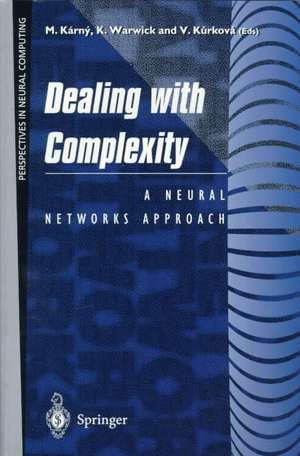
Dealing with Complexity: A Neural Networks Approach: Perspectives in Neural Computing
Editat de Mirek Karny, Kevin Warwick, Vera Kurkovaen Limba Engleză Paperback – 7 noi 1997
Din seria Perspectives in Neural Computing
- 20%
 Preț: 959.23 lei
 - 20%
 Preț: 670.60 lei
 - 20%
 Preț: 1162.68 lei
 - 20%
 Preț: 952.45 lei
 - 20%
 Preț: 653.01 lei
 - 20%
 Preț: 951.34 lei
 - 20%
 Preț: 314.86 lei
 - 20%
 Preț: 326.42 lei
 - 20%
 Preț: 614.83 lei
 - 20%
 Preț: 623.52 lei
 - 20%
 Preț: 322.74 lei
 - 20%
 Preț: 648.12 lei
 - 20%
 Preț: 622.77 lei
 - 20%
 Preț: 616.72 lei
 - 15%
 Preț: 619.12 lei
 - 20%
 Preț: 330.98 lei
 - 20%
 Preț: 315.26 lei
 - 20%
 Preț: 618.64 lei
 - 20%
 Preț: 430.44 lei
 - 20%
 Preț: 621.49 lei
 - 18%
 Preț: 755.90 lei
 - 20%
 Preț: 314.22 lei
 - 20%
 Preț: 655.02 lei
 - 20%
 Preț: 652.26 lei
 - 20%
 Preț: 657.14 lei
 - 20%
 Preț: 652.38 lei
 - 20%
 Preț: 337.80 lei
 - 20%
 Preț: 335.02 lei
 - 20%
 Preț: 323.10 lei
Preț: 623.39 lei
Preț vechi: 779.23 lei
-20%
Puncte Express: 935
Carte tipărită la comandă
Livrare economică 27 noiembrie-11 decembrie
Livrare prin curier în România Termenul estimat este afișat lângă disponibilitate.
Transport gratuit pentru acest produs Plată online sau ramburs, în funcție de opțiunile comenzii.
Retur gratuit în 14 zile Comandă securizată și suport în română.
Specificații
ISBN-13: 9783540761600
ISBN-10: 3540761608
Pagini: 328
Ilustrații: XV, 308 p. 5 illus.
Dimensiuni: 155 x 235 x 17 mm
Greutate: 0.5 kg
Ediția:1st Edition.
Editura: SPRINGER LONDON
Colecția Springer
Seria Perspectives in Neural Computing
Locul publicării:London, United Kingdom
ISBN-10: 3540761608
Pagini: 328
Ilustrații: XV, 308 p. 5 illus.
Dimensiuni: 155 x 235 x 17 mm
Greutate: 0.5 kg
Ediția:1st Edition.
Editura: SPRINGER LONDON
Colecția Springer
Seria Perspectives in Neural Computing
Locul publicării:London, United Kingdom
V-ar putea interesa
-
 Introduction to EEG- and Speech-Based Emotion RecognitionPriyanka A. Abhang-28%Preț: 490.76 lei678.59 lei
 -
 Artificial Intelligence: The BasicsKevin WarwickPreț: 212.80 lei
 -
 -20%Preț: 513.70 lei642.12 lei
 -
 Computer Intensive Methods in Control and Signal ProcessingMiroslav Karny-15%Preț: 667.74 lei785.58 lei
 -
 Turing's Imitation GameKevin Warwick-20%Preț: 268.85 lei336.06 lei
 -
 Neuronal DynamicsWulfram Gerstner-20%Preț: 424.44 lei530.56 lei
 -
 Wavelet Neural NetworksAntonis K Alexandridis-20%Preț: 634.18 lei792.72 lei
 -
 Frontiers of Higher Order Fuzzy SetsAlireza Sadeghian-20%Preț: 673.79 lei842.25 lei
 -
 Learning TensorflowTom Hope-20%Preț: 279.45 lei349.32 lei
 -
 Neurocomputing: Learning, Architectures & ModelingElizabeth T Mueller-35%Preț: 834.42 lei1289.20 lei
 -
 Designs and Applied Principles of Artificial Neural NetworksJeremy Rogerson-20%Preț: 630.08 lei787.60 lei
 -
 -20%Preț: 726.00 lei907.49 lei
 -
 -20%Preț: 347.17 lei433.97 lei
 -
 Neural Networks and Artificial IntelligenceVladimir Golovko-20%Preț: 323.95 lei404.94 lei
 -
 Fuzziness in Information SystemsMiroslav Hudec-20%Preț: 670.71 lei838.38 lei
 -
 -20%Preț: 323.10 lei403.87 lei
 -
 Coupled Oscillating NeuronsJ.G. Taylor-20%Preț: 314.22 lei392.77 lei
 -
 -20%Preț: 314.86 lei393.57 lei
 -
 The Promise of Neural NetworksJ.G. Taylor-20%Preț: 614.83 lei768.53 lei
 -
 -20%Preț: 324.50 lei405.63 lei
 -
 Digital Signal Processing in Telecommunications: European Project COST#229 Technical ContributionsAnibal R. Figueiras-Vidal-15%Preț: 621.34 lei730.99 lei
 -
 Second-Order Methods for Neural NetworksAdrian J. Shepherd-20%Preț: 315.26 lei394.07 lei
 -
 Concepts for Neural Networks: A SurveyLawrence J. Landau-20%Preț: 623.52 lei779.40 lei
 -
 Fuzziness and Foundations of Exact and Inexact SciencesKofi Kissi Dompere-20%Preț: 669.62 lei837.02 lei
Public țintă
ResearchCuprins
1 Recurrent Neural Networks: Some Systems-Theoretic Aspects.- 1 Introduction.- 2 System-Theory Results: Statements.- 3 System-Theory Results: Discussion.- 4 Computational Power.- 5 Some Remarks.- 2 The Use of State Space Control Theory for Analysing Feedforward Neural Networks.- 1 Introduction.- 2 State Space Theory.- 3 State Space Representation of Feedforward Neural Networks.- 4 Observability of Feedforward Neural Networks.- 5 Controllability.- 6 Stability.- 7 Discussion.- 8 Appendix: Linear Systems of Equations [7].- 3 Statistical Decision Making and Neural Networks.- 1 Introduction.- 2 Statistical Decision Making.- 3 Bayesian Learning.- 4 On Ingredients of Bayesian Learning.- 5 Interlude on Gaussian Linear Regression Model.- 6 Approximate On-Line Estimation.- 7 Conclusions.- 4 A Tutorial on the EM Algorithm and its Applications to Neural Network Learning.- 1 Introduction.- 2 The EM Algorithm.- 3 Practical Applications.- 4 Convergence Properties.- 5 Concluding Remarks.- 5 On the Effectiveness of Memory-Based Methods inMachine Learning.- 1 Introduction.- 2 Background.- 3 The Curse of Dimensionality.- 4 The Barron-Jones Theory.- 5 Experimental Results.- 6 Analysis of Memory-Based Methods.- 7 Discussion.- 6 A Study of Non Mean Square Error Criteria for the Training of Neural Networks.- 1 Introduction.- 2 Statement of the Problem.- 3 Cost Function Minimisation for ? = E(y/x).- 4 Cost Function Minimisation for the Median of p(y/x).- 5 Simulation Results.- 6 Conclusion.- 7 A Priori Information in Network Design.- 1 Introduction.- 2 Preliminaries.- 3 Recurrent Networks and Relative Order.- 4 Simulations.- 5 Conclusions.- 8 Neurofuzzy Systems Modelling: A Transparent Approach.- 1 Empirical Data Modelling.- 2 Neurofuzzy Construction Algorithms.- 3 Modelling Case Studies.- 4Conclusions.- 9 Feature Selection and Classification by a Modified Model with Latent Structure.- 1 Introduction.- 2 Modified Model with Latent Structure.- 3 Optimizing Model Parameters.- 4 Approach to Feature Selection.- 5 Pseudo-Bayes Decision Rule.- 6 Experiments.- 7 Summary and Conclusion.- 10 Geometric Algebra Based Neural Networks.- 1 Introduction.- 2 Complex-Valued Neural Networks.- 3 Comments on the Applicability of CVNNs to n-Dimensional Signals.- 4 Generalisations of CVNNs Within a GA Framework.- 5 Summary.- 11 Discrete Event Complex Systems: Scheduling with Neural Networks.- 1 Introduction.- 2 The DNN Architecture.- 3 Continuous Time Control Law.- 4 Real-Time Scheduling.- 5 Simulation Results.- 6 Summary.- 12 Incremental Approximation by Neural Networks.- 1 Introduction.- 2 Approximation of Functions by One-Hidden-Layer Networks.- 3 Rates of Approximation of Incremental Approximants.- 4 Variation with Respect to a Set of Functions.- 5 Incremental Approximation by Perceptron and RBF Networks.- 6 Discussion.- 13 Approximation of Smooth Functions by Neural Networks.- 1 Introduction.- 2 Preliminaries.- 3 Complexity Theorems.- 4 Local Approximation.- 5 Some Open Problems.- 14 Rates of Approximation in a Feedforward Network Depend on the Type of Computational Unit.- 1 Introduction.- 2 Feedforward Networks with Various Computational Units.- 3 Discussion.- 15 Recent Results and Mathematical Methods for Functional Approximation by Neural Networks.- 1 Introduction.- 2 Individual vs Variable Context.- 3 Nonlinear Approximation.- 4 Feedforward Architectures.- 5 Lower Bounds on Rate of Approximation.- 6 Uniqueness of Approximation by Neural Networks.- 7 Other Approaches.- 16 Differential Neurocontrol of Multidimensional Systems.- 1 Introduction.- 2 Neurophysiological Basis.- 3 Scheme of the Differential Neurocontroller.- 4 Multiplicative Units.- 5 Feedback Block.- 6 Feedforward Block.- 7 Convergence of Learning.- 8 Computer Simulations.- 9 Conclusions.- 17 The Psychological Limits of Neural Computation.- 1 Neural Networks and Turing Machines.- 2 Function Approximation.- 3 Representation of Logical Functions Using Neural Networks.- 4 The Complexity of Learning in Neural Networks.- 5 Learning Logical Functions.- 6 The Optimization of Circuits.- 7 Final Remarks.- 18 A Brain-Like Design to Learn Optimal Decision Strategies in Complex Environments.- 1 Introduction.- 2 Time-Chunked Approximate Dynamic Programming.- 3 Temporal Chunking with Neural Networks.- 4 Spatial Chunking and Critical Subsystems.- 5 Adding the Third Brain.- Research Acknowledgements.