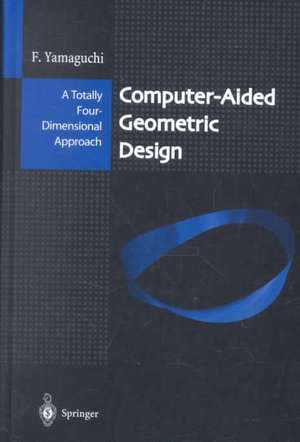
Computer-Aided Geometric Design
Autor Fujio Yamaguchien Limba Engleză Hardback – 14 oct 2002
Preț: 1049.21 lei
Preț vechi: 1311.51 lei
-20%
Puncte Express: 1574
Carte tipărită la comandă
Livrare economică 30 noiembrie-14 decembrie
Livrare prin curier în România Termenul estimat este afișat lângă disponibilitate.
Transport gratuit pentru acest produs Plată online sau ramburs, în funcție de opțiunile comenzii.
Retur gratuit în 14 zile Comandă securizată și suport în română.
Specificații
ISBN-13: 9784431703402
ISBN-10: 4431703403
Pagini: 672
Ilustrații: XXXIX, 630 p.
Dimensiuni: 160 x 241 x 46 mm
Greutate: 1.23 kg
Ediția:2002
Editura: Springer
Locul publicării:Tokyo, Japan
ISBN-10: 4431703403
Pagini: 672
Ilustrații: XXXIX, 630 p.
Dimensiuni: 160 x 241 x 46 mm
Greutate: 1.23 kg
Ediția:2002
Editura: Springer
Locul publicării:Tokyo, Japan
V-ar putea interesa
-
 -20%Preț: 410.94 lei513.69 lei
 -
 Computer Architecture: A Quantitative ApproachJohn L. Hennessy-39%Preț: 534.37 lei882.55 lei
 -
 -24%Preț: 146.90 lei192.22 lei
 -
 -36%Preț: 96.36 lei151.43 lei
 -
 -34%Preț: 149.68 lei227.27 lei
 -
 Linear AlgebraGeorgi E Shilov-18%Preț: 124.20 lei151.89 lei
 -
 Preț: 105.05 lei
 -
 Numerical RecipesWilliam H. Press-14%Preț: 872.22 lei1014.21 lei
 -
 Notes on the Synthesis of FormChristopher AlexanderPreț: 235.55 lei
 -
 Discrete and Computational Geometry, 2nd EditionJoseph O'Rourke-14%Preț: 514.77 lei598.57 lei
 -
 Pro/Engineer Wildfire 4.0 EssentialsInc Kogent-20%Preț: 580.51 lei725.63 lei
 -
 Drawing GeometryJon AllenPreț: 93.99 lei
 -
 Designing with Algorithms: A Mathematical GuideArash Soleimani-20%Preț: 329.03 lei411.29 lei
 -
 Computer Aided Engineering DesignBirendra Sahay-18%Preț: 1603.10 lei1954.99 lei
 -
 Parametric Design for ArchitectureWassim Jabi-26%Preț: 229.91 lei309.66 lei
 -
 Drawing for Product DesignersKevin Henry-30%Preț: 160.26 lei229.64 lei
 -
 Computational GeometryMark de BergPreț: 450.09 lei
 -
 Computational GeometryMark de BergPreț: 441.16 lei
 -
 -20%Preț: 317.85 lei397.31 lei
Public țintă
ResearchDescriere
Computer graphics, computer-aided design, and computer-aided manufacturing are tools that have become indispensable to a wide array of activities in contemporary society. Euclidean processing provides the basis for these computer-aided design systems although it contains elements that inevitably lead to an inaccurate, non-robust, and complex system. The primary cause of the deficiencies of Euclidean processing is the division operation, which becomes necessary if an n-space problem is to be processed in n-space. The difficulties that accompany the division operation may be avoided if processing is conducted entirely in (n+1)-space. The paradigm attained through the logical extension of this approach, totally four-dimensional processing, is the subject of this book. This book offers a new system of geometric processing techniques that attain accurate, robust, and compact computations, and allow the construction of a systematically structured CAD system.
Cuprins
I Problem Definitions.- 1 Problems of Euclidean Approach.- 2 Homogeneous Coordinates.- 3 Classical Projective Space.- 4 Two-Sided Space.- 5 Processing in Projective Spaces.- 6 Transformations.- II Presentation of a Solution-Four-dimensional Processing-Four-dimensional Processing-.- 7 A Solution.- 8 Geometric Definitions in General.- 9 Geometric Element Definitions.- 10 Homogeneous Curves.- 11 Homogeneous Surfaces.- 12 Basic Intersections.- 13 4 × 4 Determinant Methods.- 14 The Homogeneous Determinant Method.- 15 Geometric Newton-Raphson Method.- 16 Exact Arithmetic.- 17 Fundamentals of Topology.- 18 Data Structures.- 19 Euclidean and Affine.- 20 Set Operations.- 21 Polyhedron Subdivisions.- 22 Reconstruction of 3-D Points.- 23 Display Process.- 24 Classical or Two-Sided ?.- III Test Results.- 25 Various Tests.- IV Conclusions.- 26 Evaluations.- 27 Role of Division Operations.- 28 Various Interpretations.- Afterword.- A Fundamentals on Euclidean Processing.- A.1.- A.2.- A.3.- A.4.- B Various Geometries.- C Plane Determinant Method.- C.1.- C.2.- C.3.- C.4.- C.5.- C.5.1.- C.5.2.- D Analytical Geometry in Vector Space.- D.1.- D.1.1.- D.1.2.- D.1.3.- D.2.- D.2.1.- E Proofs for Chapter 16.- E.1.- E.2.