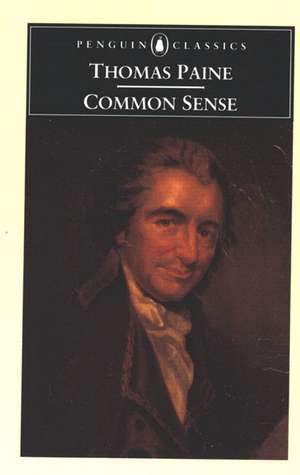
Common Sense: PENGUIN RANDOM HOUSE UK
Autor Thomas Paine Editat de Isaac Kramnicken Limba Engleză Paperback – 25 noi 1982


Preț: 69.60 lei
Puncte Express: 104
Carte disponibilă
Livrare economică 11-25 noiembrie
Livrare express 27-31 octombrie pentru 14.78 lei
Livrare prin curier în România Termenul estimat este afișat lângă disponibilitate.
Transport gratuit de la 400.00 lei Plată online sau ramburs, în funcție de opțiunile comenzii.
Retur gratuit în 14 zile Comandă securizată și suport în română.
Specificații
ISBN-13: 9780140390162
ISBN-10: 0140390162
Pagini: 128
Dimensiuni: 131 x 199 x 8 mm
Greutate: 0.1 kg
Ediția:Revised
Editura: Penguin Random House UK
Colecția PENGUIN RANDOM HOUSE UK
Seria PENGUIN RANDOM HOUSE UK
Locul publicării:London, United Kingdom
ISBN-10: 0140390162
Pagini: 128
Dimensiuni: 131 x 199 x 8 mm
Greutate: 0.1 kg
Ediția:Revised
Editura: Penguin Random House UK
Colecția PENGUIN RANDOM HOUSE UK
Seria PENGUIN RANDOM HOUSE UK
Locul publicării:London, United Kingdom
V-ar putea interesa
-
 The Thomas Paine ReaderThomas Paine-28%Preț: 77.61 lei108.32 lei
 -
 Great Ideas Common SenseThomas Paine-21%Preț: 43.86 lei55.43 lei
 -
 The Sign of Four. Penguin English Library EditionArthur Conan Doyle-28%Preț: 45.94 lei63.97 lei
 -
 -15%Preț: 51.49 lei60.28 lei
 -
 Anecdotes of the CynicsRobert Dobbin-39%Preț: 17.44 lei28.47 lei
 -
 Why I Am so CleverFriedrich Nietzsche-39%Preț: 17.06 lei28.11 lei
 -
 Thomas Paine and the Clarion Call for American IndependenceHarlow Giles Unger-31%Preț: 130.58 lei188.36 lei
 -
 The Rights of ManThomas Paine-16%Preț: 24.79 lei29.58 lei
 -
 Preț: 180.95 lei
 -
 Locke: Political WritingsJohn Locke-17%Preț: 141.78 lei171.31 lei
 -
 Preț: 96.25 lei
 -
 The Autobiography of Benjamin FranklinBenjamin FranklinPreț: 40.29 lei
 -
 Two Treatises of GovernmentJohn LockePreț: 47.31 lei
 -
 The Age of ReasonThomas PainePreț: 40.29 lei
 -
 Thomas PaineThomas PainePreț: 70.73 lei
 -
 Life, Liberty and the Pursuit of HappinessPeter MoorePreț: 93.51 lei
 -
 The Declaration of IndependenceThomas JeffersonPreț: 53.66 lei
 -
 The Declaration of IndependenceThomas JeffersonPreț: 38.52 lei
 -
 -18%Preț: 64.98 lei79.50 leiRecomandat
 -
 Thomas Paine's Rights of ManChristopher Hitchens-22%Preț: 52.76 lei67.45 lei
 -
 The Rights Of Man And Common SenseThomas PainePreț: 96.80 lei
 -
 The Greatest Sentence Ever WrittenWalter Isaacson-19%Preț: 63.76 lei78.72 lei
 -
 UtopiaThomas MorePreț: 33.19 lei
Notă biografică
Thomas Paine was born in1737 at Thetford, Norfolk in England, as a son of a Quaker. He immigrated to America in 1774. There he published works criticising the slavery and supporting American independence. He became very popular but returned to England where he became involved in the French Revolution. After that he returned to America where he died in 1802.
Isaac Kramnick is Professor of Government at Cornell University and has edited of The Federalist Papers and the Thomas Paine Reader.
Isaac Kramnick is Professor of Government at Cornell University and has edited of The Federalist Papers and the Thomas Paine Reader.
Recenzii
When Common Sense was published in January 1776, it sold, by some estimates, a stunning 150,000 copies in the colonies. What exactly made this pamphlet so appealing? This is a question not only about the state of mind of Paine’s audience, but also about the role of public opinion and debate, the function of the press, and the shape of political culture in the colonies.
This Broadview edition of Paine’s famous pamphlet attempts to reconstruct the context in which it appeared and to recapture the energy and passion of the dispute over the political future of the British colonies in North America. Included along with the text of Common Sense are some of the contemporary arguments for and against the Revolution by John Dickinson, John Adams, and Thomas Jefferson; materials from the debate that followed the pamphlet’s publication showing the difficulty of the choices facing the colonists; the Declaration of Independence; and the Pennsylvania Constitution of 1776.
“Edward Larkin’s new edition of Common Sense will be welcomed by readers. With a lively and detailed introduction, thorough scholarly notes, and a representative selection of the contemporaneous responses it provoked, this should become the definitive new edition of Paine’s classic tract.” — Richard Boyd, University of Wisconsin-Madison
“The big problem with Paine is that current readers have trouble seeing why his ideas did not seem so common-sensical to eighteenth-century people. Larkin addresses this problem with supplementary texts that focus on the debate over independence in America; along with his interesting and approachable introduction, the combination makes for the best edition of Paine’s Common Sense available.” — Daniel Vickers, University of California, San Diego
“There are many fine editions of this indispensable American text. But this one is richer and more rewarding than the others. It invites readers to encounter Common Sense in the fullness of its historical setting. And as it does, it makes plain how utterly Tom Paine towered above all other Revolutionary writers.” — Michael W. Zuckerman, University of Pennsylvania
“Edward Larkin’s new edition of Tom Paine’s Common Sense will be a boon to teachers and students. It thoughtfully contextualizes Paine’s pamphlet while highlighting the singularity of his voice. Most importantly, it will aid students in placing Common Sense in that absolutely central eighteenth-century culture war: the beginning of the unfinished argument over modern democracy.” — Michael Meranze, University of California, San Diego
This Broadview edition of Paine’s famous pamphlet attempts to reconstruct the context in which it appeared and to recapture the energy and passion of the dispute over the political future of the British colonies in North America. Included along with the text of Common Sense are some of the contemporary arguments for and against the Revolution by John Dickinson, John Adams, and Thomas Jefferson; materials from the debate that followed the pamphlet’s publication showing the difficulty of the choices facing the colonists; the Declaration of Independence; and the Pennsylvania Constitution of 1776.
“Edward Larkin’s new edition of Common Sense will be welcomed by readers. With a lively and detailed introduction, thorough scholarly notes, and a representative selection of the contemporaneous responses it provoked, this should become the definitive new edition of Paine’s classic tract.” — Richard Boyd, University of Wisconsin-Madison
“The big problem with Paine is that current readers have trouble seeing why his ideas did not seem so common-sensical to eighteenth-century people. Larkin addresses this problem with supplementary texts that focus on the debate over independence in America; along with his interesting and approachable introduction, the combination makes for the best edition of Paine’s Common Sense available.” — Daniel Vickers, University of California, San Diego
“There are many fine editions of this indispensable American text. But this one is richer and more rewarding than the others. It invites readers to encounter Common Sense in the fullness of its historical setting. And as it does, it makes plain how utterly Tom Paine towered above all other Revolutionary writers.” — Michael W. Zuckerman, University of Pennsylvania
“Edward Larkin’s new edition of Tom Paine’s Common Sense will be a boon to teachers and students. It thoughtfully contextualizes Paine’s pamphlet while highlighting the singularity of his voice. Most importantly, it will aid students in placing Common Sense in that absolutely central eighteenth-century culture war: the beginning of the unfinished argument over modern democracy.” — Michael Meranze, University of California, San Diego
Cuprins
Acknowledgements
Introduction
Works Cited
Thomas Paine: A Brief Chronology
A Note on the Texts
Common Sense
Appendix A: Antecedents to Common Sense
Suggestions for Further Reading
Introduction
Works Cited
Thomas Paine: A Brief Chronology
A Note on the Texts
Common Sense
Appendix A: Antecedents to Common Sense
- [John Adams], “A Dissertation on the Canon and Feudal Law,” Boston Gazette (1765)
- [John Dickinson], Letters from a Farmer in Pennsylvania (1767)
- Thomas Jefferson, A Summary View of the Rights of British America (1774)
- [Charles Inglis], The True Interest of America Impartially Stated (1776)
- Candidus [James Chalmers], Plain Truth (1776)
- Selections from “Cato’s Letters” [William Smith] and “The Forester” [Thomas Paine], Pennsylvania Gazette(1776)
- [John Adams], Thoughts on Government (1776)
- The Declaration of Independence (1776)
- The Constitution of Pennsylvania (1776)
Suggestions for Further Reading