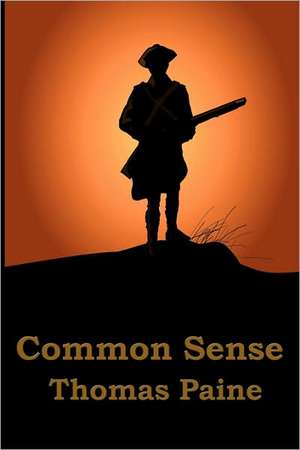
Common Sense
Autor Thomas Paineen Limba Engleză Paperback – 9 noi 2007
Preț: 60.10 lei
Carte tipărită la comandă
Livrare economică 28 noiembrie-12 decembrie
Specificații
ISBN-10: 1604591315
Pagini: 52
Dimensiuni: 152 x 229 x 3 mm
Greutate: 0.09 kg
Editura: Wilder Publications
V-ar putea interesa
-
 The Thomas Paine ReaderThomas Paine-28%Preț: 77.61 lei108.32 lei
 -
 Great Ideas Common SenseThomas Paine-21%Preț: 43.86 lei55.43 lei
 -
 The Sign of Four. Penguin English Library EditionArthur Conan Doyle-28%Preț: 45.92 lei63.97 lei
 -
 -15%Preț: 51.44 lei60.28 lei
 -
 Anecdotes of the CynicsRobert Dobbin-39%Preț: 17.43 lei28.47 lei
 -
 Why I Am so CleverFriedrich Nietzsche-39%Preț: 17.06 lei28.11 lei
 -
 Thomas Paine and the Clarion Call for American IndependenceHarlow Giles Unger-31%Preț: 130.58 lei188.36 lei
 -
 -16%Preț: 24.79 lei29.58 lei
 -
 Preț: 180.95 lei
 -
 Locke: Political WritingsJohn Locke-17%Preț: 141.78 lei171.31 lei
 -
 Preț: 96.25 lei
 -
 The Autobiography of Benjamin FranklinBenjamin FranklinPreț: 40.29 lei
 -
 Two Treatises of GovernmentJohn LockePreț: 47.31 lei
 -
 The Age of ReasonThomas PainePreț: 40.29 lei
 -
 Thomas PaineThomas PainePreț: 70.73 lei
 -
 Life, Liberty and the Pursuit of HappinessPeter MoorePreț: 93.51 lei
 -
 The Declaration of IndependenceThomas JeffersonPreț: 53.66 lei
 -
 The Declaration of IndependenceThomas JeffersonPreț: 38.52 lei
 -
 -18%Preț: 64.98 lei79.50 leiRecomandat
 -
 Thomas Paine's Rights of ManChristopher Hitchens-22%Preț: 52.76 lei67.45 lei
 -
 The Rights Of Man And Common SenseThomas PainePreț: 96.80 lei
 -
 The Greatest Sentence Ever WrittenWalter Isaacson-19%Preț: 63.55 lei78.63 lei
 -
 UtopiaThomas MorePreț: 33.19 lei
Notă biografică
Descriere
Struggling under oppressive laws, high taxes, and the heavy hand of King George the Third's rule, the people living in early America longed for freedoms seemingly out of reach. Talk of rebellion stayed in bars and in the secret of homes, never really given serious consideration until Thomas Paine picked up a pen. Common Sense was the one of the first major cases made public for independence. Written as if it were a sermon, Paine advocates for religious freedom and independence from Great Britain. Common Sense is separated by four sections: "Of the Origin and Design of Government in General, With Concise Remarks on the English Constitution", "Of Monarchy and Hereditary Succession," "Thoughts on the Present State of American Affairs," and "On the Present Ability of America, With Some Miscellaneous Reflections." Each use concise and persuasive prose to address Paine's main points and arguments for independence, based on the origins of the British government, the current state of America, and the issues of each. With Common Sense Thomas Paine entered a frequently talked about and yearned for solution for the young, struggling nation into public discourse for serious consideration.
Without the pen of the author of Common Sense, the sword of Washington would have been raised in vain," John Adams said of Thomas Paine . Common Sense not only helped to inspire the American Revolution, but it also gave the founding fathers direction. Using clear, concise, and persuasive prose, Paine argues for American independence before other public figures of his time had the bravery or eloquence to. The ideologies of Common Sense are still employed in government today, and is a testament to the American spirit.
Now with in a modern, easy-to-read font and with a distinct cover design, Common Sense by Thomas Paine embodies the American spirit and ingenuity like never before. It is a must-have for any collection seeking to appreciate American history and the origins of American democracy.
Recenzii
This Broadview edition of Paine’s famous pamphlet attempts to reconstruct the context in which it appeared and to recapture the energy and passion of the dispute over the political future of the British colonies in North America. Included along with the text of Common Sense are some of the contemporary arguments for and against the Revolution by John Dickinson, John Adams, and Thomas Jefferson; materials from the debate that followed the pamphlet’s publication showing the difficulty of the choices facing the colonists; the Declaration of Independence; and the Pennsylvania Constitution of 1776.
“Edward Larkin’s new edition of Common Sense will be welcomed by readers. With a lively and detailed introduction, thorough scholarly notes, and a representative selection of the contemporaneous responses it provoked, this should become the definitive new edition of Paine’s classic tract.” — Richard Boyd, University of Wisconsin-Madison
“The big problem with Paine is that current readers have trouble seeing why his ideas did not seem so common-sensical to eighteenth-century people. Larkin addresses this problem with supplementary texts that focus on the debate over independence in America; along with his interesting and approachable introduction, the combination makes for the best edition of Paine’s Common Sense available.” — Daniel Vickers, University of California, San Diego
“There are many fine editions of this indispensable American text. But this one is richer and more rewarding than the others. It invites readers to encounter Common Sense in the fullness of its historical setting. And as it does, it makes plain how utterly Tom Paine towered above all other Revolutionary writers.” — Michael W. Zuckerman, University of Pennsylvania
“Edward Larkin’s new edition of Tom Paine’s Common Sense will be a boon to teachers and students. It thoughtfully contextualizes Paine’s pamphlet while highlighting the singularity of his voice. Most importantly, it will aid students in placing Common Sense in that absolutely central eighteenth-century culture war: the beginning of the unfinished argument over modern democracy.” — Michael Meranze, University of California, San Diego
Cuprins
Introduction
Works Cited
Thomas Paine: A Brief Chronology
A Note on the Texts
Common Sense
Appendix A: Antecedents to Common Sense
- [John Adams], “A Dissertation on the Canon and Feudal Law,” Boston Gazette (1765)
- [John Dickinson], Letters from a Farmer in Pennsylvania (1767)
- Thomas Jefferson, A Summary View of the Rights of British America (1774)
- [Charles Inglis], The True Interest of America Impartially Stated (1776)
- Candidus [James Chalmers], Plain Truth (1776)
- Selections from “Cato’s Letters” [William Smith] and “The Forester” [Thomas Paine], Pennsylvania Gazette(1776)
- [John Adams], Thoughts on Government (1776)
- The Declaration of Independence (1776)
- The Constitution of Pennsylvania (1776)
Suggestions for Further Reading