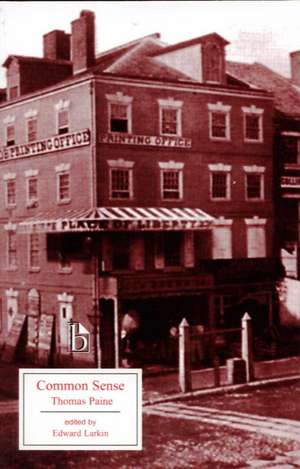
Common Sense
Autor Thomas Paine Editat de Edward Larkinen Limba Engleză Paperback – 16 mar 2004
This Broadview edition of Paine’s famous pamphlet attempts to reconstruct the context in which it appeared and to recapture the energy and passion of the dispute over the political future of the British colonies in North America. Included along with the text of Common Sense are some of the contemporary arguments for and against the Revolution by John Dickinson, John Adams, and Thomas Jefferson; materials from the debate that followed the pamphlet’s publication showing the difficulty of the choices facing the colonists; the Declaration of Independence; and the Pennsylvania Constitution of 1776.
Preț: 137.15 lei
Puncte Express: 206
Carte disponibilă
Livrare economică 07-21 noiembrie
Livrare prin curier în România Termenul estimat este afișat lângă disponibilitate.
Transport gratuit de la 400.00 lei Plată online sau ramburs, în funcție de opțiunile comenzii.
Retur gratuit în 14 zile Comandă securizată și suport în română.
Specificații
ISBN-13: 9781551115719
ISBN-10: 1551115719
Pagini: 252
Dimensiuni: 140 x 216 x 16 mm
Greutate: 0.4 kg
Ediția:Critical
Editura: BROADVIEW PR
Colecția Broadview Press
Locul publicării:Peterborough, Canada
ISBN-10: 1551115719
Pagini: 252
Dimensiuni: 140 x 216 x 16 mm
Greutate: 0.4 kg
Ediția:Critical
Editura: BROADVIEW PR
Colecția Broadview Press
Locul publicării:Peterborough, Canada
V-ar putea interesa
-
 The Thomas Paine ReaderThomas Paine-28%Preț: 77.61 lei108.32 lei
 -
 Great Ideas Common SenseThomas Paine-21%Preț: 43.86 lei55.43 lei
 -
 The Sign of Four. Penguin English Library EditionArthur Conan Doyle-28%Preț: 45.92 lei63.97 lei
 -
 -15%Preț: 51.44 lei60.28 lei
 -
 Anecdotes of the CynicsRobert Dobbin-39%Preț: 17.43 lei28.47 lei
 -
 Why I Am so CleverFriedrich Nietzsche-39%Preț: 17.06 lei28.11 lei
 -
 Thomas Paine and the Clarion Call for American IndependenceHarlow Giles Unger-31%Preț: 130.58 lei188.36 lei
 -
 -16%Preț: 24.79 lei29.58 lei
 -
 Preț: 180.95 lei
 -
 Locke: Political WritingsJohn Locke-17%Preț: 141.78 lei171.31 lei
 -
 Preț: 96.25 lei
 -
 The Autobiography of Benjamin FranklinBenjamin FranklinPreț: 40.29 lei
 -
 Two Treatises of GovernmentJohn LockePreț: 47.31 lei
 -
 The Age of ReasonThomas PainePreț: 40.29 lei
 -
 Thomas PaineThomas PainePreț: 70.73 lei
 -
 Life, Liberty and the Pursuit of HappinessPeter MoorePreț: 93.51 lei
 -
 The Declaration of IndependenceThomas JeffersonPreț: 53.66 lei
 -
 The Declaration of IndependenceThomas JeffersonPreț: 38.52 lei
 -
 -18%Preț: 64.98 lei79.50 leiRecomandat
 -
 Thomas Paine's Rights of ManChristopher Hitchens-22%Preț: 52.76 lei67.45 lei
 -
 The Rights Of Man And Common SenseThomas PainePreț: 96.80 lei
 -
 The Greatest Sentence Ever WrittenWalter Isaacson-19%Preț: 63.55 lei78.63 lei
 -
 UtopiaThomas MorePreț: 33.19 lei
Recenzii
When Common Sense was published in January 1776, it sold, by some estimates, a stunning 150,000 copies in the colonies. What exactly made this pamphlet so appealing? This is a question not only about the state of mind of Paine’s audience, but also about the role of public opinion and debate, the function of the press, and the shape of political culture in the colonies.
This Broadview edition of Paine’s famous pamphlet attempts to reconstruct the context in which it appeared and to recapture the energy and passion of the dispute over the political future of the British colonies in North America. Included along with the text of Common Sense are some of the contemporary arguments for and against the Revolution by John Dickinson, John Adams, and Thomas Jefferson; materials from the debate that followed the pamphlet’s publication showing the difficulty of the choices facing the colonists; the Declaration of Independence; and the Pennsylvania Constitution of 1776.
“Edward Larkin’s new edition of Common Sense will be welcomed by readers. With a lively and detailed introduction, thorough scholarly notes, and a representative selection of the contemporaneous responses it provoked, this should become the definitive new edition of Paine’s classic tract.” — Richard Boyd, University of Wisconsin-Madison
“The big problem with Paine is that current readers have trouble seeing why his ideas did not seem so common-sensical to eighteenth-century people. Larkin addresses this problem with supplementary texts that focus on the debate over independence in America; along with his interesting and approachable introduction, the combination makes for the best edition of Paine’s Common Sense available.” — Daniel Vickers, University of California, San Diego
“There are many fine editions of this indispensable American text. But this one is richer and more rewarding than the others. It invites readers to encounter Common Sense in the fullness of its historical setting. And as it does, it makes plain how utterly Tom Paine towered above all other Revolutionary writers.” — Michael W. Zuckerman, University of Pennsylvania
“Edward Larkin’s new edition of Tom Paine’s Common Sense will be a boon to teachers and students. It thoughtfully contextualizes Paine’s pamphlet while highlighting the singularity of his voice. Most importantly, it will aid students in placing Common Sense in that absolutely central eighteenth-century culture war: the beginning of the unfinished argument over modern democracy.” — Michael Meranze, University of California, San Diego
This Broadview edition of Paine’s famous pamphlet attempts to reconstruct the context in which it appeared and to recapture the energy and passion of the dispute over the political future of the British colonies in North America. Included along with the text of Common Sense are some of the contemporary arguments for and against the Revolution by John Dickinson, John Adams, and Thomas Jefferson; materials from the debate that followed the pamphlet’s publication showing the difficulty of the choices facing the colonists; the Declaration of Independence; and the Pennsylvania Constitution of 1776.
“Edward Larkin’s new edition of Common Sense will be welcomed by readers. With a lively and detailed introduction, thorough scholarly notes, and a representative selection of the contemporaneous responses it provoked, this should become the definitive new edition of Paine’s classic tract.” — Richard Boyd, University of Wisconsin-Madison
“The big problem with Paine is that current readers have trouble seeing why his ideas did not seem so common-sensical to eighteenth-century people. Larkin addresses this problem with supplementary texts that focus on the debate over independence in America; along with his interesting and approachable introduction, the combination makes for the best edition of Paine’s Common Sense available.” — Daniel Vickers, University of California, San Diego
“There are many fine editions of this indispensable American text. But this one is richer and more rewarding than the others. It invites readers to encounter Common Sense in the fullness of its historical setting. And as it does, it makes plain how utterly Tom Paine towered above all other Revolutionary writers.” — Michael W. Zuckerman, University of Pennsylvania
“Edward Larkin’s new edition of Tom Paine’s Common Sense will be a boon to teachers and students. It thoughtfully contextualizes Paine’s pamphlet while highlighting the singularity of his voice. Most importantly, it will aid students in placing Common Sense in that absolutely central eighteenth-century culture war: the beginning of the unfinished argument over modern democracy.” — Michael Meranze, University of California, San Diego
Cuprins
Acknowledgements
Introduction
Works Cited
Thomas Paine: A Brief Chronology
A Note on the Texts
Common Sense
Appendix A: Antecedents to Common Sense
Suggestions for Further Reading
Introduction
Works Cited
Thomas Paine: A Brief Chronology
A Note on the Texts
Common Sense
Appendix A: Antecedents to Common Sense
- [John Adams], “A Dissertation on the Canon and Feudal Law,” Boston Gazette (1765)
- [John Dickinson], Letters from a Farmer in Pennsylvania (1767)
- Thomas Jefferson, A Summary View of the Rights of British America (1774)
- [Charles Inglis], The True Interest of America Impartially Stated (1776)
- Candidus [James Chalmers], Plain Truth (1776)
- Selections from “Cato’s Letters” [William Smith] and “The Forester” [Thomas Paine], Pennsylvania Gazette(1776)
- [John Adams], Thoughts on Government (1776)
- The Declaration of Independence (1776)
- The Constitution of Pennsylvania (1776)
Suggestions for Further Reading
Notă biografică
Thomas Paine (born Thomas Pain[1]) (February 9, 1737 [O.S. January 29, 1736]- June 8, 1809) was an English-born American political activist, philosopher, political theorist, and revolutionary. He authored the two most influential pamphlets at the start of the American Revolution and inspired the patriots in 1776 to declare independence from Great Britain.[2] His ideas reflected Enlightenment-era ideals of transnational human rights.[3] Historian Saul K. Padover described him as "a corsetmaker by trade, a journalist by profession, and a propagandist by inclination".[4] Born in Thetford in the English county of Norfolk, Paine migrated to the British American colonies in 1774 with the help of Benjamin Franklin, arriving just in time to participate in the American Revolution. Virtually every rebel read (or listened to a reading of) his powerful pamphlet Common Sense (1776), proportionally the all-time best-selling[5][6] American title, which catalysed the rebellious demand for independence from Great Britain. His The American Crisis (1776-1783) was a pro-revolutionary pamphlet series. Common Sense was so influential that John Adams said: "Without the pen of the author of Common Sense, the sword of Washington would have been raised in vain".[7] Paine lived in France for most of the 1790s, becoming deeply involved in the French Revolution. He wrote Rights of Man (1791), in part a defense of the French Revolution against its critics. His attacks on Anglo-Irish conservative writer Edmund Burke led to a trial and conviction in absentia in England in 1792 for the crime of seditious libel. The British government of William Pitt the Younger, worried by the possibility that the French Revolution might spread to England, had begun suppressing works that espoused radical philosophies. Paine's work, which advocated the right of the people to overthrow their government, was duly targeted, with a writ for his arrest issued in early 1792. Paine fled to France in September where, despite not being able to speak French, he was quickly elected to the French National Convention. The Girondists regarded him as an ally. Consequently, the Montagnards, especially Maximilien Robespierre, regarded him as an enemy. In December 1793, he was arrested and was taken to Luxembourg Prison in Paris. While in prison, he continued to work on The Age of Reason (1793-1794). James Monroe, a future President of the United States, used his diplomatic connections to get Paine released in November 1794. Paine became notorious because of his pamphlets. The Age of Reason, in which he advocated deism, promoted reason and free thought and argued against institutionalized religion in general and Christian doctrine in particular. He published the pamphlet Agrarian Justice (1797), discussing the origins of property and introduced the concept of a guaranteed minimum income through a one-time inheritance tax on landowners. In 1802, he returned to the U.S. When he died on June 8, 1809 only six people attended his funeral as he had been ostracized for his ridicule of Christianity