Class, Networks, and Identity: Replanting Jewish Lives from Nazi Germany to Rural New York: Rowman & Littlefield Publishers
Autor Rhonda F. Levineen Limba Engleză Paperback – 6 iun 2001
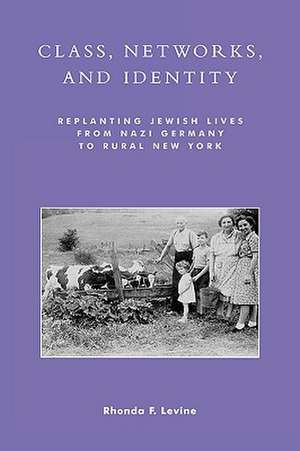
Yet Levine goes further than her analysis of German Jewish refugees. She also argues that it is possible to explain the situations of other immigrant and ethnic groups using the structure/network/identity framework that arises from this research. According to Levine, situating the lives of immigrants and refugees within the larger context of economic and social change, but without losing sight of the significance of social networks and everyday life, shows how social structure, class, ethnicity, and gender interact to account for immigrant adaptation and mobility.
Din seria Rowman & Littlefield Publishers
-
 Preț: 113.89 lei
 - 13%
 Preț: 155.38 lei
 -
 Preț: 109.93 lei
 - 20%
 Preț: 370.93 lei
 - 19%
 Preț: 323.76 lei
 - 25%
 Preț: 228.52 lei
 - 19%
 Preț: 328.78 lei
 - 28%
 Preț: 148.13 lei
 - 20%
 Preț: 191.09 lei
 - 24%
 Preț: 255.02 lei
 - 16%
 Preț: 109.26 lei
 - 31%
 Preț: 351.69 lei
 - 15%
 Preț: 127.13 lei
 - 22%
 Preț: 330.19 lei
 - 19%
 Preț: 324.21 lei
 - 30%
 Preț: 355.24 lei
 - 23%
 Preț: 258.39 lei
 -
 Preț: 402.96 lei
 - 23%
 Preț: 282.77 lei
 - 24%
 Preț: 275.28 lei
 - 31%
 Preț: 351.50 lei
 - 22%
 Preț: 331.09 lei
 - 32%
 Preț: 373.39 lei
 - 34%
 Preț: 842.33 lei
 - 19%
 Preț: 314.30 lei
 - 23%
 Preț: 363.28 lei
 - 21%
 Preț: 128.84 lei
 - 30%
 Preț: 774.75 lei
 - 23%
 Preț: 278.65 lei
 - 22%
 Preț: 266.38 lei
 - 19%
 Preț: 344.02 lei
 - 32%
 Preț: 594.45 lei
 - 31%
 Preț: 566.85 lei
 - 22%
 Preț: 367.22 lei
 - 19%
 Preț: 322.03 lei
 - 16%
 Preț: 148.06 lei
 - 21%
 Preț: 369.53 lei
 - 19%
 Preț: 323.37 lei
 - 20%
 Preț: 314.77 lei
 - 30%
 Preț: 424.70 lei
 - 25%
 Preț: 344.18 lei
 - 30%
 Preț: 703.64 lei
 - 14%
 Preț: 152.49 lei
 - 30%
 Preț: 847.72 lei
 - 19%
 Preț: 316.66 lei
 - 23%
 Preț: 283.57 lei
 - 29%
 Preț: 727.24 lei
 - 23%
 Preț: 262.16 lei
 - 19%
 Preț: 343.92 lei
Preț: 359.82 lei
Preț vechi: 469.30 lei
-23%
Puncte Express: 540
Carte tipărită la comandă
Livrare economică 04-18 decembrie
Livrare prin curier în România Termenul estimat este afișat lângă disponibilitate.
Transport gratuit de la 400.00 lei Plată online sau ramburs, în funcție de opțiunile comenzii.
Retur gratuit în 14 zile Comandă securizată și suport în română.
Specificații
ISBN-13: 9780742509931
ISBN-10: 0742509931
Pagini: 224
Dimensiuni: 145 x 231 x 14 mm
Greutate: 0.35 kg
Ediția:0240
Editura: Bloomsbury Publishing
Colecția Rowman & Littlefield
Seria Rowman & Littlefield Publishers
Locul publicării:New York, United States
ISBN-10: 0742509931
Pagini: 224
Dimensiuni: 145 x 231 x 14 mm
Greutate: 0.35 kg
Ediția:0240
Editura: Bloomsbury Publishing
Colecția Rowman & Littlefield
Seria Rowman & Littlefield Publishers
Locul publicării:New York, United States
V-ar putea interesa
-
 Jewish Terrorism in IsraelAmi PedahzurPreț: 227.47 lei
 -
 Preț: 255.57 lei
 -
 Modern Ladino CultureOlga BorovayaPreț: 271.53 lei
 -
 David FranksMark Abbott SternPreț: 249.12 lei
 -
 In Ishmael's House: A History of Jews in Muslim LandsMartin GilbertPreț: 176.27 lei
 -
 Risky Genes: Genetics, Breast Cancer and Jewish IdentityJessica Mozersky-18%Preț: 1250.28 lei1524.74 lei
 -
 Preț: 320.77 lei
 -
 Muscular Judaism: The Jewish Body and the Politics of RegenerationTodd Samuel PresnerPreț: 467.12 lei
 -
 The Jewish-Chinese Nexus: A Meeting of CivilizationsM. Avrum EhrlichPreț: 470.52 lei
 -
 When They Come for Us, We'll Be GoneGal BeckermanPreț: 121.50 lei
 -
 Jewish Renaissance in the Russian RevolutionKenneth B. MossPreț: 462.54 lei
 -
 Moses MontefioreAbigail GreenPreț: 223.21 lei
 -
 Capitalism and the JewsJerry Z. MullerPreț: 172.33 lei
 -
 Of Jews and AnimalsAndrew Benjamin-17%Preț: 179.70 lei215.86 lei
 -
 We Are Here: Memories of the Lithuanian HolocaustEllen CassedyPreț: 114.15 lei
 -
 Jews in the Early Modern English Imagination: A Scattered NationEva Johanna Holmberg-18%Preț: 1293.33 lei1577.23 lei
 -
 On the Nation and the 'Jewish People'Shlomo SandPreț: 110.89 lei
Cuprins
Chapter 1 Structural Adaptation, Social Networks, and Ethnic Identity: The Untold Story of Rural German Jewish Immigrants
Chapter 2 Old World Patterns: Cattle Dealing and Jewish Life in Rural Germany
Chapter 3 Disrupted Lives: From Nazi Germany to Washington Heights
Chapter 4 The Story of Milk
Chapter 5 Plowing New Fields: Resettling in Rural New York
Chapter 6 Old Patterns in a New Setting: Cattle Dealing and German Jews
Chapter 7 Getting Together: Creating Community and Maintaining Ethnic Identity
Chapter 8 Continuities and Discontinuities
Chapter 9 Finding Sociology in Unlikely Places
Chapter 10 References
Chapter 2 Old World Patterns: Cattle Dealing and Jewish Life in Rural Germany
Chapter 3 Disrupted Lives: From Nazi Germany to Washington Heights
Chapter 4 The Story of Milk
Chapter 5 Plowing New Fields: Resettling in Rural New York
Chapter 6 Old Patterns in a New Setting: Cattle Dealing and German Jews
Chapter 7 Getting Together: Creating Community and Maintaining Ethnic Identity
Chapter 8 Continuities and Discontinuities
Chapter 9 Finding Sociology in Unlikely Places
Chapter 10 References
Recenzii
Levine has done the readers of this book an important service in two ways. She has captured with enormous sensitivity an interesting part of American Jewish history. At the same time, she has provided students of sociology with a rich case study that demonstrates the intersection of social networks and the nature of ethnic identity.
Like a sociological Proust, Levine has rescued an extraordinary story from the edge of oblivion. The tale of how rural German Jews succeeded in escaping the clutches of the Third Reich and reestablished a familiar world in rural New York has the plot elements that a novelist would envy. Yet, remarkably, it also has much to tell us about how immigrants construct worlds of meaning that blend aspects of their former and current homes, while ingeniously exporting the few niches that social and economic structures leave open to them. Levine tells the story with great sensitivity to the human pain and creativity it reveals and with a wonderful eye for the multiple layers of sociological explanation it requires.
Tracing the transplantation of this unexpected occupation, Levine uses her case of refugees from Nazi Germany to deliver all sorts of novel insights into processes of immigration and adaptation, political economy and social identity. History, fieldwork, and theory are fused to produce global ethnography at its very best.
A book about Jewish cattle dealers in upstate New York? What will sociologists think to write about next? Yet, it's a wonderful story and an instructive one - about refugees who reconstructed their lives by finding a niche in the American economy and thereby surviving, economically, and culturally. Rhonda Levine doesn't forget that women were half the story. Try it; you'll enjoy it, and you'll learn from it.
Sophisticated and satisfying. By depicting the variables of social structure, class, and gender, as well as past group historical experience and contemporary historical reality that need to be considered when trying to understand immigrant socioeconomic adaptation and identity formation, Levine has made a singular contribution to understanding immigrant and ethnic mobility. All academic levels.
Levine's study of German-Jewish cattle dealers is a richly researched and lively report on an unusual ethnic community and an invaluable addition to the fields of ethnic rural sociology and Jewish community studies. Class, Networks, and Identity is a rare gem of a book as Levine follows an ethnic population from its community of origin through emigration and immigration to acculturation and dissolution.
A valuable contribution to the ethnography of American Jewry and the sociology of immigration processes. The book is well-written, tightly organized, and accessible, and it will be a useful case study for scholars and teachers in rural sociology, immigration studies, and Jewish studies.
A valuable contribution to the ethnography of American Jewry and the sociology of immigration process. Levine has created a valuable picture of an immigrant experience previously neglected by sociological studies. The book is well-written, tightly organized, and accessible, and it will be a useful case study for scholars and teachers in rural sociology, immigration studies, and Jewish studies.
It is an interesting work.
A well-researched and engagingly presented study. An interesting and useful study that historians and sociologists of immigration should add to their collections. It will also be of interest to students of gender relations and to those seeking to link different-level dimensions of social life in their analysis.
Like a sociological Proust, Levine has rescued an extraordinary story from the edge of oblivion. The tale of how rural German Jews succeeded in escaping the clutches of the Third Reich and reestablished a familiar world in rural New York has the plot elements that a novelist would envy. Yet, remarkably, it also has much to tell us about how immigrants construct worlds of meaning that blend aspects of their former and current homes, while ingeniously exporting the few niches that social and economic structures leave open to them. Levine tells the story with great sensitivity to the human pain and creativity it reveals and with a wonderful eye for the multiple layers of sociological explanation it requires.
Tracing the transplantation of this unexpected occupation, Levine uses her case of refugees from Nazi Germany to deliver all sorts of novel insights into processes of immigration and adaptation, political economy and social identity. History, fieldwork, and theory are fused to produce global ethnography at its very best.
A book about Jewish cattle dealers in upstate New York? What will sociologists think to write about next? Yet, it's a wonderful story and an instructive one - about refugees who reconstructed their lives by finding a niche in the American economy and thereby surviving, economically, and culturally. Rhonda Levine doesn't forget that women were half the story. Try it; you'll enjoy it, and you'll learn from it.
Sophisticated and satisfying. By depicting the variables of social structure, class, and gender, as well as past group historical experience and contemporary historical reality that need to be considered when trying to understand immigrant socioeconomic adaptation and identity formation, Levine has made a singular contribution to understanding immigrant and ethnic mobility. All academic levels.
Levine's study of German-Jewish cattle dealers is a richly researched and lively report on an unusual ethnic community and an invaluable addition to the fields of ethnic rural sociology and Jewish community studies. Class, Networks, and Identity is a rare gem of a book as Levine follows an ethnic population from its community of origin through emigration and immigration to acculturation and dissolution.
A valuable contribution to the ethnography of American Jewry and the sociology of immigration processes. The book is well-written, tightly organized, and accessible, and it will be a useful case study for scholars and teachers in rural sociology, immigration studies, and Jewish studies.
A valuable contribution to the ethnography of American Jewry and the sociology of immigration process. Levine has created a valuable picture of an immigrant experience previously neglected by sociological studies. The book is well-written, tightly organized, and accessible, and it will be a useful case study for scholars and teachers in rural sociology, immigration studies, and Jewish studies.
It is an interesting work.
A well-researched and engagingly presented study. An interesting and useful study that historians and sociologists of immigration should add to their collections. It will also be of interest to students of gender relations and to those seeking to link different-level dimensions of social life in their analysis.