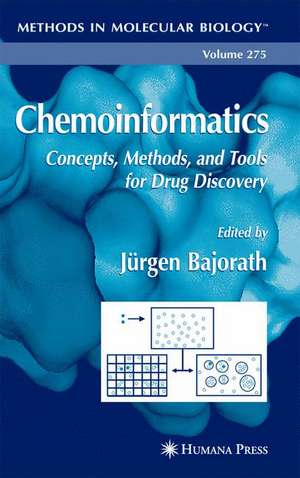
Chemoinformatics
Editat de Jürgen Bajorathen Limba Engleză Hardback – 12 mai 2004
Merită menționat că volumul Chemoinformatics este susținut de o bibliografie extensivă de rapoarte de cercetare originale și resurse metodologice, oferind acces la strategii testate în laboratoarele de cercetare farmaceutică internațională. Putem afirma că lucrarea coordonată de Jürgen Bajorath nu se limitează la teorie, ci funcționează ca un ghid tehnic riguros, axat pe ceea ce funcționează și ce eșuează în practica curentă a descoperirii medicamentelor. Ca și Barry A. Bunin în Chemoinformatics: Theory, Practice, & Products, autorul distilează experiență reală în principii acționabile, însă Jürgen Bajorath pune un accent deosebit pe integrarea chimiei cu informatica și biologia chimică. Această abordare este o continuare firească a temelor explorate de autor în lucrarea sa anterioară, Chemoinformatics and Computational Chemical Biology, unde analiza interacțiunilor țintă-ligand și designul bibliotecilor de compuși erau piloni centrali. În volumul de față, perspectiva este extinsă către infrastructura sistemelor și optimizarea lead-urilor în context industrial. Structura cărții este organizată logic, în 15 capitole, facilitând o progresie tehnică de la bazele modelării la aplicații complexe. Primele secțiuni funcționează ca un tutorial critic pentru evitarea capcanelor în construirea modelelor predictive, urmate de analize avansate precum teoria mulțimilor brute pentru expresia genelor și modelele Naïve Bayesian. Această organizare permite cercetătorilor să navigheze de la evaluarea screening-ului virtual până la implementarea unor sisteme integrate, beneficiind de expertiza cumulată a peste trei decenii de dezvoltare software în domeniu.
Preț: 1154.16 lei
Preț vechi: 1214.90 lei
-5%
Carte tipărită la comandă
Livrare economică 07-21 decembrie
Specificații
ISBN-10: 1588292614
Pagini: 540
Ilustrații: XIV, 524 p.
Dimensiuni: 160 x 241 x 38 mm
Greutate: 1.02 kg
Ediția:2004
Editura: Humana
Locul publicării:Totowa, NJ, United States
V-ar putea interesa
-
 Comprehensive Medicinal Chemistry IIISamuel Chackalamannil-28%Preț: 30362.14 lei42101.46 lei
 -
 Oxford Handbook of PaediatricsRobert C. TaskerPreț: 283.95 lei
 -
 Oxford Handbook of Nutrition and DieteticsJoan Webster-GandyPreț: 297.47 lei
 -
 Medical Biochemistry at a GlanceJ. G. Salway-5%Preț: 307.35 lei323.52 lei
 -
 Essentials of Pharmaceutical ChemistryDonald Cairns-6%Preț: 352.10 lei373.93 lei
 -
 Exploiting Chemical Diversity for Drug DiscoveryPaul A Bartlett-14%Preț: 1171.98 lei1362.77 lei
 -
 -9%Preț: 1478.93 lei1625.20 lei
 -
 Introduction to the Pharmaceutical Sciences: An Integrated ApproachNita K. Pandit PhD-21%Preț: 589.95 lei747.92 lei
 -
 -22%Preț: 116.89 lei149.23 lei
 -
 -14%Preț: 5094.94 lei5924.35 lei
 -
 In Silico Medicinal ChemistryNathan Brown-14%Preț: 1349.59 lei1569.30 lei
 -
 Foye's Principles of Medicinal ChemistryKimberly Beck PhD-16%Preț: 695.93 lei833.32 lei
 -
 Statistics for ScientistsUmberto Michelucci-20%Preț: 279.62 lei349.53 lei
 -
 -14%Preț: 983.36 lei1143.44 lei
 -
 Computational Drug DiscoveryVasanthanathan Poongavanam-14%Preț: 1726.96 lei2008.09 lei
 -
 -14%Preț: 850.79 lei989.29 lei
 -
 Chemogenomics and Chemical GeneticsEric Marechal-15%Preț: 670.71 lei789.07 lei
Public țintă
ResearchDe ce să citești această carte
Această lucrare este esențială pentru cercetătorii din chimia computațională și farmaceutică, oferind un set de bune practici validate industrial. Cititorul câștigă acces la studii de caz reale și metodologii de optimizare care reduc riscul de eroare în modelarea predictivă. Este un instrument practic pentru oricine dorește să înțeleagă cum infrastructura informatică poate accelera descoperirea de noi compuși terapeutici, economisind timp și resurse experimentale.
Despre autor
Jürgen Bajorath este un expert recunoscut la nivel mondial în domeniul chimioinformaticii și al modelării computaționale aplicate în biologia chimică. Cu o carieră marcată de numeroase contribuții în designul medicamentelor și analiza structură-activitate, el ocupă poziții academice de prestigiu și colaborează strâns cu industria farmaceutică. Lucrările sale sunt fundamentale pentru înțelegerea modului în care datele chimice complexe pot fi transformate în cunoștințe aplicabile pentru identificarea de noi ținte terapeutice.
Descriere scurtă
Cuprins
Recenzii
Textul de pe ultima copertă
State-of-the-art and user-friendly, Chemoinformatics: Concepts, Methods, and Tools for Drug Discovery illuminates the conceptual and methodological diversity of this rapidly evolving field and offers instructive examples of cutting-edge applications in the drug discovery process.
Notă biografică
JÜRGEN BAJORATH, PhD, is Chair of Life Science Informatics at the University of Bonn and also an Affiliate Professor in the Department of Biological Structure at the University of Washington. In addition, he has more than 10 years' experience in drug disovery. His research focuses on the development of computational methods for medicinal chemistry and chemical biology. Dr. Bajorath holds 26 patents, has authored more than 400 scientific articles, and edited four books.
Descriere
Chemoinformatics strategies to improve drug discovery results With contributions from leading researchers in academia and the pharmaceutical industry as well as experts from the software industry, this book explains how chemoinformatics enhances drug discovery and pharmaceutical research efforts, describing what works and what doesn't. Strong emphasis is put on tested and proven practical applications, with plenty of case studies detailing the development and implementation of chemoinformatics methods to support successful drug discovery efforts. Many of these case studies depict groundbreaking collaborations between academia and the pharmaceutical industry. Chemoinformatics for Drug Discovery is logically organized, offering readers a solid base in methods and models and advancing to drug discovery applications and the design of chemoinformatics infrastructures. The book features 15 chapters, including: * What are our models really telling us? A practical tutorial on avoiding common mistakes when building predictive models * Exploration of structure-activity relationships and transfer of key elements in lead optimization * Collaborations between academia and pharma * Applications of chemoinformatics in pharmaceutical research-experiences at large international pharmaceutical companies * Lessons learned from 30 years of developing successful integrated chemoinformatic systems Throughout the book, the authors present chemoinformatics strategies and methods that have been proven to work in pharmaceutical research, offering insights culled from their own investigations. Each chapter is extensively referenced with citations to original research reports and reviews. Integrating chemistry, computer science, and drug discovery, Chemoinformatics for Drug Discovery encapsulates the field as it stands today and opens the door to further advances.