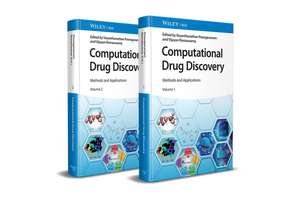
Computational Drug Discovery
Editat de Vasanthanathan Poongavanam, Vijayan Ramaswamyen Limba Engleză Hardback – 21 feb 2024
În contextul actual al cercetării farmaceutice, unde viteza de identificare a compușilor activi este critică, Computational Drug Discovery – Methods and Applications se poziționează ca o resursă academică și tehnică de referință. Considerăm că această lucrare în două volume reprezintă un pilon esențial pentru curriculumul de chimie computațională și design de medicamente, oferind o sinteză între bazele teoretice și aplicațiile industriale recente. Ne-a atras atenția în mod deosebit modul în care V Poongavanam integrează progresele din inteligența artificială, precum predicția structurii proteinelor și screening-ul virtual generativ, cu infrastructura modernă de calcul de tip cloud și quantum. Lucrarea acoperă aceeași arie tematică precum Computational Drug Discovery and Design de Mohini Gore, dar se distinge printr-o abordare mult mai extinsă asupra noilor modalități terapeutice. În timp ce volumul lui Gore se concentrează pe metodele clasice de optimizare a lead-urilor, ediția de față explorează frontierele designului de tip PROTACs și al „molecular glues”, oferind soluții pentru ținte biologice considerate anterior inaccesibile. De asemenea, spre deosebire de Quantum Mechanics in Drug Discovery, care este focalizat strict pe metodele QM, acest tratat oferă o perspectivă interdisciplinară, legând mecanica cuantică de dinamica moleculară și big data. Structura celor opt secțiuni tematice ghidează cititorul de la fundamentele termodinamicii solvării și cinetica legării drug-target, către aplicații complexe de deep learning. Progresia editorială este logică: primele volume așază fundamentul fizico-chimic prin QM/MM, urmând ca secțiunile ulterioare să abordeze navigarea în spațiul chimic și predicțiile ADMET in silico, esențiale pentru reducerea ratei de eșec în studiile clinice.
Preț: 1726.96 lei
Preț vechi: 2008.09 lei
-14%
Carte disponibilă
Livrare economică 07-21 noiembrie
Livrare express 27-31 octombrie pentru 85.99 lei
Specificații
ISBN-10: 3527351663
Pagini: 736
Ilustrații: 27 schwarz-weiße Tabellen
Dimensiuni: 176 x 251 x 44 mm
Greutate: 1.69 kg
Ediția:2 Volumes
Editura: Wiley-VCH GmbH
Locul publicării:Weinheim, Germany
V-ar putea interesa
-
 Preț: 156.59 lei
 -
 Chemistry of Aldehydes and KetonesRakesh GiriPreț: 291.50 lei
 -
 Advances in The Chemistry and Applications of FluoroquinolonesNesrin Mahmoud Morsy MohamedPreț: 290.38 lei
 -
 Adsorption sur Matériaux Fibreux CationiquesMohamed Hassen V Baouab-8%Preț: 484.50 lei526.64 lei
 -
 Les complexes mixtes de cuivre(II)Hadda Bougherra-8%Preț: 422.73 lei459.50 lei
 -
 LIMNOLOGIARenee Condori ApazaPreț: 364.12 lei
 -
 Variación de la Concentración de MetanolAmadeo Collado PachecoPreț: 255.08 lei
 -
 Resíduos do controle químico de pragas urbanas:Grice Anne Dos Santos Vaz-8%Preț: 421.47 lei458.12 lei
 -
 L'indice de réfraction et son applicationRupali SethiPreț: 244.89 lei
 -
 El índice de refracción y su aplicaciónRupali SethiPreț: 244.89 lei
 -
 Preț: 170.30 lei
 -
 Badania biochemiczne i immunologiczneTaghreed Abdul Hameed Al-SadoonPreț: 396.08 lei
 -
 -8%Preț: 558.98 lei607.59 lei
 -
 Preț: 256.29 lei
De ce să citești această carte
Recomandăm această lucrare profesioniștilor din industria biotech și cercetătorilor care doresc să stăpânească instrumentele de AI și quantum computing aplicate în farmacologie. Cititorul câștigă acces la metodologii de ultimă oră pentru screening virtual la scară ultra-largă și design de inhibitori covalenți, beneficiind de expertiza combinată a mediului academic și a furnizorilor de software de top. Este o investiție necesară pentru orice laborator modern de design rațional al medicamentelor.
Cuprins
Volume 1:
PART I. MOLECULAR DYNAMICS AND RELATED METHODS IN DRUG DISCOVERY
Binding Free Energy Calculations in Drug Discovery
Gaussian Accelerated Molecular Dynamics in Drug Discovery
MD Simulations for Drug-Target (Un)Binding Kinetics
Solvation Thermodynamics and its Competitive Saturation as a Paradigm of Co-Solvent Methods
PART II. QUANTUM MECHANICS APPLICATION FOR DRUG DISCOVERY
QM/MM Approaches for Structure Based Drug Design: Techniques and Applications
Recent Advances in Practical Quantum Mechanics and Mixed-QM/MM Driven X-Ray Crystallography and Cryo-Electron Microscopy (Cryo-EM) and their Impact on Structure-Based Drug Discovery
Quantum-Mechanical Analyses of Interactions for Biochemical Applications
PART III. ARTIFICIAL INTELLIGENCE IN PRE-CLINICAL DRUG DISCOVERY
The Role of Computer Aided Drug Design in Drug Discovery - An Introduction
AI-Based Protein Structure Predictions and their Implications in Drug Discovery
Deep Learning for the Structure-Based Binding Free Energy Prediction of Small Molecule Ligands
Using Artificial Intelligence for the De Novo Drug Design and Retrosynthesis
Reliability and Applicability Assessment for Machine Learning Models
Volume 2:
PART IV. CHEMICAL SPACE AND KNOWLEDGE BASED DRUG DISCOVERY
Enumerable Libraries and Accessible Chemical Space
Navigating Chemical Space
Visualization, Exploration, and Screening of Chemical Space in Drug Discovery
SAR Knowledge Based for Driving Drug Discovery
Cambridge Structural Database (CSD) - Drug Discovery through Data Mining and Knowledge Based Tools
PART V. STRUCTURE-BASED VIRTUAL SCREENING USING DOCKING
Structure-Based Ultra-Large Scale Virtual Screenings
Community Benchmarking Exercises for Docking and Scoring
PART VI. IN SILICO ADMET MODELLING
Advances in the Application of In Silico ADMET Models - An Industry Perspective
PART VII. COMPUTATIONAL APPROACHES FOR NEW THERAPEUTIC MODALITIES
Modelling the Structures of Ternary Complexes Mediated by Molecular Glues
Free Energy Calculations in Covalent Drug Design
PART VIII. COMPUTING TECHNOLOGIES DRIVING DRUG DISCOVERY
Orion® A Cloud-Native Molecular Design Platform
Cloud-Native Rendering Platform and GPUs Aid Drug Discovery
The Quantum Computing Paradigm
Descriere scurtă
Descriere
Notă biografică
a Drug Research Academy Fellow at the University of Copenhagen, Denmark, on computational modeling of Cytochrome P450. His research interests focus on understanding the molecular properties that govern the pharmacokinetic profile of molecules beyond the Ro5 space, including macrocycles and PROTACs.
Vijayan Ramaswamy is a research scientist with the Structural Chemistry group at the Institute for Applied Cancer Science, University of Texas MD Anderson Cancer, TX, USA. Before starting at the MD Anderson Cancer in 2016, he was a postdoctoral fellow at Rutgers University, NJ, USA, and at Temple University, PA, USA. He received his Ph.D as a CSIR senior research fellow from the Indian Institute of Chemical Biology, Kolkata, India. His research focuses on applying computational chemistry methods to drive small-molecule drug discovery programs, particularly in oncology and neurodegenerative diseases.