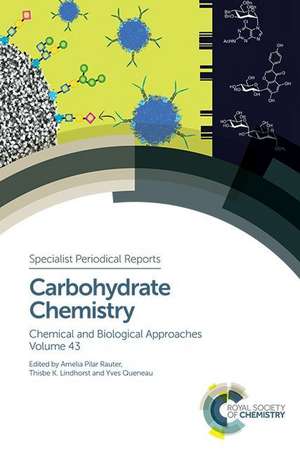
Carbohydrate Chemistry
en Limba Engleză Hardback – 13 dec 2017
Adresat studenților la masterat, cercetătorilor din biochimie și practicienilor din industria farmaceutică, acest volum oferă o sinteză riguroasă a progreselor recente în chimia zaharidelor. Carbohydrate Chemistry, ajuns la numărul 40 în prestigioasa serie Specialist Periodical Reports a Royal Society Of Chemistry, demonstrează rolul critic al gliconștiințelor în progresul societății contemporane. Observăm o structură densă, de 670 de pagini, care acoperă atât fundamentul teoretic al sintezei, cât și aplicațiile practice în biologie. Remarcăm modul în care editorii Amelia Pilar Rauter, Thisbe K. Lindhorst și Yves Queneau au selectat contribuțiile pentru a evidenția convergența dintre chimia organică și biologia moleculară. Lucrarea extinde cadrul propus de Recent Trends in Carbohydrate Chemistry cu date noi din perioada recentă, punând un accent mai mare pe inovația sistemică și pe impactul social al noilor descoperiri. Apreciem rigoarea metodologică și actualitatea surselor citate, volumul servind drept o arhivă critică a stadiului actual al cercetării, similară ca profunzime cu seria Advances in Carbohydrate Chemistry and Biochemistry, dar cu o orientare specifică spre abordările chimico-biologice integrate. Textul în limba engleză este tehnic, fiind esențial pentru cei care urmăresc ultimele metodologii de laborator și tendințele în designul glicoconjugaților.
Preț: 2486.04 lei
Preț vechi: 3405.54 lei
-27%
Carte tipărită la comandă
Livrare economică 05-19 decembrie
Specificații
ISBN-10: 1788010035
Pagini: 276
Dimensiuni: 156 x 234 x 18 mm
Greutate: 0.57 kg
Editura: Royal Society Of Chemistry
V-ar putea interesa
-
 -28%Preț: 621.49 lei861.80 lei
-
 The Heavier d-Block Metals: Aspects of Inorganic and Coordination ChemistryCatherine E. HousecroftPreț: 197.61 lei
-
 Exercises in Synthetic Organic ChemistryChiara Ghiron-34%Preț: 516.74 lei778.38 lei
-
 Introduction to GlycobiologyMaureen E. Taylor-15%Preț: 519.10 lei610.51 lei
-
 Advanced Organic ChemistryFrancis A. Carey-17%Preț: 433.52 lei522.32 lei
-
 Organic SynthesisMichael Smith-31%Preț: 835.23 lei1208.85 lei
-
 Clinical ChemistryWilliam J. Marshall-5%Preț: 357.78 lei376.60 leiRecomandat
-
 Studies in Natural Products ChemistryAtta-Ur-Rahman-31%Preț: 1488.37 lei2167.02 lei
-
 -19%Preț: 434.93 lei536.95 lei
-
 Organosilanes in Radical ChemistryChryssostomos Chatgilialoglu-9%Preț: 1562.78 lei1717.34 lei
-
 Guidebook to Mechanism in Organic ChemistryPeter Sykes-13%Preț: 577.74 lei664.08 lei
-
 Nomenclature of Organic ChemistryHenri A Favre-14%Preț: 1430.37 lei1663.21 lei
-
 Glycobiology Research TrendsGeorge Powell-26%Preț: 735.35 lei995.39 lei
-
 Oligosaccharides: Sources, Properties & ApplicationsNicole S Gordon-26%Preț: 1359.62 lei1849.65 lei
-
 Essentials of Glycobiology, Third EditionAjit Varki-23%Preț: 979.36 lei1271.90 lei
-
 -27%Preț: 1578.86 lei2151.98 lei
-
 Chemistry Research Summaries.: Volume 10 with Biographical SketchesLucille Monaco Cacioppo-27%Preț: 1798.17 lei2449.96 lei
-
 Sulfated PolysaccharidesMiguel Gama Ph.D.-27%Preț: 1636.68 lei2229.56 lei
-
 Carbohydrate ChemistryAmélia Pilar Rauter-27%Preț: 2403.58 lei3292.58 lei
-
 BIOS Instant Notes in Organic ChemistryGraham PatrickPreț: 268.54 lei
-
 Modern Molecular Photochemistry of Organic MoleculesNicholas J. Turro-23%Preț: 854.71 lei1110.01 lei
-
 -18%Preț: 1000.25 lei1219.82 lei
-
 Carbohydrate–Based TherapeuticsR Adamo-14%Preț: 884.33 lei1028.28 lei
-
 Overcoming Synthetic Challenges in Medicinal ChemistryTongshuang Li-23%Preț: 678.05 lei880.59 lei
-
 Glycoscience: Chemistry and Chemical BiologyGregory L. Coté-18%Preț: 3054.82 lei3725.39 lei
-
 -24%Preț: 701.43 lei922.93 lei
De ce să citești această carte
Cercetătorii și studenții avansați beneficiază de o imagine de ansamblu asupra celor mai noi strategii de sinteză și analiză în gliconștiințe. Cartea oferă acces la expertiza colectivă a unor lideri în domeniu, fiind un instrument de referință pentru documentarea proiectelor de cercetare biomedicală și dezvoltare tehnologică, unde carbohidrații joacă un rol central în inovație.
Despre autor
Amelia Pilar Rauter este o personalitate proeminentă în chimia carbohidraților, profesor la Universitatea din Lisabona și editor experimentat pentru publicații de prestigiu ale Royal Society of Chemistry. Alături de Thisbe K. Lindhorst, specialistă în chimie organică la Universitatea din Kiel, și Yves Queneau, director de cercetare la CNRS în Lyon, aceștia formează o echipă editorială cu o vastă experiență internațională. Expertiza lor combinată acoperă sinteza organică, glicobiologia și aplicațiile industriale, asigurând o selecție riguroasă a materialelor științifice publicate în seria Specialist Periodical Reports.