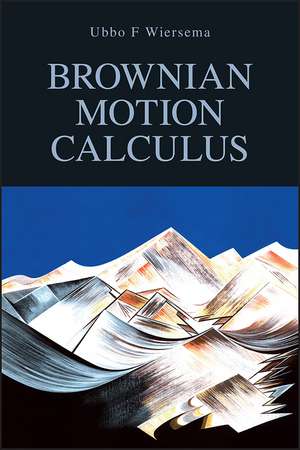
Brownian Motion Calculus
Autor Ubbo F. Wiersemaen Limba Engleză Paperback – 15 apr 2008
Actualizarea oferită de Brownian Motion Calculus în peisajul literaturii financiare constă în simplificarea riguroasă a trecerii de la modelele discrete la cele în timp continuu. Notăm cu interes faptul că Ubbo F. Wiersema nu presupune o cunoaștere prealabilă a proceselor stocastice complexe, ci își construiește argumentația plecând de la „random walk” — un concept intuitiv pentru orice student familiarizat cu analiza matematică standard. Recomandăm acest volum pentru modul în care reușește să demistifice transformarea Girsanov, tratând-o nu ca pe un artificiu matematic, ci ca pe o unealtă logică esențială în evaluarea derivatelor financiare. Structura cărții urmărește o progresie didactică precisă: primele capitole definesc mișcarea browniană și proprietățile martingalelor, elemente ce devin ulterior fundamentul pentru integrarea stocastică Ito. Descoperim aici o abordare practică a ecuațiilor diferențiale stocastice, unde formula lui Ito este prezentată ca un set de reguli operaționale, facilitând aplicarea imediată în modelarea prețurilor acțiunilor. Pe linia practică a lucrării Stochastic Calculus for Finance II de Steven Shreve, dar cu focus pe un parcurs introductiv mai gradual, volumul de față servește drept punte între intuiție și formalismul tehnic regăsit în lucrări mai dense precum Brownian Motion and Stochastic Calculus de Ioannis Karatzas. Finalul volumului se concentrează pe aplicații concrete în evaluarea opțiunilor și utilizarea numeraire-ului pentru eficientizarea calculelor. Prezența exercițiilor rezolvate integral transformă textul dintr-un simplu suport de curs într-un instrument de lucru autonom, ideal pentru cei care doresc să stăpânească mecanica din spatele modelelor financiare moderne fără a se pierde în demonstrații de teoria măsurii.
Preț: 363.71 lei
Carte disponibilă
Livrare economică 29 octombrie-12 noiembrie
Livrare express 15-21 octombrie pentru 39.13 lei
Specificații
ISBN-10: 0470021705
Pagini: 336
Dimensiuni: 152 x 229 x 18 mm
Greutate: 0.48 kg
Editura: John Wiley & Sons, Inc.
Locul publicării:Chichester, United Kingdom
V-ar putea interesa
-
 An Introduction to Quantitative FinanceStephen Blyth-12%Preț: 364.59 lei414.55 lei
 -
 Mastering Derivatives MarketsFrancesca Taylor-19%Preț: 443.13 lei547.07 lei
 -
 Statistics for FinanceErik Lindström-8%Preț: 438.66 lei476.80 lei
 -
 Intermediate Financial TheoryJean-Pierre Danthine-33%Preț: 444.06 lei666.40 lei
 -
 Paul Wilmott on Quantitative Finance 2e +CD 3V SetPaul Wilmott-23%Preț: 1382.43 lei1795.36 lei
 -
 Paul Wilmott Introduces Quantitative FinancePaul Wilmott-19%Preț: 450.62 lei556.31 lei
 -
 Numerical Methods in Finance with C++Maciej J. Capi¿skiPreț: 329.19 lei
 -
 Financial Mathematics: A Comprehensive Treatment in Discrete TimeGiuseppe Campolieti-8%Preț: 482.52 lei524.48 lei
 -
 Introduction to Stochastic Finance with Market ExamplesNicolas Privault-9%Preț: 984.40 lei1081.76 lei
 -
 Introduction to Stochastic Calculus Applied to FinanceDamien LambertonPreț: 448.87 lei
 -
 -18%Preț: 800.09 lei975.71 lei
 -
 Foundations of the Pricing of Financial DerivativesRobert E Brooks-8%Preț: 512.83 lei557.43 lei
 -
 An Introduction to Mathematical Finance with ApplicationsArlie O. Petters-15%Preț: 483.63 lei568.97 lei
 -
 Financial Mathematics: From Discrete to Continuous TimeKevin J. Hastings-14%Preț: 814.66 lei947.29 lei
 -
 Computation and Simulation for FinanceCónall Kelly-17%Preț: 408.65 lei492.34 lei
 -
 Probability Theory IIAndrea PascucciPreț: 470.50 lei
 -
 An Introduction to the Modern Martingale Theory and ApplicationsWilfredo Urbina-Romero-13%Preț: 398.10 lei457.59 lei
 -
 Mathematical Finance: Theory Review and ExercisesEmanuela Rosazza GianinPreț: 357.66 lei
 -
 Financial MathematicsAndrea PascucciPreț: 458.33 lei
 -
 Introduction to Stochastic CalculusRajeeva L. Karandikar-18%Preț: 681.55 lei831.16 lei
Public țintă
Suitable for finance masters courses sometimes as a stand alone course and sometimes as part of the financial mathematics/derivatives modulesDe ce să citești această carte
Recomandăm această carte studenților la masterat și profesioniștilor care doresc să înțeleagă calculul stocastic fără barierele matematice excesive. Veți câștiga o bază solidă în utilizarea integralei Ito și a transformării Girsanov, abilități critice pentru evaluarea corectă a instrumentelor derivate. Este un ghid practic care transformă conceptele abstracte în instrumente de calcul aplicabile imediat în modelarea financiară.
Cuprins
1. Brownian Motion Origins Notion of a Random Process Brownian Motion Stock Price Dynamics Construction of Brownian Motion from a Discrete Symmetric Random Walk Features of Brownian Motion Paths Computations with Brownian motion References Examples 2. Martingales Introduction Filtration Conditional Expectation Martingale Martingale examples References Examples 3. Ito Stochastic Integration How a Stochastic integral arises in stock trading Construction of Ito Stochastic integral for random step functions Extension to general random integrands Summary of properties of an Ito stochastic integral Reference Examples 4. Ito Calculus Stochastic differential notation Taylor's expansion in ordinary calculus Ito's formula as a set of rules Illustrations of Ito's formula Justification of Ito's formula References Examples 5. Stochastic differential equations Structure of a stochastic differental equation Stocastic differntail equations arising in finance Finding a closed form solution Checking the solution of an sde General method for solving sde's References Examples 6. Risk-neutral probability Risk-neutral valuation - the basic concept Risk-neutral probability construction in discrete one period binomial framework Risk-neutral probability construction in the continuous framework Girsanov's theorem Radon-Nikodym derivative Numerical Illustration Motivation for Girsanov's theorem Summary References 7. Feynman-Kac Representation Stochastic Representation Derivation of simple Feynman-Kac formula Application to Black Scholes pde Generalisations Solution by Simulation References Annexes Computations with Brownian motion Riemann Integration Brownian Motion Variability Norms Einstrin's Model of Brownian Motion
Descriere scurtă
Brownian Motion Calculus Ubbo Wiersema Brownian Motion Calculus presents the basics of Stochastic Calculus with a focus on the valuation of financial derivatives. It is intended as an accessible introduction to the technical literature. The sequence of chapters starts with a description of Brownian motion, the random process which serves as the basic driver of the irregular behaviour of financial quantities. That exposition is based on the easily understood discrete random walk. Thereafter the gains from trading in a random environment are formulated in a discrete-time setting. The continuous-time equivalent requires a new concept, the ItM stochastic integral. Its construction is explained step by step, using the so-called norm of a random process (its magnitude), of which a motivated exposition is given in an Annex. The next topic is ItM's formula for evaluating stochastic integrals; it is the random process counter part of the well known Taylor formula for functions in ordinary calculus. Many examples are given. These ingredients are then used to formulate some well established models for the evolution of stock prices and interest rates, so-called stochastic differential equations, together with their solution methods. Once all that is in place, two methodologies for option valuation are presented. One uses the concept of a change of probability and the Girsanov transformation, which is at the core of financial mathematics. As this technique is often perceived as a magic trick, particular care has been taken to make the explanation elementary and to show numerous applications. The final chapter discusses how computations can be made more convenient by a suitable choice of the so-called numeraire. A clear distinction has been made between the mathematics that is convenient for a first introduction, and the more rigorous underpinnings which are best studied from the selected technical references. The inclusion of fully worked out exercises makes the book attractive for self study. Standard probability theory and ordinary calculus are the prerequisites. Summary slides for revision and teaching can be found on the book website www.wiley.com/go/brownianmotioncalculus.
Descriere
There are not many calculus books that are very accessible to students without a strong mathematical background and the large majority of financial derivatives students do not have a strong quantitative background. This book provides a short introduction to the subject with examples of its use in mathematical finance e. g pricing of derivatives.