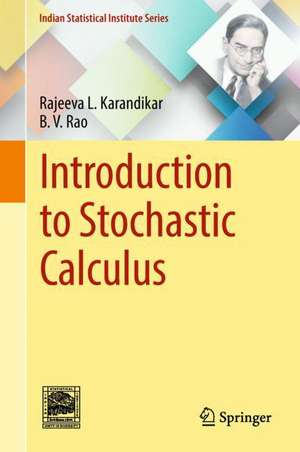
Introduction to Stochastic Calculus: Indian Statistical Institute Series
Autor Rajeeva L. Karandikar, B. V. Raoen Limba Engleză Hardback – 15 iun 2018
Notăm cu interes apariția volumului Introduction to Stochastic Calculus, o lucrare care propune o metodologie riguroasă, dar accesibilă, pentru studiul calculului stochastic. Structura materialului este organizată progresiv, debutând cu fundamentele martingalelor cu parametru discret și procesele în timp continuu, pentru a construi baza necesară înțelegerii integralei Itô. Ceea ce distinge acest volum în literatura de specialitate este abordarea inovatoare a formulelor pathwise pentru integrala stochastică, fiind prima lucrare care introduce această perspectivă pentru a simplifica tratamentul matematic fără a sacrifica rigoarea. Subliniem evoluția logică a cuprinsului, care ghidează cititorul prin concepte avansate precum topologia Emery, inegalitatea Davis și reprezentarea martingalelor ca integrale stochastice. Un punct central al lucrării îl reprezintă analiza ecuațiilor diferențiale stochastice (SDE) conduse de semi-martingale r.c.l.l., unde autorii utilizează inegalitatea Metivier–Pellaumail pentru a deriva soluții complexe. Cititorii familiarizați cu INTRO TO STOCH CALC WITH APPL, 3 ED de Klebaner Fima C vor aprecia aici profunzimea teoretică sporită și accentul pus pe demonstrațiile structurale, în timp ce, față de abordarea din Stochastic Calculus and Financial Applications de J. Michael Steele, acest volum oferă o fundamentare mai tehnică a proceselor de creștere și a schimbării aleatorii de timp. Această lucrare consolidează contribuțiile anterioare ale lui Rajeeva L. Karandikar, care în Introduction to Option Pricing Theory a explorat latura aplicată a proceselor stochastice în finanțe. Introduction to Stochastic Calculus servește drept ancoră teoretică, oferind instrumentele necesare pentru a înțelege a doua teoremă fundamentală a evaluării activelor, integrând perfect teoria pură cu necesitățile ingineriei financiare moderne.
Din seria Indian Statistical Institute Series
- 15%
 Preț: 729.44 lei
 - 5%
 Preț: 1077.26 lei
 - 20%
 Preț: 639.12 lei
 - 15%
 Preț: 666.56 lei
 -
 Preț: 410.30 lei
 - 24%
 Preț: 910.95 lei
 - 20%
 Preț: 844.09 lei
 - 24%
 Preț: 757.76 lei
 - 18%
 Preț: 989.52 lei
 - 18%
 Preț: 733.00 lei
 - 23%
 Preț: 705.54 lei
 - 24%
 Preț: 963.26 lei
 - 15%
 Preț: 528.52 lei
 - 18%
 Preț: 754.50 lei
 - 18%
 Preț: 766.77 lei
 - 15%
 Preț: 442.17 lei
Preț: 715.96 lei
Preț vechi: 873.13 lei
-18%
Carte disponibilă
Livrare economică 07-21 noiembrie
Livrare express 27-31 octombrie pentru 47.04 lei
Specificații
ISBN-10: 9811083177
Pagini: 456
Ilustrații: XIII, 441 p.
Dimensiuni: 160 x 241 x 30 mm
Greutate: 0.79 kg
Ediția:1st ed. 2018
Editura: Springer
Colecția Indian Statistical Institute Series
Seria Indian Statistical Institute Series
Locul publicării:Singapore, Singapore
De ce să citești această carte
Recomandăm această carte studenților de la facultățile de matematică și inginerie care doresc o stăpânire precisă a integralei stochastice. Cititorul câștigă o perspectivă modernă asupra semi-martingalelor și a ecuațiilor diferențiale stochastice, beneficiind de un stil compact și clar, susținut de numeroase exerciții. Este o resursă esențială pentru cei care vizează o carieră în finanțe matematice sau cercetare statistică, oferind rigoarea necesară pentru a trece de la calculul clasic la modelarea fenomenelor aleatorii.
Despre autor
Rajeeva L. Karandikar este un matematician și statistician de renume, cunoscut pentru contribuțiile sale vaste în domeniul proceselor stochastice și al aplicațiilor acestora în finanțe. În lucrările sale anterioare, precum Stochastic Processes, a explorat diversele ramuri ale probabilităților, onorând tradiția cercetării matematice de înalt nivel. Alături de B. V. Rao, Karandikar aduce în acest volum din Indian Statistical Institute Series o experiență didactică și de cercetare acumulată pe parcursul a decenii, transformând concepte abstracte în instrumente de lucru fundamentale pentru comunitatea academică internațională.