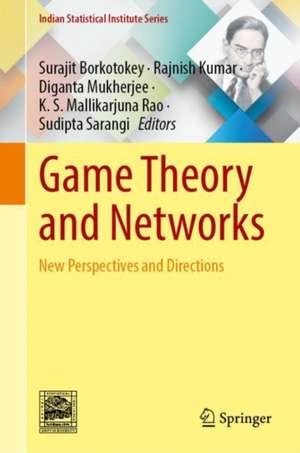
Game Theory and Networks: Indian Statistical Institute Series
Editat de Surajit Borkotokey, Rajnish Kumar, Diganta Mukherjee, K. S. Mallikarjuna Rao, Sudipta Sarangien Limba Engleză Hardback – 26 noi 2021
Găsim în această lucrare colectivă, Game Theory and Networks, o analiză riguroasă a problemelor de alocare echitabilă în contextul cozi de așteptare (queuing) și al jocurilor cooperative cu utilități transferabile. Volumul debutează prin explorarea componentelor practice, oferind soluții pentru probleme de asamblare și modele de imitație în învățare, elemente esențiale pentru cercetătorii care aplică teoria jocurilor în sisteme complexe. Notăm cu interes modul în care editorii Surajit Borkotokey și Sudipta Sarangi au structurat conținutul: primele secțiuni sunt dedicate măsurătorilor și formării rețelelor, în timp ce capitolele ulterioare extind aplicabilitatea acestor modele în domenii precum biologia (analiza datelor biologice prin grafuri) și macroeconomia. Putem afirma că volumul reușește să mențină un echilibru între avansul teoretic și accesibilitate. În timp ce contribuții precum cele semnate de Agnieszka Rusinowska despre metodele de clasificare se adresează specialiștilor, capitolele de sinteză despre teoria jocurilor evoluționiste și designul mecanismelor sunt concepute special pentru a ghida debutanții. Comparabil cu Networking Games de Vladimir Mazalov în ceea ce privește rigoarea tehnică, acest volum este actualizat pentru dinamica rețelelor sociale moderne și constrângerile de formare a acestora, oferind o perspectivă mai largă asupra preferințelor sociale și a bunurilor publice. Spre deosebire de lucrările anterioare ale editorului Surajit Borkotokey, cum este Advanced Topics in Fuzzy Algebra, care se concentrau pe structuri matematice abstracte, această apariție din Indian Statistical Institute Series ancorează teoria matematică în realități multidisciplinare. Progresia de la reguli de raționalizare la stabilitatea funcțiilor de alegere socială oferă o acoperire exhaustivă, transformând volumul într-o resursă fundamentală pentru înțelegerea interacțiunilor strategice în rețele.





Preț: 958.62 lei
Preț vechi: 1169.05 lei
-18%
Carte tipărită la comandă
Livrare economică 23 noiembrie-07 decembrie
Specificații
ISBN-10: 9811647364
Pagini: 384
Ilustrații: XIX, 362 p. 37 illus., 25 illus. in color.
Dimensiuni: 160 x 241 x 27 mm
Greutate: 0.71 kg
Ediția:1st edition 2021
Editura: Springer
Colecția Indian Statistical Institute Series
Seria Indian Statistical Institute Series
Locul publicării:Singapore, Singapore
De ce să citești această carte
Această carte se adresează cercetătorilor și studenților la masterat sau doctorat care doresc să stăpânească intersecția dintre teoria jocurilor și analiza rețelelor. Cititorul câștigă o înțelegere profundă a modului în care modelele matematice pot explica fenomene diverse, de la contagiunea economică la structurile biologice. Este o resursă esențială pentru cei care caută metode riguroase de alocare a resurselor și design de mecanisme în sisteme complexe.
Despre autor
Editorii acestui volum sunt cadre didactice și cercetători de renume, reprezentând instituții de prestigiu precum Indian Statistical Institute și universități internaționale din India și Marea Britanie. Surajit Borkotokey este recunoscut pentru contribuțiile sale în algebra fuzzy și teoria jocurilor, publicând anterior Advanced Topics in Fuzzy Algebra. Sudipta Sarangi și colegii săi de redacție aduc o expertiză vastă în economie experimentală și rețele sociale, colaborările lor fiind esențiale pentru dezvoltarea acestui domeniu interdisciplinar la nivel global.
Descriere scurtă
This book discusses the use of game theoretic tools and network models across disciplines: mathematics, statistics, economics, computer science, political science, sociology and psychology. It aims at providing a suitable learning experience to beginners on the basics of cooperative games, networks and mechanism design, as well as recent developments to research scholars having the basic knowledge of these topics.
Cuprins
Notă biografică
Rajnish Kumar is Senior Lecturerin Economics at Queen’s Management School at Queen’s University, Belfast, UK. He has earned his Ph.D. in Economics from Rice University, Houston, and the Master’s degree from the Indian Statistical Institute, New Delhi, India. His research interests include game theory, network economics, mechanism design and welfare economics. His publications include papers in the fields of fair division, network economics, industrial organization and resource allocation. He has published in journals including the Economic Theory, the European Journal of Operational Research, the International Journal of Game Theory, the Mathematical Social Sciences, the Economics Letters and the Manchester School. Dr. Kumar regularly presents in conferences like the world congress of game theory, social choice and welfare, royal economic society and others. He has been teaching undergraduate and graduate courses on game theory, microeconomics, industrial organization and economics policy. Member of professional societies like the Econometric Society, the Society of Social Choice and Welfare, The Game Theory Society and the Society of Economic Design, Dr. Kumar is recipient of several research grants including from the British Council, the Medical Research Council, the British Academy and the International Growth Centre.
Diganta Mukherjee is Associate Professor at the Sampling and Official Statistics Unit of the Indian Statistical Institute (ISI), Kolkata, India. Earlier, he taught at Jawaharlal Nehru University, New Delhi, India; the University of Essex, UK; and ICFAI Business School, India. He also worked as Consultant for NGOs and other Public Action Groups. Earlier, he has been Technical Advisor to Multi-Commodity Exchange (MCX), Mumbai; the Reserve Bank of India; the Securities and Exchange Board of India; National Sample Survey Office; National Accounts Division (Central Statistical Office), UNDP (through the Ministry of Home Affairs) and Ministry of Electronics and Information Technology. Dr. Mukherjee has been involved in several projects with large corporate houses and various ministries of the Government of India and the Government of West Bengal.
Dr. Mukherjee completed his Ph.D. from the ISI, Kolkata, in 1998, with a thesis titled “Essays on Deprivation, Poverty and Well-being”. He also completed his Master of Statistics (1995) and Bachelor of Statistics (1993) degrees from the ISI, Kolkata. His research interests are in welfare and development economics in general and multidimensional poverty in particular. He also is active in the area of finance, particularly mathematical models for pricing contracts and analysis and modelling of network data. An author of four books, Dr. Mukherjee has also published over 90 research articles in several journals of repute. He was included in the “2000 Outstanding Intellectuals of the 21st Century” list by the International Biographical Centre, Cambridge, UK, in 2011. A recipient of the National Talent Search Award in 1988 by the National Council of Educational Research and Training, Dr. Mukherjee has delivered invited talks and lectures at universities and institutions around the country.
K. S. Mallikarjuna Rao is Professor at the Department of Industrial Engineering and Operations Research, Indian Institute of Technology Bombay (IIT Bombay), India. He completed his Ph.D. in Mathematics from the Indian Institute of Science (IISc), Bengaluru, India, in 2002, and M.Sc. in Mathematics form Andhra University, Visakhapattanam, India. Earlier, he held postdoc positions at the Universite de Province at Marseille, France; the Indian Statistical Institute, Delhi, India; the University of Texas at Dallas, USA; and the TIFR-CAM, Bengaluru, India. His research interests are in control theory, game theory, networks, probability, optimization and mathematical finance. His research articles have been published in journals of repute. Sudipta Sarangi is Professor and the Head, Department and of Economics, Virginia Tech, Blacksburg, USA. He did his masters from the Delhi School of Economics, India; and Ph.D. from Virginia Tech, USA, in 2000. He also is Research Associate of DIW Berlin, GATE, University of Lyon-St. Etienne and the Lima School of Economics. Earlier, he served as Program Director at the National Science Foundation during 2013–2015. His research interests range from network theory to development economics. His work on networks focuses on the strategic formation of social and economic networks and how participation in multiple networks affects social outcomes. He also serves on the editorial boards of Journal of Economic Behavior and Organization, Journal of Public Economic Theory and Studies in Microeconomics. He has been awarded the Merit Scholarship by the Delhi School of Economics (1991–1993) and National Talent Search Scholarship by the National Council for Educational Research and Training, the Government of India (1986–1991).