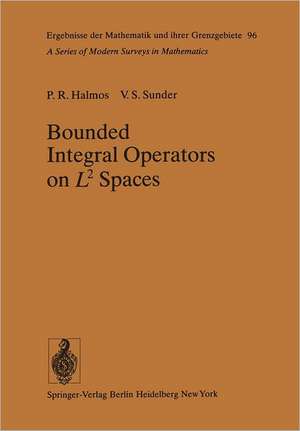
Bounded Integral Operators on L 2 Spaces: ERGEBNISSE DER MATHEMATIK UND IHRER GRENZGEBIETE 2 FOLGE, cartea 96
Autor P. R. Halmos, V. S. Sunderen Limba Engleză Paperback – 15 noi 2011
Din seria ERGEBNISSE DER MATHEMATIK UND IHRER GRENZGEBIETE 2 FOLGE
-
 Preț: 425.17 lei
 -
 Preț: 393.85 lei
 -
 Preț: 465.97 lei
 -
 Preț: 362.68 lei
 -
 Preț: 472.92 lei
 - 15%
 Preț: 676.82 lei
 -
 Preț: 332.66 lei
 -
 Preț: 368.59 lei
 -
 Preț: 368.43 lei
 - 15%
 Preț: 611.89 lei
 -
 Preț: 471.15 lei
 -
 Preț: 373.03 lei
 - 15%
 Preț: 474.60 lei
 -
 Preț: 378.41 lei
 -
 Preț: 363.61 lei
 -
 Preț: 369.74 lei
 -
 Preț: 397.35 lei
 -
 Preț: 365.82 lei
 -
 Preț: 396.99 lei
 -
 Preț: 371.00 lei
 -
 Preț: 399.60 lei
 -
 Preț: 362.30 lei
 -
 Preț: 365.09 lei
 -
 Preț: 398.66 lei
 - 15%
 Preț: 557.33 lei
 - 15%
 Preț: 612.05 lei
 -
 Preț: 403.10 lei
 - 18%
 Preț: 1065.57 lei
 - 15%
 Preț: 556.10 lei
 -
 Preț: 366.95 lei
 -
 Preț: 368.59 lei
 -
 Preț: 361.22 lei
 -
 Preț: 164.99 lei
 -
 Preț: 144.13 lei
 -
 Preț: 366.56 lei
 -
 Preț: 397.55 lei
 -
 Preț: 394.58 lei
 -
 Preț: 366.76 lei
 -
 Preț: 368.59 lei
 -
 Preț: 462.46 lei
 -
 Preț: 361.37 lei
 -
 Preț: 367.85 lei
 -
 Preț: 370.06 lei
 -
 Preț: 174.60 lei
 -
 Preț: 393.22 lei
 -
 Preț: 345.94 lei
 -
 Preț: 362.15 lei
 -
 Preț: 358.55 lei
Preț: 366.95 lei
Puncte Express: 550
Preț estimativ în valută:
64.92€ • 76.54$ • 56.39£
64.92€ • 76.54$ • 56.39£
Carte tipărită la comandă
Livrare economică 23 martie-06 aprilie
Specificații
ISBN-13: 9783642670183
ISBN-10: 3642670180
Pagini: 156
Ilustrații: XVI, 134 p.
Dimensiuni: 170 x 244 x 8 mm
Greutate: 0.26 kg
Ediția:Softcover reprint of the original 1st ed. 1978
Editura: Springer Berlin, Heidelberg
Colecția Springer
Seria ERGEBNISSE DER MATHEMATIK UND IHRER GRENZGEBIETE 2 FOLGE
Locul publicării:Berlin, Heidelberg, Germany
ISBN-10: 3642670180
Pagini: 156
Ilustrații: XVI, 134 p.
Dimensiuni: 170 x 244 x 8 mm
Greutate: 0.26 kg
Ediția:Softcover reprint of the original 1st ed. 1978
Editura: Springer Berlin, Heidelberg
Colecția Springer
Seria ERGEBNISSE DER MATHEMATIK UND IHRER GRENZGEBIETE 2 FOLGE
Locul publicării:Berlin, Heidelberg, Germany
V-ar putea interesa
-
 -31%Preț: 490.40 lei710.04 lei
 -
 Naive Set TheoryP. R. Halmos-15%Preț: 526.28 lei619.16 lei
 -
 Introduction to Discrete Dynamical Systems and ChaosMario Martelli-9%Preț: 1176.07 lei1292.38 lei
 -
 Wavelets – Theory & ApplicationsAK Louis-9%Preț: 1162.89 lei1277.90 lei
 -
 Calculus: Concepts and MethodsKen Binmore-19%Preț: 513.32 lei633.73 lei
 -
 Integration and Modern AnalysisJohn J Benedetto-18%Preț: 770.58 lei939.74 lei
 -
 Introduction to Applied Nonlinear Dynamical Systems and ChaosStephen Wiggins-17%Preț: 540.71 lei651.46 lei
 -
 Numerical Solution of Stochastic Differential EquationsPeter E. Kloeden-18%Preț: 774.25 lei944.21 lei
 -
 Stochastic Integration and Differential EquationsPhilip Protter-18%Preț: 704.96 lei859.71 lei
 -
 Random Dynamical SystemsLudwig Arnold-18%Preț: 765.00 lei932.93 lei
 -
 -18%Preț: 1094.80 lei1335.13 lei
 -
 Preț: 435.53 lei
 -
 Preț: 383.23 lei
Public țintă
ResearchCuprins
§1. Measure Spaces.- Example 1.1. Separable, not ?-finite.- Example 1.2. Finite, not separable.- §2. Kernels.- § 3. Domains.- Example 3.1. Domain 0.- Example 3.2. Hilbert transform.- Problem 3.3. Closed domain.- Example 3.4. Dense domain.- Example 3.5. Dense domain.- Example 3.6. Non-closed kernel.- Example 3.7. Non-closed kernel.- Theorem 3.8. Carleman kernels.- Lemma 3.9. Dominated subsequences.- Theorem 3.10. Full domain.- Example 3.11. Everywhere defined kernels.- Problem 3.12. Closed domains and kernels.- §4. Boundedness.- Lemma 4.1. Square integrable kernels.- Example 4.2. Dyads.- Lemma 4.3. Rank 1.- Corollary 4.4. Finite rank.- Theorem 4.5. Hilbert-Schmidt operators.- Corollary 4.6. Compactness.- Corollary 4.7. Singular values.- §5. Examples.- Example 5.1. Inflated identity.- Theorem 5.2. Schur test.- Example 5.3. Abel kernel.- Example 5.4. Cesàro kernel.- Example 5.5. Hilbert-Hankel matrix.- Theorem 5.6. Toeplitz matrices.- Example 5.7. Hilbert-Toeplitz matrix.- Example 5.8. Discrete Fourier transform.- §6. Isomorphisms.- Theorem 6.1. Induced unitary operators.- Theorem 6.2. Transforms of kernels.- Corollary 6.3. Unitary equivalence.- Corollary 6.4. Preservation of structure.- Example 6.5. Projection on L2(II).- Example 6.6. Atomic spaces versus ?.- §7. Algebra.- Problem 7.1. Multipliability.- Example 7.2. Compact Fourier transform.- Theorem 7.3. Operators on atomic spaces.- Lemma 7.4. Integrable approximation.- Theorem 7.5. Conjugate transposes.- Corollary 7.6. Atomic domain.- Corollary 7.7. Matrices.- §8. Uniqueness.- Theorem 8.1. Uniqueness.- Problem 8.2. Determination.- Example 8.3. Non-measurable kernel.- Problem 8.4. Measurability.- Theorem 8.5. Identity operator.- Theorem 8.6. Multiplication operators.- §9. Tensors.- Theorem 9.1. Directsums.- Corollary 9.2. Carleman kernels.- Theorem 9.3. Tensor products.- Problem 9.4. Bounded kernels.- Theorem 9.5. Tensor multiplicativity of Int.- Theorem 9.6. Tensors with dyads.- Example 9.7. Isometry on L2(II).- Example 9.8. Inflations as tensor products.- Theorem 9.9. Bounded matrices.- Corollary 9.10. Schur products.- Example 9.11. Schur products with dyads.- §10. Absolute Boundedness.- Example 10.1. Hilbert-Toeplitz matrix.- Example 10.2. Discrete Fourier transform.- Example 10.3. Direct sum matrix.- Example 10.4. Divisible spaces.- Theorem 10.5. Characterization.- Corollary 10.6. Adjoints.- Theorem 10.7. Products.- Theorem 10.8. Non-invertibility.- Theorem 10.9. Schur products.- Example 10.10. Unbounded Schur products.- Remark 10.11. Tensor quotients.- §11. Carleman Kernels.- Example 11.1. Absolutely bounded, not Carleman.- Theorem 11.2. Inclusion relations.- Example 11.3. Counterexamples.- Theorem 11.4. Strong boundedness.- Theorem 11.5. Carleman functions.- Theorem 11.6. Right ideal.- Corollary 11.7. Non-invertibility.- Problem 11.8. Right ideal.- Theorem 11.9. Co-boundedness.- Theorem 11.10. Hermitian kernels.- Theorem 11.11. Normal Carleman adjoints.- Problem 11.12. Normal integral adjoints.- Example 11.13. Non-Carleman integral adjoint.- §12. Compactness.- Lemma 12.1. Convolution kernels on L1.- Theorem 12.2. Convolution kernels on L2.- Corollary 12.3. Compactness.- Example 12.4. Non-integral, compact.- §13. Compactness.- Lemma 13.1. Large characteristic functions.- Lemma 13.2. Absolute continuity.- Example 13.3. Non-absolute continuity.- Lemma 13.4. Hille-Tamarkin kernels.- Example 13.5. Non-Hille-Tamarkin kernels.- Remark 13.6. Hille-Tamarkin operators.- Lemma 13.7. Integrable kernels.- Theorem 13.8. compactness.- Corollary 13.9. Hilbert-Schmidtapproximation.- § 14. Essential Spectrum.- Example 14.1. Tensor products and spectra.- Theorem 14.2. Atkinson’s theorem.- Theorem 14.3. Normal operators.- Theorem 14.4. A and A*A.- Corollary 14.5. A and AA*.- Theorem 14.6. Orthonormal sequences, left.- Corollary 14.7. Orthonormal sequences, right.- Remark 14.8. Absolute boundedness and invertibility.- Remark 14.9. Non-emptiness.- Theorem 14.10. Normal Carleman operators.- Lemma 14.11. Nearly invariant subspaces.- Remark 14.12. Hilbert-Schmidt strengthening.- Theorem 14.13. Weyl-von Neumann theorem.- Problem 14.14. Normal generalization.- Problem 14.15. Quasidiagonal generalization.- §15. Characterization.- Theorem 15.1. Integral operator, essential spectrum.- Remark 15.2. Right versus left.- Corollary 15.3. Unitary transforms.- Lemma 15.4. Matrix inflations.- Remark 15.5. Partially atomic spaces.- Lemma 15.6. Perturbations of Hermitian operators.- Theorem 15.7. Carleman operator, essential spectrum.- Corollary 15.8. Carleman if and only if integral.- Example 15.9. Unilateral shift.- Example 15.10. Non-simultaneity of A and A*.- Theorem 15.11. Simultaneity of A and A*.- Corollary 15.12. Simultaneous integral representability.- Lemma 15.13. Large 0 direct summand.- Theorem 15.14. Simultaneous Carleman representability.- Corollary 15.15. Simultaneous Carleman if and only if integral.- Problem 15.16. Absolutely bounded operators.- Theorem 15.17. Essential non-invertibility of A*A+AA*.- Theorem 15.18. Absolutely bounded operators.- §16. Universality.- Theorem 16.1. Universal integral operators.- Remark 16.2. Universal Carleman operators.- Problem 16.3. Small unitary transforms.- Lemma 16.4. Operator norm.- Theorem 16.5. Universally absolutely bounded matrices.- §17. Recognition.- Remark 17.1. Pointwise domination.-Theorem 17.2. Carleman characterization.- Corollary 17.3. Hilbert-Schmidt characterization.- Problem 17.4. Integral characterization.- Theorem 17.5. Orthonormal Carleman characterization.- Problem 17.6. Orthonormal integral characterization.- Theorem 17.7. Null-sequence Carleman characterization.- Appendix A. Finiteness and Countability Conditions.- Appendix B. Pointwise Unbounded Bounded Kernels.- Theorem B1. Pointwise unbounded subkernels.- Corollary B2. Subrectangles.- Corollary B3. Square integrable kernels.- Problem B4. Unbounded subkernels.- Appendix C. Riemann-Lebesgue Lemma.- Notes.- References.