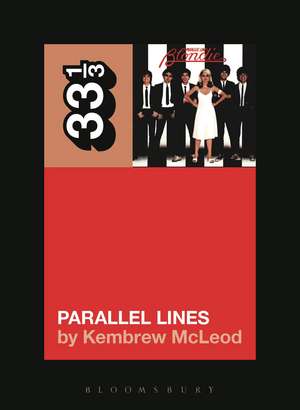
Blondie's Parallel Lines: 33 1/3
Autor Kembrew McLeoden Limba Engleză Paperback – 24 mar 2016
Debbie Harry's campy glamor and sassy snarl shook up the rock'n'roll boy's club during a growing backlash against the women's and gay liberation movements, which helped fuel the "disco sucks" battle cry in the late 1970s. Despite disco's roots in a queer, black and Latino underground scene that began in downtown New York, punk is usually celebrated by critics and scholars as the quintessential subculture. This book challenges the conventional wisdom that dismissed disco as fluffy prefab schlock while also recuperating punk's unhip pop influences, revealing how these two genres were more closely connected than most people assume. Even Blondie's album title, Parallel Lines, evokes the parallel development of punk and disco-along with their eventual crossover into the mainstream.
Din seria 33 1/3
- 32%
 Preț: 52.13 lei
 - 33%
 Preț: 51.20 lei
 - 32%
 Preț: 52.23 lei
 - 32%
 Preț: 51.93 lei
 - 31%
 Preț: 52.71 lei
 - 32%
 Preț: 52.13 lei
 - 32%
 Preț: 51.43 lei
 - 32%
 Preț: 51.43 lei
 - 33%
 Preț: 49.87 lei
 - 32%
 Preț: 51.43 lei
 - 32%
 Preț: 51.70 lei
 - 33%
 Preț: 51.32 lei
 - 31%
 Preț: 52.71 lei
 - 33%
 Preț: 50.11 lei
 - 32%
 Preț: 52.20 lei
 - 32%
 Preț: 52.03 lei
 - 32%
 Preț: 51.64 lei
 - 33%
 Preț: 51.23 lei
 - 32%
 Preț: 51.70 lei
 - 32%
 Preț: 52.20 lei
 - 32%
 Preț: 52.23 lei
 - 32%
 Preț: 51.55 lei
 - 32%
 Preț: 51.70 lei
 - 32%
 Preț: 51.35 lei
 - 32%
 Preț: 50.67 lei
 - 32%
 Preț: 52.07 lei
 - 32%
 Preț: 50.70 lei
 - 42%
 Preț: 50.62 lei
 - 33%
 Preț: 50.41 lei
 - 33%
 Preț: 50.31 lei
 - 32%
 Preț: 51.70 lei
 - 33%
 Preț: 49.81 lei
 - 32%
 Preț: 52.00 lei
 - 32%
 Preț: 51.50 lei
 - 33%
 Preț: 51.20 lei
 - 32%
 Preț: 51.73 lei
 - 33%
 Preț: 51.23 lei
 - 32%
 Preț: 51.70 lei
 - 33%
 Preț: 51.20 lei
 - 32%
 Preț: 51.73 lei
 - 32%
 Preț: 51.93 lei
 - 33%
 Preț: 50.67 lei
 - 33%
 Preț: 50.93 lei
 - 32%
 Preț: 51.90 lei
 - 33%
 Preț: 51.23 lei
 - 32%
 Preț: 51.55 lei
 - 33%
 Preț: 50.35 lei
 - 32%
 Preț: 51.43 lei
 - 42%
 Preț: 50.15 lei
 - 32%
 Preț: 52.31 lei
Preț: 50.57 lei
Preț vechi: 74.98 lei
-33%
Puncte Express: 76
Carte disponibilă
Livrare economică 06-20 noiembrie
Livrare express 22-28 octombrie pentru 40.84 lei
Livrare prin curier în România Termenul estimat este afișat lângă disponibilitate.
Transport gratuit de la 400.00 lei Plată online sau ramburs, în funcție de opțiunile comenzii.
Retur gratuit în 14 zile Comandă securizată și suport în română.
Specificații
ISBN-13: 9781501302374
ISBN-10: 150130237X
Pagini: 168
Dimensiuni: 120 x 164 x 14 mm
Greutate: 0.14 kg
Editura: Bloomsbury Publishing
Colecția Bloomsbury Academic
Seria 33 1/3
Locul publicării:New York, United States
ISBN-10: 150130237X
Pagini: 168
Dimensiuni: 120 x 164 x 14 mm
Greutate: 0.14 kg
Editura: Bloomsbury Publishing
Colecția Bloomsbury Academic
Seria 33 1/3
Locul publicării:New York, United States
V-ar putea interesa
-
 Seven Deadly SinsCorey Taylor-20%Preț: 84.89 lei106.43 lei
 -
 A Funny Thing Happened On The Way To HeavenCorey Taylor-20%Preț: 85.16 lei106.37 lei
 -
 You're Making Me Hate YouCorey Taylor-30%Preț: 74.15 lei106.27 lei
 -
 Freddie Mercury: The biographyLaura Jackson-27%Preț: 67.77 lei92.93 lei
 -
 Pranksters – Making Mischief in the Modern WorldKembrew McleodPreț: 287.97 lei
 -
 Owning CultureKembrew McLeodPreț: 266.91 lei
 -
 Cutting Across MediaKembrew McleodPreț: 331.71 lei
 -
 Creative LicenseKembrew McleodPreț: 198.89 lei
 -
 Foo FightersMick Wall-27%Preț: 68.52 lei93.38 lei
 -
 Collected Studies Op. 100 - Op. 105 - Op. 109Louis OesterlePreț: 83.69 lei
 -
 The Art of SongwritingAndrew West-20%Preț: 175.61 lei218.24 lei
 -
 A Perfect Union of Contrary ThingsMaynard James Keenan-35%Preț: 135.78 lei207.59 lei
 -
 After Sound: Toward a Critical MusicG Douglas Barrett-19%Preț: 212.71 lei262.16 lei
 -
 Hip Hop Headphones: A Scholar’s Critical PlaylistJames Braxton Peterson-17%Preț: 208.13 lei249.48 lei
 -
 Weekend SocietiesGraham St John-24%Preț: 914.52 lei1210.03 lei
 -
 Beyond No Future: Cultures of German PunkMirko M. Hall-25%Preț: 833.62 lei1104.69 lei
 -
 Chaos Media: A Sonic Economy of Digital SpaceStephen Kennedy-25%Preț: 275.99 lei368.43 lei
 -
 San Francisco and the Long 60sDr. Sarah Hill-14%Preț: 267.42 lei311.99 lei
Cuprins
Introduction: "Went Walking One Day on the Lower East Side . "
Chapter One: Downtown New York in the 1960s and 1970s
Blondie's New York Genes
Punk's Bubblegum Roots
The Avant-Garde Goes Pop!
Children of The Velvet Underground
Max's Kansas City
Chapter Two: Blondie's Arty Antecedents
Off-Off-Broadway Sets the Stage for Punk
Eric Emerson Makes the Scene
Two Stars Align in the Glitter Age
Punk's Trash Aesthetic
Chapter Three: Parallel Scenes
The Downtown Disco Underground Emerges
Blondie Stumbles Into Existence
CBGB and the Bowery Neighborhood
The Downtown Rock Scene Coalesces
Chapter Four: From the Bowery to Blondiemania
Debbie and Chris Rebuild
Blondie Takes Off
"Going Professional"
Art and Commerce
Chapter Five: "Disco Sucks," "Chicks Can't Rock," Blah Blah Blah
"Heart of Glass" Breaks Blondie In America
From CBGB to Studio 54
"Death To Disco!"
Punk vs. Disco?
Gender Trouble
Conclusion, or, Fade Away (and Radiate)
Postscript: Blondie Points To the Future, Then Ceases To Exist
Chapter One: Downtown New York in the 1960s and 1970s
Blondie's New York Genes
Punk's Bubblegum Roots
The Avant-Garde Goes Pop!
Children of The Velvet Underground
Max's Kansas City
Chapter Two: Blondie's Arty Antecedents
Off-Off-Broadway Sets the Stage for Punk
Eric Emerson Makes the Scene
Two Stars Align in the Glitter Age
Punk's Trash Aesthetic
Chapter Three: Parallel Scenes
The Downtown Disco Underground Emerges
Blondie Stumbles Into Existence
CBGB and the Bowery Neighborhood
The Downtown Rock Scene Coalesces
Chapter Four: From the Bowery to Blondiemania
Debbie and Chris Rebuild
Blondie Takes Off
"Going Professional"
Art and Commerce
Chapter Five: "Disco Sucks," "Chicks Can't Rock," Blah Blah Blah
"Heart of Glass" Breaks Blondie In America
From CBGB to Studio 54
"Death To Disco!"
Punk vs. Disco?
Gender Trouble
Conclusion, or, Fade Away (and Radiate)
Postscript: Blondie Points To the Future, Then Ceases To Exist
Recenzii
It's a rare treat when an author busts out a tightly researched agenda that totally flips your perspective on a record, a band, a scene, a genre, and an entire artistic era. Kembrew McLeod provides such a treat with this gloriously revisionist history, positing that Blondie and the core of the New York punk scene's early bands and aesthetics were a product of a wildly vital gay underground theater scene that flourished from the late 1960s to the early 1970s.
A neat snapshot of a time of revolution, reinvention and experimentation ... [This book is] every bit as appetising as the album itself, and an astute, erudite examination of one of the greatest albums of all time.
An interesting thesis well made in this enjoyable addition to the 33 1/3 series.
There's a little book I've been devouring on the subway this past week or two: Blondie's Parallel Lines by Kembrew McLeod. It has had me tracing and re-tracing connections all over the place, re-examining my own assumptions about my own evolving musical tastes and cultural assumptions from the time of my first transistor radio ... Refreshing.
Nothing beats a great argument that makes you think of the album in question in a whole new light, then - of course - sends you right back to the music to love it all over again ... Parallel Lines - the book - is worth reading if you're a devotee of Blondie or the 33 1/3 series (and of course for fans of both already) but if, somehow, you've never experienced this record in your lifetime and haven't yet read any of the other entries into this set of snapshots of classic albums, McLeod's book might instantly, easily, make you a fan of both.
The publisher Bloomsbury cannot be praised highly enough for the 33 1/3 series ... This volume houses countless surprising details ... [and] McLeod writes so informatively and with such inspiration that one cannot dismiss Parallel Lines or any of the other similar music covered in the book.
[Blondie's] Parallel Lines ... gives a good critical insight into how record labels have worked up until the present day ... the whole thing reads very well.
A neat snapshot of a time of revolution, reinvention and experimentation ... [This book is] every bit as appetising as the album itself, and an astute, erudite examination of one of the greatest albums of all time.
An interesting thesis well made in this enjoyable addition to the 33 1/3 series.
There's a little book I've been devouring on the subway this past week or two: Blondie's Parallel Lines by Kembrew McLeod. It has had me tracing and re-tracing connections all over the place, re-examining my own assumptions about my own evolving musical tastes and cultural assumptions from the time of my first transistor radio ... Refreshing.
Nothing beats a great argument that makes you think of the album in question in a whole new light, then - of course - sends you right back to the music to love it all over again ... Parallel Lines - the book - is worth reading if you're a devotee of Blondie or the 33 1/3 series (and of course for fans of both already) but if, somehow, you've never experienced this record in your lifetime and haven't yet read any of the other entries into this set of snapshots of classic albums, McLeod's book might instantly, easily, make you a fan of both.
The publisher Bloomsbury cannot be praised highly enough for the 33 1/3 series ... This volume houses countless surprising details ... [and] McLeod writes so informatively and with such inspiration that one cannot dismiss Parallel Lines or any of the other similar music covered in the book.
[Blondie's] Parallel Lines ... gives a good critical insight into how record labels have worked up until the present day ... the whole thing reads very well.