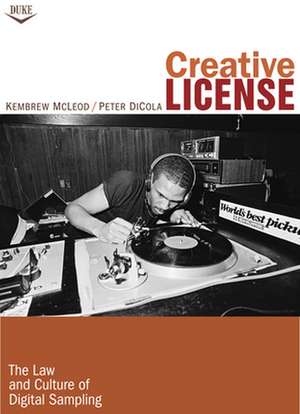
Creative License
Autor Kembrew Mcleoden Limba Engleză Paperback – 14 mar 2011
În „Creative License”, autorii Kembrew Mcleod și Peter DiCola adoptă perspectiva unor curatori ai memoriei sonore, explorând modul în care fragmentele de realitate înregistrată devin monedă de schimb în industria muzicală modernă. Observăm o analiză fascinantă a contradicțiilor legale care fac ca un colecționar de muzică folk din era Marii Depresiuni, Alan Lomax, să figureze pe creditele unui cântec semnat de Jay-Z. Autorii ne ghidează prin labirintul birocratic al licențierii, dezvăluind cum creativitatea este adesea sufocată de mecanisme ineficiente. Descoperim aici o structură riguroasă, care pornește de la „epoca de aur” a sampling-ului și avansează spre studiile de caz ale proceselor celebre care au transformat hip-hop-ul într-un câmp de bătălie juridic. Ca și în Plunderphonics, Creative License pune în valoare impactul utilizării fragmentelor audio neautorizate, dar cu un accent mult mai pronunțat pe aspectele juridice și pe mărturiile directe ale celor care navighează acest sistem: avocați, manageri și artiști iconici precum David Byrne sau RZA. Această lucrare continuă preocuparea lui Kembrew Mcleod pentru politica aproprierii culturale, temă explorată și în Cutting Across Media, însă aici focusul este strict pe industria muzicală și pe modul în care tehnologia digitală a forțat redefinirea proprietății intelectuale. Suntem de părere că valoarea acestui volum rezidă în capacitatea de a transforma un subiect tehnic într-o narațiune vibrantă despre dreptul de a crea în era remixului.
Preț: 205.54 lei
Carte disponibilă
Livrare economică 13-27 noiembrie
Specificații
ISBN-10: 0822348756
Pagini: 336
Dimensiuni: 156 x 214 x 22 mm
Greutate: 0.44 kg
Editura: Duke University Press
V-ar putea interesa
-
 The Copyright Librarian: A Practical HandbookLinda Frederiksen-29%Preț: 362.55 lei513.76 lei
 -
 Pranksters – Making Mischief in the Modern WorldKembrew McleodPreț: 287.97 lei
 -
 Owning CultureKembrew McLeodPreț: 266.91 lei
 -
 The Construction of AuthorshipMartha WoodmanseePreț: 310.94 lei
 -
 Cutting Across MediaKembrew McleodPreț: 331.71 lei
 -
 Copyright Law in an Age of Limitations and ExceptionsRuth L. Okediji-14%Preț: 992.82 lei1154.43 lei
 -
 Blondie's Parallel LinesKembrew McLeod-33%Preț: 50.57 lei74.98 lei
 -
 Copyright Restoration & the Supreme Court's Golan v. Holder DecisionNicholas A Hernandez-26%Preț: 500.65 lei674.94 lei
 -
 International Approaches to Online Copyright EnforcementPatricia Wade-27%Preț: 1216.17 lei1658.64 lei
 -
 -27%Preț: 1385.49 lei1888.63 lei
 -
 -19%Preț: 1611.05 lei1978.74 lei
 -
 Preț: 141.41 lei
 -
 -15%Preț: 667.86 lei785.72 lei
 -
 Preț: 183.46 lei
 -
 Preț: 361.64 lei
De ce să citești această carte
„Creative License” este o resursă esențială pentru muzicieni, producători și pasionați de hip-hop care doresc să înțeleagă dedesubturile legale ale sampling-ului. Cititorul câștigă o perspectivă rară asupra modului în care legile dreptului de autor influențează direct textura sunetului modern. Este un argument solid pentru reforma proprietății intelectuale, susținut de experiențele directe ale unor legende ale muzicii, oferind claritate într-un domeniu marcat de ambiguitate.
Descriere scurtă
Cuprins
Introduction 1
1. The Golden Age of Sampling 19
2. A Legal and Cultural History of Sound Collage 36
3. The Competing Interests in Sample Licensing 75
4. Sampling Lawsuits: Hip-Hop Goes to Court 128
5. The Sample Clearance System: How It Works (and How It Breaks Down) 148
6. Consequences for Creativity: An Assessment of the Sample Clearance System 187
7. Proposals for Reform 217
Conclusion 258
Appendix 1: Interviewee List 269
Appendix 2: Interview Questions 273
Notes 283
Bibliography 303
Index 313