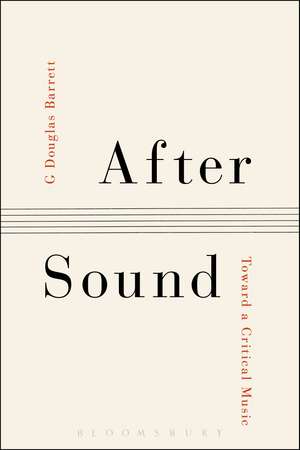
After Sound: Toward a Critical Music
Autor G Douglas Barretten Limba Engleză Paperback – 11 aug 2016
Through a series of intimate studies of artworks surveyed from the visual and performing arts of the past ten years-Pussy Riot, Ultra-red, Hong-Kai Wang, Peter Ablinger, Pauline Boudry and Renate Lorenz, and others-After Sound offers a significant revision to the way we think about music. The book as a whole offers a way out of one of the most vexing deadlocks of contemporary cultural criticism: the choice between a sound art effectively divorced from the formal-historical coordinates of musical practice and the hermetic music that dominates new music circles today.
Preț: 212.71 lei
Preț vechi: 262.16 lei
-19%
Puncte Express: 319
Carte tipărită la comandă
Livrare economică 27 noiembrie-11 decembrie
Livrare prin curier în România Termenul estimat este afișat lângă disponibilitate.
Transport gratuit de la 400.00 lei Plată online sau ramburs, în funcție de opțiunile comenzii.
Retur gratuit în 14 zile Comandă securizată și suport în română.
Specificații
ISBN-13: 9781501308123
ISBN-10: 1501308122
Pagini: 256
Ilustrații: 6 bw illus
Dimensiuni: 150 x 228 x 14 mm
Greutate: 0.38 kg
Editura: Bloomsbury Publishing
Colecția Bloomsbury Academic
Locul publicării:New York, United States
ISBN-10: 1501308122
Pagini: 256
Ilustrații: 6 bw illus
Dimensiuni: 150 x 228 x 14 mm
Greutate: 0.38 kg
Editura: Bloomsbury Publishing
Colecția Bloomsbury Academic
Locul publicării:New York, United States
V-ar putea interesa
-
 The Piano: A HistoryCyril Ehrlich-28%Preț: 471.20 lei658.90 lei
 -
 More Rock Family TreesPete Frame-21%Preț: 108.29 lei136.46 lei
 -
 Preț: 104.08 lei
 -
 Elvis Has Left the BuildingDylan Jones-19%Preț: 58.56 lei72.11 lei
 -
 Nico, Songs They Never Play on the RadioJames Young-27%Preț: 78.44 lei107.19 lei
 -
 The Official Spinal Tap CompanionKarl French-26%Preț: 89.01 lei120.70 lei
 -
 -23%Preț: 56.83 lei74.15 lei
 -
 JaprocksamplerJulian Cope-27%Preț: 76.96 lei105.54 lei
 -
 Hallelujah!John WarburtonPreț: 115.22 lei
 -
 The Art of SongwritingAndrew West-20%Preț: 175.61 lei218.24 lei
 -
 -18%Preț: 34.91 lei42.79 lei
 -
 Too Much Too SoonNina AntoniaPreț: 88.66 lei
Cuprins
Introduction: Music After Sound
Silence and Collectivity
Chapter 1: The Limits of Performing Cage: Ultra-red's SILENT|LISTEN
Chapter 2: The Silent Network: The Music of Wandelweiser
Language and Authority
Chapter 3: "IDEAS MATTER": Zizek Sings Pussy Riot
Chapter 4: Music to the Letter: Noise, Language, and the Letter from Schoenberg
Speculation and Sense
Chapter 5: The Debt of Philosophy: Music, Speculation, and The Sound of Debt
Chapter 6: The Metaphoricity of Sense: Hong-Kai Wang's Music While We Work - with Lindsey Lodhie
Conclusion: Music After Art
Acknowledgments
Notes
Selected Bibliography
Index
Silence and Collectivity
Chapter 1: The Limits of Performing Cage: Ultra-red's SILENT|LISTEN
Chapter 2: The Silent Network: The Music of Wandelweiser
Language and Authority
Chapter 3: "IDEAS MATTER": Zizek Sings Pussy Riot
Chapter 4: Music to the Letter: Noise, Language, and the Letter from Schoenberg
Speculation and Sense
Chapter 5: The Debt of Philosophy: Music, Speculation, and The Sound of Debt
Chapter 6: The Metaphoricity of Sense: Hong-Kai Wang's Music While We Work - with Lindsey Lodhie
Conclusion: Music After Art
Acknowledgments
Notes
Selected Bibliography
Index
Recenzii
[A] provocative thesis. ... Barrett summarises Cage's manifold aims in one brilliant paragraph ... [and] shows he can write lucidly ... I learned a lot from this book.
Barrett's book goes beyond the protesting of sound-art difference of Cox or Kim-Cohen and addresses the musicophobia of Kane. It identifies an important path and begins to move along it. Then think even harder and give us more ... If writing such as Barrett's constantly draws our attention back to the dynamic co-existence in music of absolute conceptuality and absolute materiality, and of the social and the individual, it's performing a vital task.
Doug Barrett's book marks a crucial intervention into the embattled and often confused contemporary discourses of the sonic. Deftly navigating between the Scylla and Charybdis of recent debates (so-called materialists [Cox] versus so-called idealists [Kim-Cohen]), Barrett's call for a 'critical music' offers new terms for thinking and practicing musical art. Against ahistorical theorizations of 'sound' as a novel field, Barrett seeks to provoke a genuine interdisciplinary encounter between music and contemporary art, philosophy, and politics.
Acts of intellectual courage are few and far between in these timid times. But Barrett throws caution to the wind. There is nothing absolute, he argues, about 'absolute music.' Except for a brief historical anomaly-lasting, roughly, from Beethoven to Boulez-music has always been embedded in the concatenations of history. What's more, music has always been the strange bedfellow of power and predicament, time and climate, finance and fellowship. Barrett absolves music (and us) of any recourse to the absolute. Where does that leave us? Here and now, thankfully.
After Sound is an ambitious and polemical contribution to the debates surrounding the porous domains of sound art, new music, and twenty-first century politics. It offers engaged interpretations of three collectives and five individual artists working at the borderlands of what is customarily taken as music, and handles a wide range of challenging and complex philosophical questions with remarkable ease.
An analyst in a crowded field of partisans, G. Douglas Barrett has given us a radical tool for apprehending the mess that we call music in the twenty-first century. Favoring clear-headed argument over strident polemics, he diagnoses the limits of discourse and practice in sound art, contemporary (visual) art, and new music by listening through and beyond them.
Barrett's book goes beyond the protesting of sound-art difference of Cox or Kim-Cohen and addresses the musicophobia of Kane. It identifies an important path and begins to move along it. Then think even harder and give us more ... If writing such as Barrett's constantly draws our attention back to the dynamic co-existence in music of absolute conceptuality and absolute materiality, and of the social and the individual, it's performing a vital task.
Doug Barrett's book marks a crucial intervention into the embattled and often confused contemporary discourses of the sonic. Deftly navigating between the Scylla and Charybdis of recent debates (so-called materialists [Cox] versus so-called idealists [Kim-Cohen]), Barrett's call for a 'critical music' offers new terms for thinking and practicing musical art. Against ahistorical theorizations of 'sound' as a novel field, Barrett seeks to provoke a genuine interdisciplinary encounter between music and contemporary art, philosophy, and politics.
Acts of intellectual courage are few and far between in these timid times. But Barrett throws caution to the wind. There is nothing absolute, he argues, about 'absolute music.' Except for a brief historical anomaly-lasting, roughly, from Beethoven to Boulez-music has always been embedded in the concatenations of history. What's more, music has always been the strange bedfellow of power and predicament, time and climate, finance and fellowship. Barrett absolves music (and us) of any recourse to the absolute. Where does that leave us? Here and now, thankfully.
After Sound is an ambitious and polemical contribution to the debates surrounding the porous domains of sound art, new music, and twenty-first century politics. It offers engaged interpretations of three collectives and five individual artists working at the borderlands of what is customarily taken as music, and handles a wide range of challenging and complex philosophical questions with remarkable ease.
An analyst in a crowded field of partisans, G. Douglas Barrett has given us a radical tool for apprehending the mess that we call music in the twenty-first century. Favoring clear-headed argument over strident polemics, he diagnoses the limits of discourse and practice in sound art, contemporary (visual) art, and new music by listening through and beyond them.