
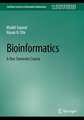
Bioinformatics: Synthesis Lectures on Biomedical Engineering
Autor Khalid Sayood, Hasan H. Otuen Limba Engleză Paperback – 9 feb 2024
Această primă ediție a lucrării Bioinformatics propune o abordare condensată și riguroasă a unui domeniu aflat la intersecția biologiei cu informatica, fiind calibrată special pentru a acoperi materia unui singur semestru universitar. Găsim în această carte o schimbare de paradigmă față de manualele voluminoase: autorii Khalid Sayood și Hasan H. Otu elimină prezentarea exhaustivă a bazelor de date și a pachetelor software comerciale, concentrându-se exclusiv pe fundamentul algoritmic necesar pentru analiza secvențelor genomice. Observăm că textul extinde cadrul propus de Algorithms in Bioinformatics de Wing-Kin Sung prin simplificarea explicațiilor matematice, fără a sacrifica însă precizia tehnică. În timp ce alte lucrări similare, precum Essential Bioinformatics de Jin Xiong, acoperă o gamă mai largă de subiecte (inclusiv proteomica), volumul de față rămâne fidel analizei de secvențe și filogeniei moleculare. Structura este una progresivă: începe cu un „primer” de biologie moleculară esențial pentru studenții de la inginerie, continuă cu alinierea secvențelor în perechi și multiple, culminând cu studiul relațiilor evolutive în capitolul dedicat filogeniei. Notăm cu interes modul în care această lucrare se integrează în opera autorului Khalid Sayood. Dacă în Introduction to Data Compression acesta explora eficiența codării informației, iar în Computational Genomic Signatures analiza volumul uriaș de date secvențiate, în Bioinformatics el distilează aceste concepte pentru a explica cum pot fi extrase informații despre funcția secvențelor și organizarea genomului. Este o resursă care prioritizează înțelegerea mecanismelor de calcul în detrimentul utilizării mecanice a unor instrumente software preexistente.
Din seria Synthesis Lectures on Biomedical Engineering
- 5%
 Preț: 388.59 lei
 -
 Preț: 396.96 lei
 -
 Preț: 397.00 lei
 -
 Preț: 313.36 lei
 - 5%
 Preț: 311.99 lei
 - 15%
 Preț: 540.90 lei
 - 15%
 Preț: 660.67 lei
 -
 Preț: 370.87 lei
 -
 Preț: 258.70 lei
 -
 Preț: 252.29 lei
 -
 Preț: 244.80 lei
 -
 Preț: 262.25 lei
 -
 Preț: 260.54 lei
 -
 Preț: 198.72 lei
 -
 Preț: 311.51 lei
 -
 Preț: 190.46 lei
 -
 Preț: 254.47 lei
 -
 Preț: 208.08 lei
 -
 Preț: 243.13 lei
 -
 Preț: 244.41 lei
 -
 Preț: 243.62 lei
 -
 Preț: 198.10 lei
 -
 Preț: 338.52 lei
 -
 Preț: 242.91 lei
 -
 Preț: 205.95 lei
 -
 Preț: 370.55 lei
 -
 Preț: 351.49 lei
 -
 Preț: 244.11 lei
 -
 Preț: 400.30 lei
 -
 Preț: 250.53 lei
 -
 Preț: 239.13 lei
 -
 Preț: 243.02 lei
 -
 Preț: 152.44 lei
 -
 Preț: 258.31 lei
 -
 Preț: 201.05 lei
 -
 Preț: 199.28 lei
 -
 Preț: 262.71 lei
 -
 Preț: 307.00 lei
 -
 Preț: 199.00 lei
 -
 Preț: 227.47 lei
 - 36%
 Preț: 331.32 lei
 -
 Preț: 239.90 lei
 -
 Preț: 371.73 lei
 -
 Preț: 379.38 lei
 -
 Preț: 262.81 lei
 -
 Preț: 199.28 lei
 -
 Preț: 247.26 lei
 -
 Preț: 200.48 lei
 -
 Preț: 239.80 lei
Preț: 448.64 lei
Carte tipărită la comandă
Livrare economică 04-18 decembrie
Specificații
ISBN-10: 3031200195
Pagini: 136
Ilustrații: VII, 128 p. 59 illus., 15 illus. in color.
Dimensiuni: 168 x 240 x 8 mm
Greutate: 0.24 kg
Ediția:1st ed. 2022
Editura: Springer
Colecția Synthesis Lectures on Biomedical Engineering
Seria Synthesis Lectures on Biomedical Engineering
Locul publicării:Cham, Switzerland
V-ar putea interesa
-
 Bioinformatics: Principles and ApplicationsZhumar GhoshPreț: 180.97 lei
 -
 Genetics: Genes, genomes, and evolutionPhilip Meneely-19%Preț: 546.53 lei675.90 lei
 -
 An Introduction to Molecular Evolution and PhylogeneticsLindell Bromham-20%Preț: 451.96 lei565.69 lei
 -
 Introduction to GenomicsArthur Lesk-8%Preț: 490.33 lei532.97 lei
 -
 Molecular Biology: Principles of Genome FunctionNancy Craig-18%Preț: 551.25 lei671.99 lei
 -
 Introduction to BioinformaticsArthur Lesk-19%Preț: 421.36 lei522.10 lei
 -
 Introduction to GenomicsArthur Lesk-19%Preț: 403.82 lei499.22 lei
 -
 Concepts in Bioinformatics and GenomicsJamil Momand-27%Preț: 1250.75 lei1713.35 lei
 -
 -20%Preț: 516.38 lei645.48 lei
 -
 Immunological BioinformaticsOle LundPreț: 434.24 lei
 -
 Understanding BioinformaticsMarketa Zvelebil-27%Preț: 770.52 lei1055.50 lei
 -
 A Primer of Genome ScienceGreg Gibson-27%Preț: 901.72 lei1235.23 lei
 -
 Practical Computing for BiologistsSteven H. D. Haddock-27%Preț: 797.38 lei1092.30 lei
 -
 Bioinformatics and Functional GenomicsJonathan Pevsner-23%Preț: 833.61 lei1082.62 lei
 -
 Computational Thinking for Life ScientistsBenny ChorPreț: 293.45 lei
 -
 -27%Preț: 1220.69 lei1661.63 lei
 -
 Computational BiologyScott T Kelley-11%Preț: 446.87 lei502.11 lei
 -
 BioinformaticsJeremy Ramsden-5%Preț: 521.87 lei549.33 lei
 -
 Fundamentals of Bioinformatics and Computational BiologyGautam B. Singh-15%Preț: 685.18 lei806.09 lei
 -
 Statistics for ScientistsUmberto Michelucci-20%Preț: 279.62 lei349.53 lei
De ce să citești această carte
Recomandăm această carte studenților și cercetătorilor care doresc să înțeleagă „motorul” din spatele programelor de analiză biologică. Spre deosebire de manualele care învață utilizarea unor unelte, Bioinformatics explică logica algoritmilor de aliniere și filogenie. Este o lectură esențială pentru cei care vin din informatică sau inginerie și au nevoie de o introducere rapidă, de un semestru, în fundamentele computaționale ale geneticii.
Despre autor
Khalid Sayood este profesor în cadrul Departamentului de Inginerie Electrică la University of Nebraska-Lincoln. Expertiza sa vastă în teoria informației și compresia datelor este reflectată în lucrări de referință precum Introduction to Data Compression. În ultimii ani, și-a orientat cercetarea spre bioinformatică, aplicând algoritmi de procesare a semnalelor pentru descifrarea semnăturilor genomice. Împreună cu Hasan H. Otu, aduce o perspectivă inginerească clară asupra biologiei computaționale, facilitând înțelegerea structurilor biologice complexe prin prisma modelelor matematice și algoritmice.
Cuprins
Notă biografică
Textul de pe ultima copertă
- Introduces and defines the foundation of bioinformatics in relation to biology
- Emphasizes the algorithmic aspects of bioinformatics
- Focuses on extraction of information on relatedness of species, function of sequences, and genome organization