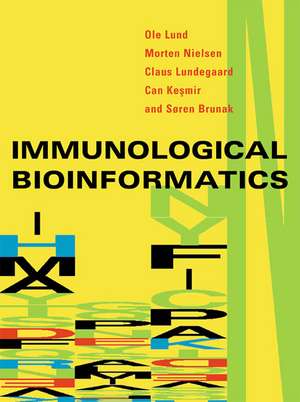
Immunological Bioinformatics
Autor Ole Lund, Morten Nielsen, Claus Lundegaard, Can Kesmir, Soren Brunaken Limba Engleză Hardback – 21 iul 2005
Subliniem relevanța capitolului final al lucrării Immunological Bioinformatics, care sintetizează integrarea tuturor metodelor prezentate pentru identificarea regiunilor imunogene în microorganisme și genomul gazdă. Această abordare transformă imunologia dintr-o disciplină tradițional reducționistă, axată pe entități moleculare izolate, într-o știință a sistemelor complexe. Considerăm că valoarea adăugată a acestui volum din seria Computational Molecular Biology constă în capacitatea autorilor de a crea o punte între discipline: oferă studenților din matematică și informatică un fundament biologic riguros, în timp ce imunologilor le explică mecanismele algoritmilor bazați pe date.
Merită menționat că textul explorează cum modelele bioinformatice pot accelera dezvoltarea de vaccinuri și terapii pentru patologii precum SIDA sau malaria, folosind datele rezultate din secvențierea genomului uman. Comparabil cu Immunoinformatics de Gregory R Bock în rigurozitatea cu care tratează interacțiunile componentelor imune, Immunological Bioinformatics este actualizat pentru era post-genomică, punând un accent mai mare pe algoritmii de tip data-driven și pe viziunea de ansamblu asupra sistemului imunitar. Stilul editorial este precis, orientat către cercetare și aplicabilitate clinică, fiind susținut vizual de cele 93 de ilustrații care clarifică procesele biochimice și computaționale descrise. Este o resursă esențială pentru cei care doresc să înțeleagă cum instrumentele „in silico” devin indispensabile în biologia modernă.
Preț: 434.24 lei
Carte disponibilă
Livrare economică 16-30 noiembrie
Livrare express 31 octombrie-06 noiembrie pentru 55.23 lei
Specificații
ISBN-10: 0262122804
Pagini: 312
Ilustrații: 93
Dimensiuni: 179 x 235 x 25 mm
Greutate: 0.81 kg
Ediția:New.
Editura: Mit Press
Locul publicării:United States
V-ar putea interesa
-
 Systems Biology: A Very Short IntroductionEberhard O. Voit-20%Preț: 56.97 lei70.82 lei
 -
 The Immune System: A Very Short IntroductionPaul Klenerman-23%Preț: 58.23 lei75.86 lei
 -
 Clinical ImmunologyAngela Hall-16%Preț: 415.94 lei493.42 lei
 -
 -20%Preț: 516.38 lei645.48 lei
 -
 -28%Preț: 401.66 lei559.91 leiRecomandat
 -
 Cellular and Molecular ImmunologyAbul K. Abbas-28%Preț: 513.14 lei710.50 leiRecomandat
 -
 Immunology for Medical Students: Helbert ImunologieMatthew Helbert-5%Preț: 390.04 lei410.57 lei
 -
 Clinical Immunology: Principles and PracticeRobert R. Rich-27%Preț: 1711.55 lei2346.37 leiRecomandat
 -
 Medical SciencesDenise Syndercombe Court-25%Preț: 432.48 lei573.48 lei
 -
 Immunology for Medical StudentsMatthew Buckland-29%Preț: 309.09 lei438.05 lei
 -
 Understanding BioinformaticsMarketa Zvelebil-27%Preț: 770.52 lei1055.50 lei
 -
 ImmunoinformaticsNamrata Tomar-5%Preț: 1090.99 lei1148.41 lei
 -
 Bioinformatics and Functional GenomicsJonathan Pevsner-23%Preț: 833.61 lei1082.62 lei
 -
 Veterinary Clinical ImmunologyLinda Kidd-5%Preț: 949.42 lei999.39 lei
 -
 ImmunologyRichard Coico-5%Preț: 595.91 lei627.28 lei
 -
 Immune to Age: The game-changing science of lifetime healthDr Jenna Macciochi-26%Preț: 99.82 lei135.33 lei
 -
 BioinformaticsKhalid SayoodPreț: 313.36 lei
 -
 Systems Biology IIJan Barciszewski-18%Preț: 1273.24 lei1552.72 lei
 -
 Statistics for ScientistsUmberto Michelucci-20%Preț: 279.62 lei349.53 lei
De ce să citești această carte
Recomandăm această carte cercetătorilor și studenților la intersecția dintre biologie și informatică. Immunological Bioinformatics oferă un cadru teoretic și practic pentru utilizarea algoritmilor în designul de vaccinuri și diagnosticarea bolilor complexe. Cititorul câștigă o înțelegere clară a modului în care datele genomice pot fi transformate în soluții terapeutice, beneficiind de expertiza unor autori de renume de la Mit Press.