Cantitate/Preț
Produs

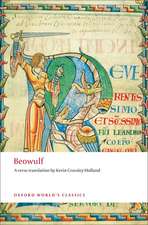
Beowulf

Autor Anonymous Traducere de J. Lesslie Hall Ph. D. Ilustrat de Reg Down
en Limba Engleză Paperback

Hrothgar, king of the Danes, builds a great mead-hall called Heorot, in which he hopes to feast his liegemen and to give them presents. But the monster, Grendel, is seized with hateful jealousy and cannot brook the sounds of joy that reach him in his fen-dwelling. He comes, bent on direful mischief, and thane after thane is ruthlessly carried off and devoured.

Thus begins the greatest Anglo-Saxon epic poem. Beowulf the warrior-hero and aristocrat is the finest example of the Anglo-Saxon heroic spirit. Dating back to the end of the first millennium this poem's influence is still felt today.

Originally published in 1892, this classic verse translation has been freshly typeset, formatted and edited. It has updated footnotes for Old English or uncommon words, plus notes on the characters as they appear in the poem. These are derived from the fuller glossary of terms and names at the end of the book. In addition, there are side notes which follow and illuminate the text itself.

Citește tot Restrânge

Toate formatele și edițiile

Toate formatele și edițiile Preț Express
Paperback (20) 2654 lei  3-5 săpt.
  Simon&Schuster – 30 iun 2005 2654 lei  3-5 săpt.
  Penguin Books – 29 apr 2003 4348 lei  24-35 zile +1832 lei  4-10 zile
  BROADVIEW PR – 25 oct 2012 17212 lei  3-5 săpt. +5742 lei  4-10 zile
  CREATESPACE – 3889 lei  3-5 săpt.
  CREATESPACE – 4437 lei  3-5 săpt.
  CREATESPACE – 4633 lei  3-5 săpt.
  CREATESPACE – 4676 lei  3-5 săpt.
  4710 lei  3-5 săpt.
  CreateSpace Independent Publishing Platform – 4856 lei  3-5 săpt.
  CreateSpace Independent Publishing Platform – 5442 lei  3-5 săpt.
  CREATESPACE – 5885 lei  3-5 săpt.
  CREATESPACE – 5934 lei  3-5 săpt.
  CREATESPACE – 6123 lei  3-5 săpt.
  CreateSpace Independent Publishing Platform – 7062 lei  6-8 săpt.
  CREATESPACE – 7416 lei  3-5 săpt.
  G&D MEDIA – 26 dec 2023 7547 lei  3-5 săpt.
  BENEDICTION CLASSICS – 26 oct 2021 7930 lei  6-8 săpt.
  9072 lei  3-5 săpt.
  CREATESPACE – 11188 lei  3-5 săpt.
  Penguin Publishing Group – 30 mai 1957 11211 lei  3-5 săpt.
Hardback (2) 7570 lei  3-5 săpt. +5239 lei  4-10 zile
  Little Brown – 21 aug 2025 7570 lei  3-5 săpt. +5239 lei  4-10 zile
  BENEDICTION CLASSICS – 28 oct 2021 13947 lei  6-8 săpt.

Preț: 7062 lei

Puncte Express: 106

Preț estimativ în valută:
1249 1466$ 1083£

Carte tipărită la comandă

Livrare economică 10-24 martie


Specificații

ISBN-13: 9781481952071
ISBN-10: 1481952072
Pagini: 144
Dimensiuni: 178 x 254 x 8 mm
Greutate: 0.26 kg
Editura: CreateSpace Independent Publishing Platform

Recenzii

R.M. Liuzza’s translation of Beowulf, first published by Broadview in 1999, has been widely praised for its accuracy and beauty. The facing-page translation is accompanied in this edition by genealogical charts, historical summaries, and a glossary of proper names. Historical appendices include related legends, stories, and religious writings from both Christian and Anglo-Saxon traditions. These texts help readers to see Beowulf as an exploration of the politics of kingship and the psychology of heroism, and as an early English meditation on the bridges and chasms between the pagan past and the Christian present.
Appendices also include a generous sample of other modern translations of Beowulf, shedding light on the process of translating the poem. This new edition features an updated introduction and an expanded section of material on Christianity and paganism.

“This Beowulf translation is a masterful synthesis of history, poetry, and narrative. Liuzza’s deep knowledge of the Anglo-Saxon period, combined with an ear keenly attuned to the cadences of Old English poetry, renders the volume an invaluable resource for medievalists everywhere. This is a brilliant, exemplary edition and a must-have for any serious student of the poem. Liuzza has set the standard for many years to come.” — Stacy S. Klein, Rutgers University
“The translation I use … is R.M. Liuzza’s. Liuzza’s choices are moderate, combining easy readability with a good level of literal translation. … His diction is plain, not fancy, but it seeks to alliterate where possible … Liuzza’s appendices include many of the texts often discussed in conjunction with Beowulf, which makes the edition indispensable to the amateur scholar.” — Ruth A. Johnston, A Companion to Beowulf

“This close and readable translation, put together by a scholar who knows so much about the poem and its craft, remakes the old tale in a new register. From the prickly dignity of overdressed spearbearers to the sad songs of beefy breakers-of-rings in their cups, there is much here to surprise and delight.” — Roberta Frank, University of Toronto
“Liuzza takes account of recent scholarly research and provides a commentary, a collection of supporting texts, and an excellent introduction to this ‘Christian poet’s bittersweet elegy for the doomed heroic life.’ His account of the peculiarities of Old English poetic style is particularly helpful.” — Frank Kermode, The New York Review of Books
“Liuzza’s volume is a resource pack for studying Beowulf and its translations. He includes specimens of other translations down the generations as well as invaluable supplementary material, the whole informed by scholarship of the highest quality and laid out attractively. The translation is fluent and unshowy. … Understandably, it (and its supplementary material) is popular with students and instructors, and it is likely to remain so in the years ahead.” — Hugh Magennis, Professor of Old English Literature and Director of Medieval Studies, Queens University Belfast, in Translating Beowulf: Modern Versions in English Verse

Descriere

Descriere de la o altă ediție sau format:
R.M. Liuzza’s translation of Beowulf, first published by Broadview in 1999, has been widely praised for its accuracy and beauty. The facing-page translation is accompanied in this edition by genealogical charts, historical summaries, and a glossary of proper names. Historical appendices include related legends, stories, and religious writings from both Christian and Anglo-Saxon traditions. These texts help readers to see Beowulf as an exploration of the politics of kingship and the psychology of heroism, and as an early English meditation on the bridges and chasms between the pagan past and the Christian present.
Appendices also include a generous sample of other modern translations of Beowulf, shedding light on the process of translating the poem. This new edition features an updated introduction and an expanded section of material on Christianity and paganism.

Cuprins

Acknowledgements
Preface
Introduction
  • Beowulf between Myth and History
    Beowulf between Song and Text
    Beowulf between Court and Cloister
    Beowulf between Old and Modern English
A Note on the Text
A Note to the Second Edition
Reading Old English
Beowulf
Glossary of Proper Names
Genealogies
The Geatish-Swedish Wars
Appendix A: Characters Mentioned in Beowulf
  1. From Gregory of Tours, History of the Franks
  2. From the Liber Monstrorum
  3. From Alcuin, Letter to “Speratus” (797)
  4. West-Saxon Royal Genealogies
    1. From Asser, Life of King Alfred (893)
    2. From Æthelweard, Chronicle
  5. “The Fight at Finnsburh”
  6. Widsith
Appendix B: Analogues to the Themes and Events in Beowulf
  1. From Grettissaga (c. 1300)
    1. The Fight in the Hall
    2. The Fight at the Falls
  2. From Saxo Grammaticus, Gesta Danorum
  3. From Snorri Sturluson, Heimskringla (c. 1223-35), Ynglinga saga
  4. From The Life of Saint Gildas
  5. From Blickling Homily 17
Appendix C: Christians and Pagans
  1. Gregory the Great, Letter to Abbot Mellitus (601)
  2. From Bede the Venerable, Ecclesiastical History of the English People
  3. From St Boniface, Letters
    1. Letter 46 (c. 738)
    2. Letter 73 (c. 746)
  4. Wulfstan, On False Gods
  5. Laws against Paganism
    1. From Wulfstan, Canons of Edgar no. 16
    2. From the Laws of Cnut, 1-5
Appendix D: Contexts for Reading Beowulf
  1. Wulfstan, Sermo Lupi ad Anglos (1014)
  2. Ælfric, Life of St Edmund (c. 995)
  3. Vainglory (before c. 975)
Appendix E: Translations of Beowulf
  1. Sharon Turner, The History of the Manners, Landed Property, Government,Laws, Poetry, Literature, Religion and Language of the Anglo-Saxons (1805)
  2. John Josias Conybeare, Illustrations of Anglo-Saxon Poetry (1826)
  3. J.M. Kemble, A Translation of the Anglo-Saxon Poem of Beowulf (1835)
  4. From Henry Wadsworth Longfellow, “Anglo-Saxon Literature,” North American Review (1838)
  5. A. Diedrich Wackerbarth, Beowulf: An Epic Poem Translated from the Anglo-Saxon into English Verse (1849)
  6. John Earle, The Deeds of Beowulf (1892)
  7. William Morris and A.J. Wyatt, The Tale of Beowulf Sometime King of the Folk of the Weder Geats (1895)
  8. Francis B. Gummere, The Oldest English Epic (1909)
  9. William Ellery Leonard, Beowulf (1923)
  10. R.K. Gordon, The Song of Beowulf (1923)
  11. Charles W. Kennedy, Beowulf (1940)
  12. Edwin Morgan, Beowulf (1952)
  13. Burton Raffel, Beowulf (1963)
  14. E. Talbot Donaldson, Beowulf (1966)
  15. Kevin Crossley-Holland, Beowulf (1968)
  16. Michael Alexander, Beowulf (1973)
  17. Howell D. Chickering, Jr., Beowulf (1977)
  18. S.A.J. Bradley, Anglo-Saxon Poetry (1982)
  19. Stanley B. Greenfield, A Readable Beowulf (1982)
  20. Ruth P.M. Lehmann, Beowulf (1988)
  21. Marc Hudson, Beowulf (1990)
  22. Frederick Rebsamen, Beowulf (1991)
  23. R.M. Liuzza, Beowulf (1999)
  24. Seamus Heaney, Beowulf (2000)
Works Cited and Recommended Reading

Notă biografică

MICHAEL ALEXANDER (translator) is Berry Professor of English Literature at the University of St Andrews. He has translated The Earliest English Poems, The Canterbury Tales: The First Fragment, and Beowulf for Penguin.