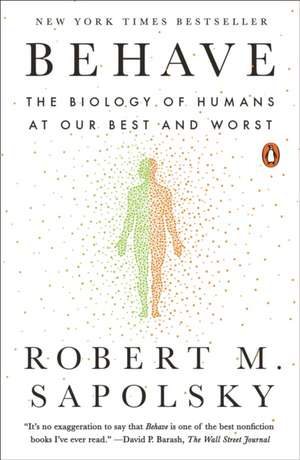
Behave
Autor Robert M. Sapolskyen Limba Engleză Paperback – mai 2018
Destinat studenților în neuroștiințe, cercetătorilor din științele sociale și practicienilor care doresc să înțeleagă mecanismele profunde ale acțiunii umane, Behave reprezintă o lucrare de referință în popularizarea științei. Considerăm că forța acestui volum de 800 de pagini rezidă în structura sa inovatoare: Robert M. Sapolsky nu se limitează la o descriere statică, ci construiește o analiză cronologică inversă. Subliniem modul în care autorul pornește de la impulsul neuronal declanșat cu o secundă înainte de un act (fie el altruist sau violent), trece prin influența hormonală a ultimelor zile și ajunge la presiunile evolutive de acum câteva milenii. Merită menționat că această abordare integrativă elimină dihotomia simplistă dintre „natură” și „educație”, oferind în schimb o viziune nuanțată asupra biologiei comportamentului. Comparabil cu The Biological Roots of Human Nature de Timothy H. Goldsmith în rigurozitate, volumul de față este actualizat pentru progresele recente în neuroimagistică și epigenetică, oferind un limbaj accesibil dar tehnic precis. În contextul operei sale, Behave extinde observațiile despre stres din De ce nu fac zebrele ulcer?, transformând studiul fiziologic într-o investigație filosofică și sociologică vastă. Este o sinteză magistrală care explică cum contextul cultural și moștenirea genetică colaborează pentru a ne defini cele mai bune și cele mai rele momente.
Preț: 141.19 lei
Carte disponibilă
Livrare economică 10-24 noiembrie
Livrare express 24-30 octombrie pentru 49.35 lei
Specificații
ISBN-10: 0143110918
Pagini: 800
Ilustrații: 132 images and diagrams
Dimensiuni: 145 x 216 x 47 mm
Greutate: 0.65 kg
Editura: Penguin LLC US
Colecția Penguin Books
V-ar putea interesa
-
 The Myth of Mental IllnessThomas S SzaszPreț: 93.70 lei
 -
 The Ocean at the End of the LaneNeil GaimanPreț: 55.56 lei
 -
 How to Win Friends and Influence PeopleDale CarnegiePreț: 63.37 lei
 -
 -18%Preț: 101.10 lei123.29 lei
 -
 MacbethJo NesboPreț: 67.30 leiRecomandat
 -
 #GirlbossSophia Amoruso-19%Preț: 62.64 lei77.62 lei
 -
 Maps of TimeDavid ChristianPreț: 262.60 lei
 -
 Elric of Melniboné and Other StoriesMichael Moorcock-25%Preț: 59.60 lei79.83 lei
 -
 Wisdom Of InsecurityAlan W Watts-20%Preț: 73.20 lei92.02 lei
 -
 FrankensteinMary ShelleyPreț: 52.34 lei
 -
 The Snowball: Warren Buffett and the Business of LifeAlice Schroeder-23%Preț: 97.24 lei126.43 lei
 -
 ChaosJames Gleick-19%Preț: 76.25 lei93.64 lei
 -
 -27%Preț: 67.35 lei92.54 lei
 -
 MythosStephen Fry-17%Preț: 67.22 lei80.80 lei
 -
 What HappenedHillary Rodham Clinton-14%Preț: 70.11 lei81.40 lei
 -
 -25%Preț: 219.46 lei292.61 lei
 -
 Ottolenghi SimpleYotam Ottolenghi-15%Preț: 205.02 lei241.20 lei
 -
 Einstein: His Life and UniverseWalter Isaacson-21%Preț: 65.55 lei83.03 lei
 -
 Preț: 37.57 lei
 -
 Teoria sentimentelor moraleADAM SMITHPreț: 55.00 lei
 -
 Preț: 129.00 lei
De ce să citești această carte
Studenții și pasionații de psihologie biologică vor găsi în această carte un curs complet despre natura umană. Cititorul câștigă o înțelegere sistemică a motivelor pentru care acționăm, depășind explicațiile bazate pe un singur factor. Este recomandată pentru capacitatea rară de a uni datele brute de laborator cu întrebările fundamentale despre moralitate și justiție socială, oferind un fundament științific solid pentru orice discuție despre comportamentul colectiv.
Despre autor
Robert M. Sapolsky (n. 1957) este un reputat cercetător în neuroendocrinologie și profesor la Stanford University, unde deține catedre în biologie, neurologie și neurochirurgie. Expertiză sa este dublată de o vastă experiență de teren ca etolog, fiind asociat al Muzeelor Naționale din Kenya, unde a studiat decenii la rând populațiile de babuini. Această dublă perspectivă — de laborator și de teren — i-a permis să scrie lucrări fundamentale despre stres și comportament, precum Why Zebras Don't Get Ulcers, devenind una dintre cele mai respectate voci în comunicarea științei la nivel mondial.
Descriere scurtă
"It's no exaggeration to say that Behave is one of the best nonfiction books I've ever read." --David P. Barash, The Wall Street JournalIt has my vote for science book of the year." --Parul Sehgal, The New York Times Hands-down one of the best books I've read in years. I loved it. --Dina Temple-Raston, The Washington Post
Named a Best Book of the Year by The Washington Post and The Wall Street Journal From the celebrated neurobiologist and primatologist, a landmark, genre-defining examination of human behavior, both good and bad, and an answer to the question: Why do we do the things we do? Sapolsky's storytelling concept is delightful but it also has a powerful intrinsic logic: he starts by looking at the factors that bear on a person's reaction in the precise moment a behavior occurs, and then hops back in time from there, in stages, ultimately ending up at the deep history of our species and its evolutionary legacy. And so the first category of explanation is the neurobiological one. A behavior occurs--whether an example of humans at our best, worst, or somewhere in between. What went on in a person's brain a second before the behavior happened? Then Sapolsky pulls out to a slightly larger field of vision, a little earlier in time: What sight, sound, or smell caused the nervous system to produce that behavior? And then, what hormones acted hours to days earlier to change how responsive that individual is to the stimuli that triggered the nervous system? By now he has increased our field of vision so that we are thinking about neurobiology and the sensory world of our environment and endocrinology in trying to explain what happened. Sapolsky keeps going: How was that behavior influenced by structural changes in the nervous system over the preceding months, by that person's adolescence, childhood, fetal life, and then back to his or her genetic makeup? Finally, he expands the view to encompass factors larger than one individual. How did culture shape that individual's group, what ecological factors millennia old formed that culture? And on and on, back to evolutionary factors millions of years old. The result is one of the most dazzling tours d'horizon of the science of human behavior ever attempted, a majestic synthesis that harvests cutting-edge research across a range of disciplines to provide a subtle and nuanced perspective on why we ultimately do the things we do...for good and for ill. Sapolsky builds on this understanding to wrestle with some of our deepest and thorniest questions relating to tribalism and xenophobia, hierarchy and competition, morality and free will, and war and peace. Wise, humane, often very funny, Behave is a towering achievement, powerfully humanizing, and downright heroic in its own right.
Descriere
THE NEW YORK TIMES BESTSELLER'Awe-inspiring... You will learn more about human nature than in any other book I can think of' Henry Marsh 'One of the best scientist-writers of our time' Oliver SacksWhy do human beings behave as they do? We are capable of savage acts of violence but also spectacular feats of kindness: is one side of our nature destined to win out over the other?Every act of human behaviour has multiple layers of causation, spiralling back seconds, minutes, hours, days, months, years, even centuries, right back to the dawn of time and the origins of our species. In the epic sweep of history, how does our biology affect the arc of war and peace, justice and persecution? How have our brains evolved alongside our cultures?This is the exhilarating story of human morality and the science underpinning the biggest question of all: what makes us human?