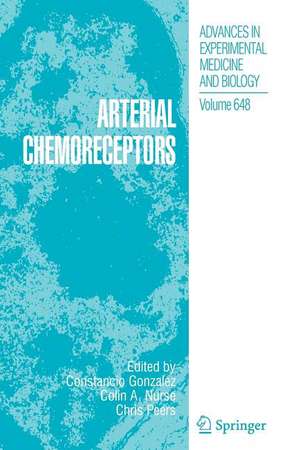
Arterial Chemoreceptors: Advances in Experimental Medicine and Biology, cartea 648
Editat de Constancio Gonzalez, Colin A. Nurse, Chris Peersen Limba Engleză Paperback – 22 oct 2010
Din seria Advances in Experimental Medicine and Biology
- 30%
 Preț: 752.07 lei
 - 5%
 Preț: 1334.86 lei
 - 5%
 Preț: 1212.42 lei
 - 5%
 Preț: 1335.15 lei
 - 5%
 Preț: 1207.57 lei
 - 5%
 Preț: 1142.42 lei
 - 18%
 Preț: 1163.92 lei
 - 5%
 Preț: 1057.02 lei
 - 5%
 Preț: 1487.84 lei
 - 5%
 Preț: 1200.13 lei
 - 18%
 Preț: 980.33 lei
 - 5%
 Preț: 942.82 lei
 - 18%
 Preț: 992.48 lei
 - 18%
 Preț: 1274.22 lei
 - 5%
 Preț: 1275.48 lei
 - 18%
 Preț: 1157.14 lei
 - 5%
 Preț: 1138.79 lei
 - 18%
 Preț: 1165.27 lei
 - 5%
 Preț: 1206.95 lei
 - 18%
 Preț: 1268.90 lei
 - 5%
 Preț: 1347.73 lei
 - 18%
 Preț: 1462.85 lei
 - 18%
 Preț: 1459.28 lei
 - 18%
 Preț: 1283.66 lei
 - 5%
 Preț: 1679.37 lei
 - 5%
 Preț: 1352.87 lei
 - 18%
 Preț: 1166.87 lei
 - 5%
 Preț: 1138.79 lei
 - 24%
 Preț: 966.03 lei
 - 15%
 Preț: 667.86 lei
 - 5%
 Preț: 1137.79 lei
 - 18%
 Preț: 981.18 lei
 - 18%
 Preț: 980.36 lei
 - 5%
 Preț: 1199.06 lei
 - 20%
 Preț: 1742.49 lei
 - 5%
 Preț: 750.62 lei
 - 18%
 Preț: 1451.34 lei
 - 5%
 Preț: 1133.64 lei
 - 18%
 Preț: 2616.27 lei
 - 5%
 Preț: 1075.08 lei
 - 18%
 Preț: 1443.07 lei
 - 5%
 Preț: 745.85 lei
 - 5%
 Preț: 1146.99 lei
 - 5%
 Preț: 696.54 lei
 - 18%
 Preț: 1037.10 lei
 - 5%
 Preț: 1363.25 lei
 - 5%
 Preț: 1084.55 lei
 - 5%
 Preț: 701.25 lei
Preț: 1426.38 lei
Preț vechi: 1501.45 lei
-5%
Puncte Express: 2140
Carte tipărită la comandă
Livrare economică 04-18 decembrie
Livrare prin curier în România Termenul estimat este afișat lângă disponibilitate.
Transport gratuit pentru acest produs Plată online sau ramburs, în funcție de opțiunile comenzii.
Retur gratuit în 14 zile Comandă securizată și suport în română.
Specificații
ISBN-13: 9789048184835
ISBN-10: 9048184835
Pagini: 484
Ilustrații: XXV, 455 p.
Dimensiuni: 155 x 235 x 27 mm
Greutate: 0.73 kg
Ediția:Softcover reprint of hardcover 1st ed. 2009
Editura: Springer
Colecția Advances in Experimental Medicine and Biology
Seria Advances in Experimental Medicine and Biology
Locul publicării:Dordrecht, Netherlands
ISBN-10: 9048184835
Pagini: 484
Ilustrații: XXV, 455 p.
Dimensiuni: 155 x 235 x 27 mm
Greutate: 0.73 kg
Ediția:Softcover reprint of hardcover 1st ed. 2009
Editura: Springer
Colecția Advances in Experimental Medicine and Biology
Seria Advances in Experimental Medicine and Biology
Locul publicării:Dordrecht, Netherlands
V-ar putea interesa
-
 -23%Preț: 489.07 lei633.62 lei
 -
 -29%Preț: 497.41 lei695.98 lei
 -
 Bayesian BiostatisticsEmmanuel Lesaffre-8%Preț: 547.71 lei595.34 lei
 -
 Applied Survival AnalysisDavid W Hosmer-5%Preț: 1009.30 lei1062.43 lei
 -
 BiometryRobert R. Sokal-11%Preț: 462.28 lei519.41 lei
 -
 Rorke's Drift & Isandlwana 1879Chris PeersPreț: 149.92 lei
 -
 Research Handbook for Health Care ProfessionalsMary Hickson-5%Preț: 367.08 lei386.39 lei
 -
 Kidnap for Ransom: Resolving the UnthinkableRichard P. Wright-18%Preț: 1114.04 lei1358.58 lei
 -
 -31%Preț: 68.68 lei100.03 lei
 -
 Design and Analysis of Non-Inferiority TrialsMark D. Rothmann-18%Preț: 1123.58 lei1370.22 lei
 -
 -5%Preț: 363.23 lei382.34 lei
 -
 Radiation ProteomicsDariusz Leszczynski-5%Preț: 742.12 lei781.18 lei
Public țintă
ResearchCuprins
The Discovery of Sensory Nature of the Carotid Bodies – Invited Article.- Fifty Years of Progress in Carotid Body Physiology – Invited Article.- Carotid Body: New Stimuli and New Preparations – Invited Article.- Enzyme-Linked Acute Oxygen Sensing in Airway and Arterial Chemoreceptors – Invited Article.- Cysteine Residues in the C-terminal Tail of the Human BKCa? Subunit Are Important for Channel Sensitivity to Carbon Monoxide.- Modulation of O2 Sensitive K+ Channels by AMP-activated Protein Kinase.- Hydrogen Sulfide Inhibits Human BKCa Channels.- DPPX Modifies TEA Sensitivity of the Kv4 Channels in Rabbit Carotid Body Chemoreceptor Cells.- Sustained Hypoxia Enhances TASK-like Current Inhibition by Acute Hypoxia in Rat Carotid Body Type-I Cells.- Inhibition of L-Type Ca2+ Channels by Carbon Monoxide.- Effects of the Polyamine Spermine on Arterial Chemoreception.- RT-PCR and Pharmacological Analysis of L-and T-Type Calcium Channels in Rat Carotid Body.- Functional Characterization of Phosphodiesterases 4 in the Rat Carotid Body: Effect of Oxygen Concentrations.- Calcium Sensitivity for Hypoxia in PGNs with PC-12 Cells in Co-Culture.- Modification of Relative Gene Expression Ratio Obtained from Real Time qPCR with Whole Carotid Body by Using Mathematical Equations.- Neurotransmitters in Carotid Body Function: The Case of Dopamine – Invited Article.- Adenosine in Peripheral Chemoreception: New Insights into a Historically Overlooked Molecule – Invited Article.- The A2B-D2 Receptor Interaction that Controls Carotid Body Catecholamines Release Locates Between the Last Two Steps of Hypoxic Transduction Cascade.- Benzodiazepines and GABA-GABAA Receptor System in the Cat Carotid Body.- Evidence for Histamine as a New Modulator of Carotid Body Chemoreception.-Fluoresceinated Peanut Agglutinin (PNA) is a Marker for Live O2 Sensing Glomus Cells in Rat Carotid Body.- Neuroglobin in Aging Carotid Bodies.- Oxygen Sensing and the Activation of the Hypoxia Inducible Factor 1 (HIF-1)– Invited Article.- Upregulation of Erythropoietin and its Receptor Expression in the Rat Carotid Body During Chronic and Intermittent Hypoxia.- Iron Chelation and the Ventilatory Response to Hypoxia.- Systemic Effects Resulting from Carotid Body Stimulation–Invited Article.- Bicarbonate-Regulated Soluble Adenylyl Cyclase (sAC) mRNA Expression and Activity in Peripheral Chemoreceptors.- Developmental Maturation of Chemosensitivity to Hypoxia of Peripheral Arterial Chemoreceptors – Invited Article.- Physiological Carotid Body Denervation During Aging.- Does Ageing Modify Ventilatory Responses to Dopamine in Anaesthetised Rats Breathing Spontaneously?.- The Role of the Carotid Bodies in the Counter-Regulatory Response to Hypoglycemia.- The Respiratory Responses to the Combined Activation of the Muscle Metaboreflex and the Ventilatory Chemoreflex.- Cardiovascular Responses to Hyperoxic Withdrawal of Arterial Chemosensory Drive.- Time-Dependence of Hyperoxia-Induced Impairment in Peripheral Chemoreceptor Activity and Glomus Cell Calcium Response.- Long-Term Regulation of Carotid Body Function: Acclimatization and Adaptation – Invited Article.- Effects of Intermittent Hypoxia on Blood Gases Plasma Catecholamine and Blood Pressure.- Cardioventilatory Acclimatization Induced by Chronic Intermittent Hypoxia.- Ventilatory Drive Is Enhanced in Male and Female Rats Following Chronic Intermittent Hypoxia.- Contrasting Effects of Intermittent and Continuous Hypoxia on Low O2 Evoked Catecholamine Secretion from Neonatal Rat Chromaffin Cells.- HypoxicPulmonary Vasoconstriction – Invited Article.- Impact of Modulators of Mitochondrial ATP-Sensitive Potassium Channel (mitoKATP) on Hypoxic Pulmonary Vasoconstriction.- Oxygen Sensing in the Brain – Invited Article.- The Central Respiratory Chemoreceptor: Where Is It Located?–Invited Article.- Anatomical Architecture and Responses to Acidosis of a Novel Respiratory Neuron Group in the High Cervical Spinal Cord (HCRG) of the Neonatal Rat.- Systemic Inhibition of the Na+/H+ Exchanger Type 3 in Intact Rats Activates Brainstem Respiratory Regions.- Nitric Oxide in the Solitary Tract Nucleus (STn) Modulates Glucose Homeostasis and FOS-ir Expression After Carotid Chemoreceptor Stimulation.- Airway Receptors and Their Reflex Function – Invited Article.- Airway Chemosensitive Receptors in Vagus Nerve Perform Neuro-Immune Interaction for Lung-Brain Communication.- The Role of NOX2 and “Novel Oxidases” in Airway Chemoreceptor O2 Sensing.- Recruitment of GABAA Receptors in Chemoreceptor Pulmonary Neuroepithelial Bodies by Prenatal Nicotine Exposure in Monkey Lung.- Concluding Remarks.
Caracteristici
Concise reports of current chemoreceptor research Authoritative reviews from internationally recognised experts A unique collection of studies from all leading groups in the field: (1) FASEB Meeting; (2) American Thoracic Society Meeting; (3) European Respiratory Society Meeting; (4) Medical Bookstores