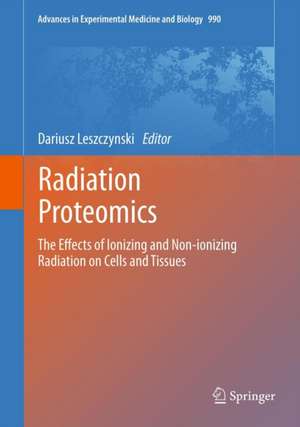
Radiation Proteomics: Advances in Experimental Medicine and Biology, cartea 990
Editat de Dariusz Leszczynskien Limba Engleză Hardback – 3 feb 2013
FARMACOLOGIA și terapeutica modernă depind critic de înțelegerea mecanismelor moleculare declanșate de stimuli externi, iar Radiation Proteomics investighează tocmai aceste răspunsuri la nivel de proteine sub influența radiațiilor. Notăm cu interes modul în care această lucrare, editată de Dariusz Leszczynski, încearcă să accelereze adoptarea proteomicii în biologia radiațiilor, un domeniu unde tehnicile de înaltă rezoluție au pătruns mai lent decât în cercetarea biomedicală generală. Considerăm că structura volumului este una riguroasă, debutând cu principiile de bază ale spectrometriei de masă și direcțiile tehnologice emergente, pentru a trece apoi la aplicații clinice și experimentale specifice. Analiza se extinde dincolo de radiațiile ionizante clasice, acoperind subiecte de actualitate precum impactul câmpurilor electromagnetice modulate prin radiofrecvență și al radiațiilor ultraviolete asupra celulelor cutanate. Un punct forte al lucrării este explorarea proteomului urinar și plasmatic ca instrument de diagnostic și predicție (biodozimetrie) în patologia indusă de radiații. Această abordare completează volumul Biomolecular Action of Ionizing Radiation de Shirley Lehnert cu o perspectivă axată strict pe dinamica proteinelor, oferind date concrete despre modul în care micromediul tumoral este alterat în timpul tratamentului radiologic. Dacă lucrările anterioare se concentrau pe daunele ADN-ului, volumul de față mută accentul pe expresia globală a proteinelor și pe căile de semnalizare celulară, oferind o imagine de ansamblu asupra stresului celular indus de radiații.
Din seria Advances in Experimental Medicine and Biology
- 30%
 Preț: 752.07 lei
 - 5%
 Preț: 1334.86 lei
 - 5%
 Preț: 1212.42 lei
 - 5%
 Preț: 1335.15 lei
 - 5%
 Preț: 1207.57 lei
 - 5%
 Preț: 1142.42 lei
 - 18%
 Preț: 1163.92 lei
 - 5%
 Preț: 1057.02 lei
 - 5%
 Preț: 1487.84 lei
 - 5%
 Preț: 1200.13 lei
 - 18%
 Preț: 980.33 lei
 - 5%
 Preț: 942.82 lei
 - 18%
 Preț: 992.48 lei
 - 18%
 Preț: 1274.22 lei
 - 5%
 Preț: 1275.48 lei
 - 18%
 Preț: 1157.14 lei
 - 5%
 Preț: 1138.79 lei
 - 18%
 Preț: 1170.08 lei
 - 5%
 Preț: 1206.95 lei
 - 18%
 Preț: 1268.90 lei
 - 5%
 Preț: 1347.73 lei
 - 18%
 Preț: 1462.85 lei
 - 18%
 Preț: 1459.28 lei
 - 18%
 Preț: 1283.66 lei
 - 5%
 Preț: 1679.37 lei
 - 5%
 Preț: 1352.87 lei
 - 18%
 Preț: 1166.87 lei
 - 5%
 Preț: 1138.79 lei
 - 24%
 Preț: 966.03 lei
 - 15%
 Preț: 667.86 lei
 - 5%
 Preț: 1137.79 lei
 - 18%
 Preț: 981.18 lei
 - 18%
 Preț: 980.36 lei
 - 5%
 Preț: 1199.06 lei
 - 5%
 Preț: 750.62 lei
 - 18%
 Preț: 1451.34 lei
 - 5%
 Preț: 1133.64 lei
 - 18%
 Preț: 2616.27 lei
 - 5%
 Preț: 1075.08 lei
 - 18%
 Preț: 1443.07 lei
 - 5%
 Preț: 745.85 lei
 - 5%
 Preț: 1146.99 lei
 - 5%
 Preț: 696.54 lei
 - 18%
 Preț: 1037.10 lei
 - 5%
 Preț: 1363.25 lei
 - 5%
 Preț: 1084.55 lei
 - 5%
 Preț: 701.25 lei
Preț: 742.12 lei
Preț vechi: 781.18 lei
-5%
Carte tipărită la comandă
Livrare economică 04-18 decembrie
Specificații
ISBN-10: 9400758952
Pagini: 140
Ilustrații: VII, 130 p. 14 illus., 9 illus. in color.
Dimensiuni: 183 x 260 x 13 mm
Greutate: 0.41 kg
Ediția:2013
Editura: Springer
Colecția Advances in Experimental Medicine and Biology
Seria Advances in Experimental Medicine and Biology
Locul publicării:Dordrecht, Netherlands
V-ar putea interesa
-
 Workbook for Radiation Protection in Medical RadiographyMary Alice Statkiewicz Sherer-5%Preț: 437.03 lei460.03 lei
 -
 From Proteins to Proteomics: Basic Concepts, Techniques, and ApplicationsSanjeeva SrivastavaPreț: 440.69 lei
 -
 Cellular and Molecular ImmunologyAbul K. Abbas-28%Preț: 513.14 lei710.50 leiRecomandat
 -
 Basic Clinical RadiobiologyMichael C. Joiner-5%Preț: 862.85 lei908.26 lei
 -
 -14%Preț: 1352.29 lei1572.43 lei
 -
 Perez & Brady's Principles and Practice of Radiation OncologyDr. Edward C. Halperin MD-5%Preț: 2279.24 lei2399.20 lei
 -
 -23%Preț: 642.99 lei837.78 lei
 -
 -27%Preț: 1331.06 lei1813.27 lei
 -
 Quantum Biology: A glimpse into the future of medicineDr Geoffrey Guy-27%Preț: 140.55 lei192.90 lei
 -
 The Ayurvedic Approach to CancerSam WattsPreț: 121.29 lei
 -
 Radiobiology for the RadiologistEric J. Hall-26%Preț: 800.89 lei1086.31 lei
 -
 The Essential Physics of Medical ImagingJerrold T. Bushberg PhD-20%Preț: 1342.91 lei1685.01 lei
 -
 Radiation Oncology and Radiation BiologyJoel Greenberger-5%Preț: 1084.69 lei1141.78 lei
 -
 Radiobiology and Radiation HormesisCharles L. Sanders-5%Preț: 880.94 lei927.31 lei
 -
 -5%Preț: 188.11 lei198.01 lei
 -
 Protein Biomarkers: Discovery and Applications in Clinical DiagnosticsSumit Kumar Singh-5%Preț: 1475.76 lei1553.42 lei
Public țintă
ResearchDe ce să citești această carte
Această resursă este esențială pentru cercetătorii din radiobiologie și fizică medicală care doresc să integreze metodele proteomice în studiul efectelor radiațiilor. Cititorul câștigă o înțelegere profundă a biomarkerilor proteici utilizați în biodozimetrie și diagnostic. Este o lectură specializată care fundamentează teoretic utilizarea spectrometriei de masă pentru evaluarea riscurilor de mediu și optimizarea radioterapiei prin monitorizarea micromediului tumoral.
Descriere scurtă
Cuprins
Textul de pe ultima copertă
The area of research that is still waiting for the proteomics “boom” is the search for the biological effects of radiation. It is relatively much known about the effects of high doses of radiation, both ionizing and non-ionizing. However, much less is known about the effects of low or very low doses of radiation, to which people are often exposed in their every day life. The effects of the low doses of ionizing radiation (e.g. bystander effect) or low doses of non-ionizing radiation (e.g. effect of radiation emitted by wireless communication devices)are not yet reliably established. Often these effects are small and difficult to discover and to replicate. One of the limiting factors in the research of low dose radiation effects is often the lack of the knowledge of the cellular target molecules.
Proteomics, the high-throughput screening of expression and activity of proteins is very well suited for the research aiming at discovery of molecular targets of low dose radiation. Proteomics approach seems to be particularly well suited for studying biological effects of low dose radiation because it might reveal effects that are not possible to predict based on the presently available knowledge concerning the effects of the high doses of radiation.
Search through the published scientific literature shows that to date was published only a very limited number of proteomics studies examining effects of radiation. This book, Radiation Proteomics, presents the current status the research of radiation effects using proteomics approach. The book begins with the review of current status and the future direction in the development of proteomics methods. This is followed by chapters dealing with the effects of ionizing and non-ionizing radiation on cells, tissues and body fluids. The editor of the book, Research Professor Dariusz Leszczynski, is known for studies that introduced, some 10 years ago, the high-throughput screening techniques of proteomics and transcriptomics into the main stream of the research on the biological effects of the non-ionizing radiation emitted by the wireless communication devices. In recent years he has also done studies examining effects of low-dose ionizing radiation on cellular proteome.