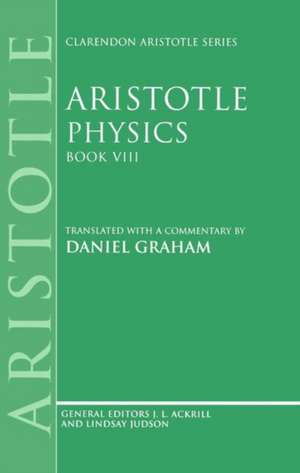
Aristotle: Physics, Book VIII: Clarendon Aristotle Series
Autor Aristotle Daniel W. Grahamen Limba Engleză Hardback – 11 feb 1999
Din seria Clarendon Aristotle Series
- 22%
 Preț: 201.10 lei
 - 15%
 Preț: 185.46 lei
 - 15%
 Preț: 186.04 lei
 - 28%
 Preț: 380.12 lei
 - 28%
 Preț: 351.46 lei
 - 29%
 Preț: 467.85 lei
 - 29%
 Preț: 396.44 lei
 - 29%
 Preț: 382.56 lei
 - 29%
 Preț: 370.77 lei
 - 28%
 Preț: 364.24 lei
 - 29%
 Preț: 363.92 lei
 - 21%
 Preț: 375.18 lei
 - 27%
 Preț: 341.05 lei
 - 30%
 Preț: 394.37 lei
 - 29%
 Preț: 375.62 lei
 - 29%
 Preț: 364.04 lei
 - 29%
 Preț: 364.10 lei
 - 28%
 Preț: 412.09 lei
 - 19%
 Preț: 327.93 lei
 - 21%
 Preț: 371.67 lei
 - 12%
 Preț: 290.74 lei
 - 26%
 Preț: 900.84 lei
Preț: 366.11 lei
Preț vechi: 521.80 lei
-30%
Puncte Express: 549
Carte tipărită la comandă
Livrare economică 27 noiembrie-08 decembrie
Livrare prin curier în România Termenul estimat este afișat lângă disponibilitate.
Transport gratuit de la 400.00 lei Plată online sau ramburs, în funcție de opțiunile comenzii.
Retur gratuit în 14 zile Comandă securizată și suport în română.
Specificații
ISBN-13: 9780198240914
ISBN-10: 0198240910
Pagini: 229
Dimensiuni: 144 x 224 x 18 mm
Greutate: 0.41 kg
Editura: Clarendon Press
Colecția Clarendon Press
Seria Clarendon Aristotle Series
Locul publicării:Oxford, United Kingdom
ISBN-10: 0198240910
Pagini: 229
Dimensiuni: 144 x 224 x 18 mm
Greutate: 0.41 kg
Editura: Clarendon Press
Colecția Clarendon Press
Seria Clarendon Aristotle Series
Locul publicării:Oxford, United Kingdom
V-ar putea interesa
-
 Aristotle: A Very Short IntroductionJonathan Barnes-19%Preț: 57.55 lei71.35 lei
 -
 Aristotle PoliticaDavid Ross-22%Preț: 272.80 lei350.86 lei
 -
 Philosophia Togata I: Essays on Philosophy and Roman SocietyMiriam Griffin-33%Preț: 660.35 lei981.34 lei
 -
 Philosophia Togata II: Plato and Aristotle at RomeJonathan Barnes-33%Preț: 723.17 lei1075.83 lei
 -
 Politics: Books III and IVAristotle-29%Preț: 382.86 lei536.54 lei
 -
 Politics: Books I and IIAristotle-29%Preț: 363.92 lei509.16 lei
 -
 -28%Preț: 372.29 lei519.46 lei
 -
 Politics: Books VII and VIIIAristotle-28%Preț: 364.50 lei509.50 lei
 -
 Aristotle's "Politics": Second EditionAristotlePreț: 142.26 lei
 -
 AristotleJohn Sellars-28%Preț: 56.17 lei77.49 lei
 -
 PoeticsAristotle-19%Preț: 20.09 lei24.92 lei
 -
 The Cambridge Translations of Medieval Philosophical TextsArthur Stephen McGrade-11%Preț: 505.83 lei568.34 lei
 -
 History of Animals, Volume IAristotlePreț: 228.42 lei
 -
 -14%Preț: 419.56 lei487.86 lei
 -
 -14%Preț: 418.63 lei486.77 lei
 -
 Aristotle's PoliticsAristotlePreț: 195.39 lei
 -
 Commentary on Aristotle's PoliticsThomas Aquinas-17%Preț: 161.92 lei196.10 lei
 -
 Epicurus and the Epicurean TraditionJeffrey FishPreț: 299.88 lei
 -
 The Philosophy of AntiochusDavid SedleyPreț: 343.89 lei
 -
 PoliticsAristotlePreț: 51.49 lei
 -
 MetaphysicsAristotlePreț: 64.88 lei
 -
 Nicomachean EthicsAristotlePreț: 44.60 lei
 -
 De AnimaAristotlePreț: 70.31 lei
 -
 The PrinceNiccolò MachiavelliPreț: 33.48 lei
 -
 UtopiaThomas MorePreț: 33.19 lei
Recenzii
Professor Graham has given us an excellent translation in modern English
Over the ... decades, a good deal of important and highly influential philosophical scholarship on Aristotle in English has appeared in these commentaries ... The present volume meets the generally high standard set by its predecessors.
Graham's translation and commentary strive for the utmost clarity in the presentation of the argument and the alternative interpretations. In this he seems to me to have been largely successful. Especially valuable is an eight page outline of the argument supplied as an appendix.
The commentary ... is admirably clear and judicious ... a solid and useful piece of work.
Over the ... decades, a good deal of important and highly influential philosophical scholarship on Aristotle in English has appeared in these commentaries ... The present volume meets the generally high standard set by its predecessors.
Graham's translation and commentary strive for the utmost clarity in the presentation of the argument and the alternative interpretations. In this he seems to me to have been largely successful. Especially valuable is an eight page outline of the argument supplied as an appendix.
The commentary ... is admirably clear and judicious ... a solid and useful piece of work.
Notă biografică
Christopher Shields studied English Literature and Classics at Bowling Green State University, in Ohio, before taking an M.A. and Ph. D. in Philosophy from Cornell University. He has been Professor of Philosophy and Classics at the University of Colorado at Boulder, Professor of Classical Philosophy at the University of Oxford, and is currently Shuster Professor of Philosophy and Concurrent Professor of Classics at the University of Notre Dame. He has held visiting positions at Cornell, Yale, Stanford, The Humboldt University, Berlin, and the Chinese University of Hong Kong.
Cuprins
- General Introduction
- A Note on the Text
- A Discursive Outline of De Anima
- TRANSLATION
- Book I
- Book II
- Book III
- COMMENTARY
- Book I
- Book II
- Book III
- Textual Notes and Variant Readings
- Glossary of Aristotelian Terminology
- Bibliography