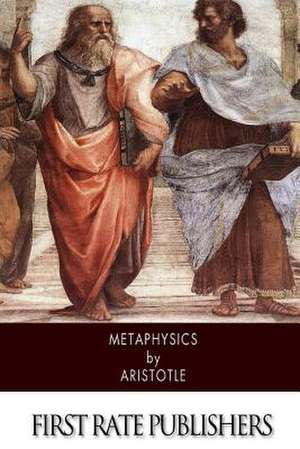
Metaphysics
Autor Aristotle Traducere de Theodorus Gazaen Limba Engleză Paperback
Preț: 64.88 lei
Puncte Express: 97
Carte disponibilă
Livrare economică 05-19 noiembrie
Livrare prin curier în România Termenul estimat este afișat lângă disponibilitate.
Transport gratuit de la 400.00 lei Plată online sau ramburs, în funcție de opțiunile comenzii.
Retur gratuit în 14 zile Comandă securizată și suport în română.
Specificații
ISBN-13: 9781505227772
ISBN-10: 1505227771
Pagini: 230
Dimensiuni: 152 x 229 x 12 mm
Greutate: 0.31 kg
Editura: CREATESPACE
ISBN-10: 1505227771
Pagini: 230
Dimensiuni: 152 x 229 x 12 mm
Greutate: 0.31 kg
Editura: CREATESPACE
V-ar putea interesa
-
 The War of the WorldsH. G. WellsPreț: 28.01 lei
 -
 XINVISIBLE MAN_CLASSICS PBH. G. WellsPreț: 28.01 lei
 -
 Silence Of The LambsThomas HarrisPreț: 79.89 lei
 -
 A Gentleman in MoscowAmor Towles-23%Preț: 61.99 lei80.95 lei
 -
 Sapiens: A Brief History of Human KindYuval Noah Harari-17%Preț: 80.04 lei95.89 lei
 -
 The Bhagavad GitaAnonymous-37%Preț: 58.60 lei92.81 lei
 -
 The Penguin Dictionary of PhilosophyThomas MautnerPreț: 125.30 lei
 -
 MeditationsMarcus Aurelius-20%Preț: 44.62 lei55.89 lei
 -
 The Phantom of the OperaGaston Leroux-25%Preț: 60.06 lei79.80 lei
 -
 Ancient RhetoricThomas Habinek-19%Preț: 75.87 lei93.41 lei
 -
 The Coddling of the American MindJonathan Haidt-30%Preț: 65.23 lei93.54 lei
 -
 -23%Preț: 124.65 lei161.02 lei
 -
 Lives of the Eminent Philosophers: by Diogenes LaertiusPamela Mensch-7%Preț: 416.94 lei447.61 lei
 -
 Anger and Forgiveness: Resentment, Generosity, JusticeMartha C. Nussbaum-18%Preț: 102.18 lei124.20 lei
 -
 Metaphysics: A Very Short IntroductionStephen Mumford-20%Preț: 56.15 lei70.53 lei
 -
 Subversion and Sympathy: Gender, Law, and the British NovelMartha C. Nussbaum-31%Preț: 696.16 lei1012.38 lei
 -
 Games People PlayEric Berne-26%Preț: 62.47 lei84.96 lei
 -
 We're Going to Win This ThingLin DevecchioPreț: 72.42 lei
 -
 HamletWilliam Shakespeare-18%Preț: 23.87 lei29.07 lei
 -
 Genghis KhanJohn Man-19%Preț: 88.00 lei108.28 lei
 -
 Nicomachean EthicsAristotlePreț: 235.32 lei
 -
 Preț: 233.83 lei
 -
 Art of RhetoricAristotlePreț: 234.19 lei
 -
 The Therapy of DesireMartha C. NussbaumPreț: 178.68 lei
 -
 Preț: 108.94 lei
 -
 The Shadow of the Wind: The Cemetery of Forgotten Books 1Carlos Ruiz Zafón-24%Preț: 72.05 lei95.33 lei
 -
 The Essays of Sir Francis BaconFrancis BaconPreț: 100.83 lei
 -
 Atomic HabitsJames Clear-23%Preț: 105.69 lei136.87 leiRecomandat
Descriere
Descriere de la o altă ediție sau format:
The books translated in this volume are fourth, fifth, and sixth in the traditional ordering of Aristotle's Metaphysics. The nature and scope of metaphysics are discussed in gamma and epsilon. A subtle examination of the principles of non-contradiction and excluded middle occupies the latter part of gamma. Delta is in the form of a philosophical lexicon. All three books contain important material on being, substance, `accident', unity, truth, cause, and other such concepts. The translation is very close to the Greek, as an aid to students who cannot check the English version against the original. It is followed by an interpretative and critical commentary. For this new edition Mr Kirwan has added a substantial section of further comment on several central issues, and considerably expanded the bibliography.
The books translated in this volume are fourth, fifth, and sixth in the traditional ordering of Aristotle's Metaphysics. The nature and scope of metaphysics are discussed in gamma and epsilon. A subtle examination of the principles of non-contradiction and excluded middle occupies the latter part of gamma. Delta is in the form of a philosophical lexicon. All three books contain important material on being, substance, `accident', unity, truth, cause, and other such concepts. The translation is very close to the Greek, as an aid to students who cannot check the English version against the original. It is followed by an interpretative and critical commentary. For this new edition Mr Kirwan has added a substantial section of further comment on several central issues, and considerably expanded the bibliography.
Notă biografică
Aristotle (Greek: ¿¿¿¿¿¿¿¿¿¿¿ Aristotél¿s, pronounced [aristotél¿¿s]; 384-322 BC)[A] was a Greek philosopher and polymath during the Classical period in Ancient Greece. Taught by Plato, he was the founder of the Lyceum, the Peripatetic school of philosophy, and the Aristotelian tradition. His writings cover many subjects. including physics, biology, zoology, metaphysics, logic, ethics, estheticspoetry, theatre, music, rhetoric, psychology, linguistics, economics, politics, and government. Aristotle provided a complex synthesis of the various philosophies existing prior to him. It was above all from his teachings that the West inherited its intellectual lexicon, as well as problems and methods of inquiry. As a result, his philosophy has exerted a unique influence on almost every form of knowledge in the West and it continues to be a subject of contemporary philosophical discussion. Little is known about his life. Aristotle was born in the city of Stagira in Northern Greece. His father, Nicomachus, died when Aristotle was a child, and he was brought up by a guardian. At seventeen or eighteen years of age he joined Plato's Academy in Athens and remained there until the age of thirty-seven (c. 347 BC).[4] Shortly after Plato died, Aristotle left Athens and, at the request of Philip II of Macedon, tutored Alexander the Great beginning in 343 BC.[5] He established a library in the Lyceum which helped him to produce many of his hundreds of books on papyrus scrolls. Though Aristotle wrote many elegant treatises and dialogues for publication, only around a third of his original output has survived, none of it intended for publication.[6] Aristotle's views on physical science profoundly shaped medieval scholarship. Their influence extended from Late Antiquity and the Early Middle Ages into the Renaissance, and were not replaced systematically until the Enlightenment and theories such as classical mechanics. Some of Aristotle's zoological observations found in his biology, such as on the hectocotyl (reproductive) arm of the octopus, were disbelieved until the 19th century. His works contain the earliest known formal study of logic, studied by medieval scholars such as Peter Abelard and John Buridan. Aristotle's influence on logic also continued well into the 19th century.
Cuprins
The Metaphysics - Aristotle Translated with an Introduction by Hugh Lawson-Tancred Preface
Introduction
THE METAPHYSICSBook Alpha
Book Alpha the Lesser
Book Beta
Book Gamma
Book Delta
Book Epsilon
Book Zeta
Book Eta
Book Theta
Book Iota
Book Kappa
Book Lambda
Book Mu
Book Nu
Bibliography
Introduction
THE METAPHYSICSBook Alpha
Book Alpha the Lesser
Book Beta
Book Gamma
Book Delta
Book Epsilon
Book Zeta
Book Eta
Book Theta
Book Iota
Book Kappa
Book Lambda
Book Mu
Book Nu
Bibliography
Recenzii
"C. D. C. Reeve adds to his already remarkable series of translations of Plato and Aristotle another stellar accomplishment: a full translation of Aristotle's daunting Metaphysics. He has managed to present Aristotle’s often ungainly Greek into perfectly flowing English syntax without sacrificing the core meaning of the text. Any translator of Aristotle will recognize what an impressive achievement this is. All readers will benefit from the over 1,600 explicative notes accompanying the translation: Reeve has a discerning eye for determining what requires amplification for the purposes of understanding and an admirable gift for saying just as much as needs to be said in order to achieve it."
—Christopher Shields, George N. Shuster Professor of Philosophy, University of Notre Dame
—Christopher Shields, George N. Shuster Professor of Philosophy, University of Notre Dame
"C. D. C. Reeve's new translation of Aristotle's Metaphysics is a very welcome tool for students, teachers, and scholarly readers. This accurate translation comes with a wealth of notes that explain Aristotle's thought or refer to or quote parallel passages from other parts of the Metaphysics or other Aristotelian works."
—Mirjam E. Kotwick, University of Cincinnati, in Ancient Philosophy
"Reeve's emendations and translations are philosophically sensitive and he scrupulously offers the alternatives in his notes. I can't fault his translation strategy, which balances literalism and readability without sacrificing accuracy and empowers readers to evaluate his choices. The interpretive notes Reeve offers are useful, but are not intended to serve as a full commentary. They will, however, help students and provide a rich resource of inspiration for researchers. The learning, skill and range exhibited by Reeve are astonishing. In short, if you teach or research Aristotle, Reeve offers a valuable addition to the English-language resources on the Metaphysics."
—Matthew Duncombe, University of Nottingham, in Notre Dame Philosophical Reviews