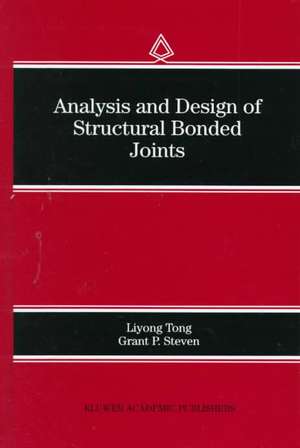
Analysis and Design of Structural Bonded Joints
Autor Liyong Tong, Grant P. Stevenen Limba Engleză Hardback – 29 apr 1999
| Toate formatele și edițiile | Preț | Express |
|---|---|---|
| Paperback (1) | 1170.04 lei 43-57 zile | |
| Springer Us – 22 feb 2014 | 1170.04 lei 43-57 zile | |
| Hardback (1) | 1175.96 lei 43-57 zile | |
| Springer Us – 29 apr 1999 | 1175.96 lei 43-57 zile |
Preț: 1175.96 lei
Preț vechi: 1434.09 lei
-18% Nou
Puncte Express: 1764
Preț estimativ în valută:
208.12€ • 244.07$ • 182.48£
208.12€ • 244.07$ • 182.48£
Carte tipărită la comandă
Livrare economică 26 ianuarie-09 februarie 26
Preluare comenzi: 021 569.72.76
Specificații
ISBN-13: 9780792384946
ISBN-10: 0792384946
Pagini: 288
Ilustrații: XIII, 288 p.
Dimensiuni: 155 x 235 x 19 mm
Greutate: 0.61 kg
Ediția:1999
Editura: Springer Us
Colecția Springer
Locul publicării:New York, NY, United States
ISBN-10: 0792384946
Pagini: 288
Ilustrații: XIII, 288 p.
Dimensiuni: 155 x 235 x 19 mm
Greutate: 0.61 kg
Ediția:1999
Editura: Springer Us
Colecția Springer
Locul publicării:New York, NY, United States
V-ar putea interesa
-
 The Hardness of MetalsD. Tabor-25%Preț: 502.59 lei666.64 lei
 -
 Strength of Materials and StructuresCarl T. F. Ross-9%Preț: 617.63 lei678.71 lei
 -
 Physics of Functional MaterialsH Fredriksson-8%Preț: 591.45 lei642.88 lei
 -
 MagnetohydrodynamicsR.J. Moreau-18%Preț: 916.19 lei1117.31 lei
 -
 Why Things Break: Understanding the World by the Way it Comes ApartMark E. Eberhart-21%Preț: 64.79 lei81.88 lei
 -
 Mechanics Of Composite MaterialsRobert M. Jones-18%Preț: 1080.32 lei1317.46 lei
 -
 -26%Preț: 1238.52 lei1674.01 lei
 -
 Advances in Materials Science Research: Volume 21Maryann C Wythers-26%Preț: 1484.01 lei2003.71 lei
 -
 PVC Degradation and StabilizationGeorge Wypych-23%Preț: 1455.27 lei1889.95 lei
 -
 Heat Transfer: Basics and PracticePeter BöckhPreț: 468.74 lei
 -
 Transient Heat TransferDonatello AnnaratonePreț: 358.44 lei
 -
 -18%Preț: 914.83 lei1115.64 lei
 -
 Soft Matter: The stuff that dreams are made ofRoberto PiazzaPreț: 204.76 lei
Public țintă
ResearchDescriere
254 7. 2 AEROSPACE 261 7. 3 MARINE 265 7. 4 GROUND TRANSPORTATION 268 7. 5 CNIL 270 References 285 Index Preface Most structures consist of an assembly of a number of individual components that must be connected to form an integral load transmission path. These connections are often referred to as joints and can be achieved in a variety of forms, e. g. by bolting, riveting, or other forms of mechanical fastening, or by welding or brazing for connecting metallic elements, or by adhesive bonding. No matter what forms of connections are used in the structure, these joints are potentially the weakest points in the structure and the locations where a weight penalty may apply. Thus structural joints must be designed adequately to meet the specific design requirements. Adhesive bonding represents one of the most important enabling technologies for developing innovative design concepts and structural configurations as well as exploiting new materials. The evolution of adhesive bonding technology, and its current knowledge base, was made possibly by the explosive growth in the adhesive applications in a great variety of industries over the past few decades. While it is easy for everyone to identify examples of adhesive bonding in the world around us, analysis and design of structural bonded joints represent one of the most challenging jobs in structural design and manufacturing. Compared to other joining methods, particularly mechanical fastening, adhesive bonding can offer substantial performance and economic advantages.
Cuprins
Preface. 1. Introduction. 2. Stress Analysis Techniques. 3. Failure Criteria and Strength Prediction. 4. Damage Tolerance. 5. Optimum Design. 6. Effect of Transverse Stitching. 7. Selected Applications. References. Index.